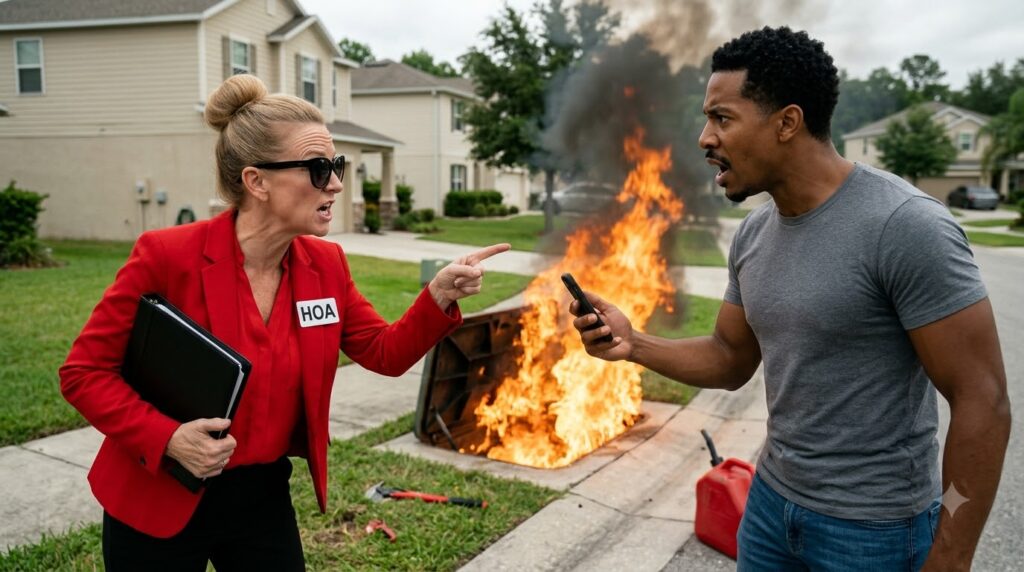
Chapter 5: The Price of Speaking Up
Monday morning brought another surprise.
Marcus received a notice from an attorney representing Patricia personally.
The letter demanded that he stop making allegedly defamatory statements about her conduct and business relationships.
It threatened civil litigation if he continued distributing accusations.
Marcus read it at the kitchen table.
His mother watched him carefully.
“Are they trying to scare you?”
“Yes.”
“Is it working?”
He considered lying.
Instead, he nodded.
“A little.”
Evelyn reached across the table.
“Good. Fear makes you careful. Just don’t let it make you quiet.”
Marcus smiled despite himself.
He had inherited his father’s stubbornness, but his mother’s quiet courage had always been the stronger force in the family.
Still, he knew he needed professional help.
He contacted Laura Chen, a local attorney who specialized in real estate disputes and community association law.
Laura was fifty-three, practical, and direct.
She reviewed the letters, the available HOA records, and Helen’s video.
Then she explained the situation.
The fire itself was a matter for law enforcement and fire investigators.
The HOA’s authority, financial records, and proposed contract raised separate legal questions.
Marcus could challenge improper assessments and seek access to association records through the procedures available under their state’s law.
But he needed to avoid publicly declaring anyone guilty of financial crimes before the evidence supported such a conclusion.
“Facts are your strongest protection,” Laura told him.
She advised him to preserve the original recordings, keep copies of correspondence, and document every financial demand.
She also suggested that homeowners organize a lawful petition for a special membership meeting.
Marcus left her office feeling more focused.
He did not need to defeat Patricia through anger.
He needed to make sure the facts could no longer be hidden.
That evening, the HOA board met behind closed doors to discuss the emergency contract.
Marcus and several homeowners waited outside the community clubhouse.
Patricia arrived in a cream-colored luxury sedan.
She wore a navy suit and carried her familiar black binder.
For the first time since the fire, she had removed her HOA badge.
Marcus noticed the change.
She walked past the waiting residents without speaking.
Inside, the meeting lasted nearly two hours.
When the doors finally opened, board vice president George Harlan emerged looking exhausted.
George was sixty-six, a retired insurance adjuster who had always been regarded as reasonable but reluctant to challenge Patricia.
He announced that the board had postponed approval of the Harborstone contract pending further review.
Patricia came out behind him.
Her face was pale with anger.
She accused the board of allowing outsiders to interfere with urgent association business.
Then she walked directly toward Marcus.
“You think you’ve won something?”
Marcus did not respond.
She leaned closer.
“You have no idea what you’ve started.”
Helen, standing several feet away, raised her phone and began recording.
Patricia noticed.
For a moment, her expression changed.
Then she turned and left.
The following morning, George called Marcus privately.
He asked to meet at Laura Chen’s office.
When he arrived, he carried a sealed envelope.
Inside were copies of documents he had recently obtained from the association’s financial files.
Among them was a payment authorization for $12,500 to Whitmore Advisory Group.
The description read: Strategic Infrastructure Planning.
George explained that the payment had been recorded under general consulting expenses.
He had approved the broader budget without realizing that the recipient company might be connected to Patricia.
“I trusted her,” he admitted.
Laura examined the documents.
She asked George whether he knew who owned Whitmore Advisory Group.
He said he did not.
Marcus had already searched public business records.
He placed a printed filing on the desk.
Whitmore Advisory Group was a limited liability company registered three years earlier.
Its listed manager was Patricia Whitmore.
George closed his eyes.
Laura remained cautious.
A disclosed and properly approved payment to a board member’s company might be lawful under some circumstances.
But an undisclosed personal financial interest in an association contract could create serious conflicts.
She asked George whether Patricia had disclosed her ownership.
He shook his head.
“Not to me.”
Laura turned to Marcus.
“This needs an independent review.”
Then George revealed something else.
The HOA’s insurance carrier had requested information about the fire.
Patricia had submitted a statement suggesting that an unknown third party might have caused the damage.
Marcus felt his anger rise.
The woman who had started the fire was not merely denying responsibility.
She was trying to create a financial record that could shift the consequences onto everyone else.
And if the insurer rejected the claim, the homeowners might be left paying for damage they had done nothing to cause.