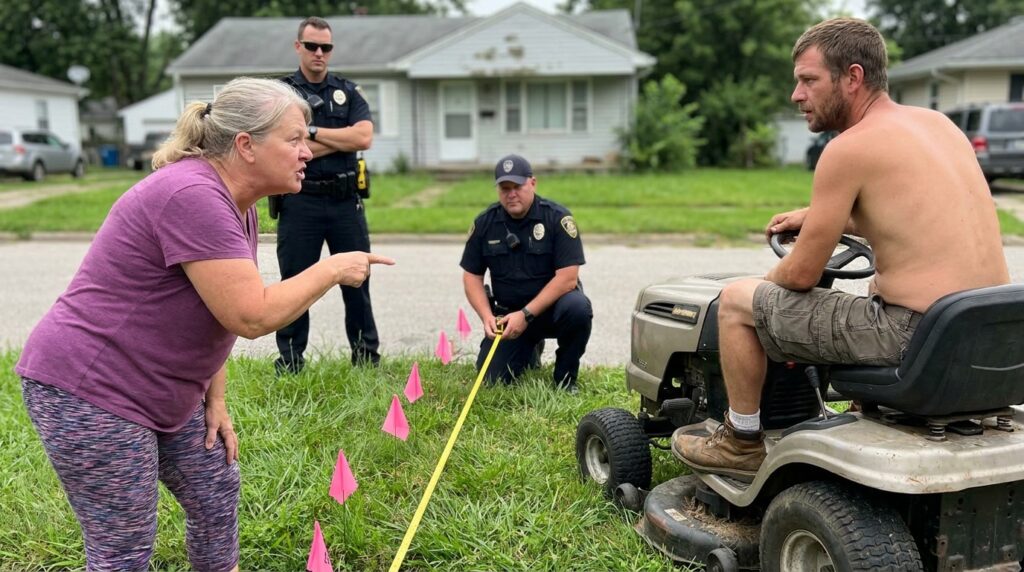
CHAPTER 8: THE TRUTH AT THE REAR MARGIN
The hydrostatic transmission didn’t just stall; it died with a flat, metallic groan that resonated directly through the steering columns into Garrett’s palms. The right rear drive wheel locked hard against an unyielding slab of stone buried two inches beneath the gray, waterlogged silt. The sudden deceleration pitched his weight forward against the rubber wheel, his boots skidding off the wet footrest as the spinning blades under the deck made a final, brutal screech against iron before their drive belt smoked into static silence.
Time didn’t track by seconds anymore; it tracked by the slow, suffocating drop of water hitting the engine block. The heat from the exhaust manifold cooked the scent of shredded grass and ancient, sulfurous scale into a gray mist that sat motionless in the humid midday air. Garrett climbed down off the vinyl seat, his knees stiff from the mechanical vibration. He didn’t look at the neighbor’s face right away. He looked down into the muddy trench where the mower’s blades had carved a clean, six-inch furrow through the yellowed thatch.
The iron isolation valve cover was only the surface. The vacuum of the rotation had stripped away a massive section of false sod, revealing a continuous, poured-concrete footing that didn’t run straight down the block. It took a sharp, two-foot hook directly across the county easement line, its gray edge scarred by the impact of his commercial blades. Beneath the fractured top layer of concrete lay a row of heavy, old-style structural iron pins—the kind used by county teams forty years ago to mark permanent municipal boundaries.
The neighbor remained on her knees on the wet concrete walk, her short, thick fingers pressed flat against the spilt sheets of grid paper. Her head was down, her gray-blonde tied hair coming loose from its pins to hang in damp strands across her cheekbones. She had lost her sunglasses in the scramble; her pale eyes were wide, fixed on the scrawled sepia coordinates that the water from the curb was slowly turning into blurred blue clouds.
The stocky officer didn’t hurry his step. He walked over to her side, his heavy leather boots making a gritty crunch as he stepped right onto the corner of the first fallen layout sheet. He didn’t reach down to pull her up. He simply knelt with a slow, heavy joint-click, his thick hand reaching past her fingers to lift the second page—the master plot rendering with the black ballpoint revisions.
“These aren’t township alignment marks,” the officer said, his baritone voice dropped to a quiet, level rumble that carried no personal anger, only the cold precision of an inspection desk. He held the thick paper up against the glare, his thumb tracing the altered index column where her husband’s tight hand had scratched out the official county numbers. “These are the internal coordinates for the 1984 reservoir bypass line. He didn’t just adjust the grass line, ma’am. He shifted the block’s master reference point forty-eight inches west to cover the footer for this basement extension.”
The woman didn’t scream. Her mouth opened a fraction of an inch, a small, dry wheeze escaping her throat that smelled of cold coffee and stale indoor air. She pulled her hands back into the lap of her patterned leggings, leaving two dark, muddy palm prints across the center of her husband’s fraudulent blueprints. “The house was built before the easement code was ratified,” she whispered, her voice thinning down into the gravelly vibration of an old iron pipe scraping against bedrock. “If the district finds the structural footing on the main isolation valve, they’ll declare the entire foundation a municipal hazard. They’ll pull the certificate of occupancy.”
Garrett stood by the stalled mower, his palm resting on the wet green fender. He understood the metric now. The decades of harassment, the manicured borders, the frantic calls to code enforcement—it had never been about the height of the rye or the speed of an independent contractor’s machine. It was about the heavy, unpermitted iron structural mass sitting directly inside the city’s path, a secret buried under four inches of carefully guarded topsoil that his blades had finally dragged into the light.
The tall backup officer walked to the edge of the trench, his black-gloved fingers tracing the exposed line of the concrete footing where it choked the neck of the isolation valve. He looked at the stocky officer, then back at Garrett, his face completely neutral behind his dark lenses. The block remained dead silent; across the blacktop, the neighbor with the yellow mug slowly lowered his container, his eyes locked onto the police uniform crouching over the muddy grid sheets.
“We’re done with the measurement, Garrett,” the stocky officer said, rising to his full height and slipping the altered papers into his own aluminum field case with a sharp, definitive snap. He looked down at the woman still kneeling on the concrete margin. “Ma’am, get up. We’re going to need to clear the driveway line for the county engineering unit. They’re going to have to pull this turf layout by the roots before the line starts to leak.”
Garrett didn’t say a word. He climbed back onto the green vinyl seat, his boot catching the starter toggle. The engine turned over on the first crank, its throat-clearing roar slamming down over the open yard, its deep industrial rhythm resuming as he backed the heavy machine out of the muck, leaving the true boundary line open to the sky.