CHAPTER 4: THE IRON UNDERNEATH
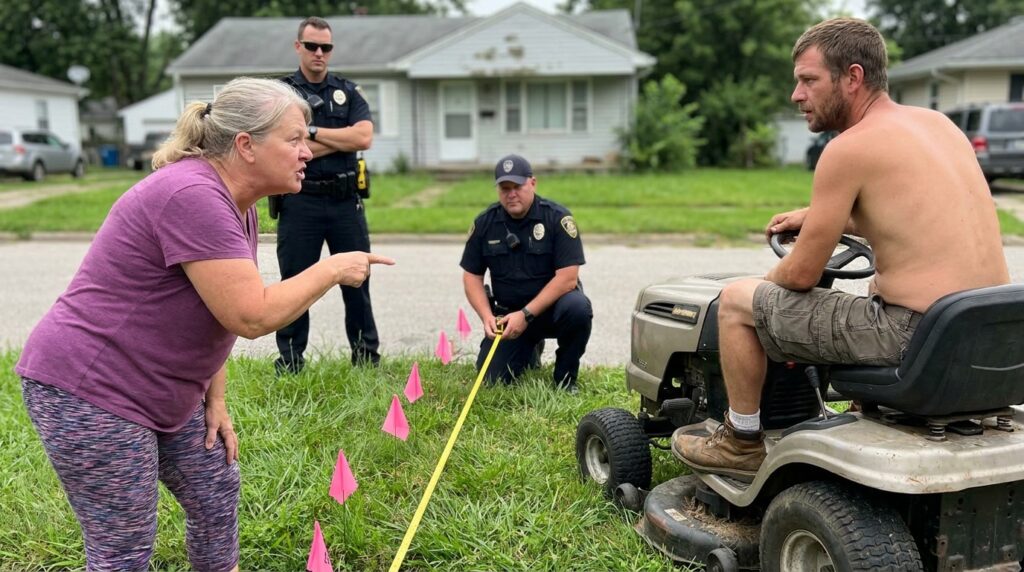
The scuff of Garrett’s work boots against the heat-shrunk weeds was the only sound for three seconds after the officer spoke. He dropped his weight off the green step of the riding mower, the thick rubber soles sinking into a patch of earth that felt entirely wrong for a high-summer easement line. It didn’t crack under his heels like the parched clay near the asphalt; it gave way with a heavy, sucking wetness that pushed a thick bubble of dark, iron-slick grease up through the yellowed stalks of rye.
He knelt down, his bare shoulder blade nearly brushing the hot metal of the exhaust shroud. The scent of sulfur was no longer a faint trace drifting on the midday air; it was a localized, heavy rot that seemed to radiate directly from the base of the fourth pink plastic flag. The plastic shaft itself was crooked, leaning toward the woman’s yard at an angle that looked less like a casual placement error and more like a deliberate attempt to crowd a specific point in the sod.
“Don’t touch that,” she said. Her voice didn’t carry its previous administrative weight. The gravelly edge had cracked, shifting into a thin, sharp projection that sounded like a dry branch rubbing against a screen door. She hadn’t moved off the sidewalk, but her clean white sneakers were twitching against the concrete seam, her hands tightening until the blue plastic folder bowed under the strain. “That’s private landscaping turf. You have no legal authority to excavate or disrupt the subsoil structure without an environmental clearance from the county board.”
Garrett didn’t look up at her. He didn’t look at the stocky officer either, who was already walking toward the concrete curb with the ring of his steel tape measure jingling against his hip. Instead, Garrett reached out with his thumb and forefinger, grasping the muddy base of the pink flag. The plastic was slick with a cold, greasy film that didn’t feel like ordinary ditch water. He pulled.
The stake didn’t come out with the clean pop of an iron pin driven into standard clay. It slid free along a three-inch track of gray, liquefied silt that reeked of old pipe scale and stagnant municipal rust. Beneath the hole left by the shaft, something hard resisted the pressure of his boot heel. It wasn’t a stone; the shape was too geometric, the edge too straight, even under two inches of accumulated weed thatch and wet soil.
He used the flat edge of his cotton rag to clear the top layer of muck. The gray fabric came away blackened with iron oxide, revealing a thick, circular plate of oxidized iron. It was pitted, heavily scarred by decades of ground moisture, but the raised letters across the center were still readable under the crust of dry mud: MUNICIPAL DISTRICT 4 – MAIN ISOLATION.
A heavy, flanged water valve cover was sitting directly under the line she had marked with her commercial flags.
Garrett wiped his palm on his cargo shorts, his skin catching on the gritty rust residue. He stood up slowly, looking across the four-foot strip toward her porch. “This valve is on the county master grid, ma’am. If your husband laid these markers based on the water district plats, he knew exactly where the city easement stopped.”
The woman didn’t reply right away. Her face stayed locked behind the dark sunglasses, but her chin dropped a fraction of an inch. Her eyes seemed fixed on the exposed iron lid, where a tiny, steady bead of dark water was welling out from the central pry-hole, glistening like engine oil under the noon glare. The water didn’t drain toward the ditch; it was pooling in the small hollow she had claimed as her yard, softening the foundation line of her own gravel driveway.
The stocky officer stopped thirty feet down the line, his black leather boot pinned against a brass marker disk embedded in the concrete header. He didn’t look down at the iron valve Garrett had uncovered. He kept his attention on his aluminum case, pulling the silver ring of the tape measure until the steel ribbon gave a long, metallic hiss across the parched grass.
“Hold the zero end on the pin, Garrett,” the officer called out, his baritone voice flat and conversational against the distant murmur of the sedan idling down the block. “Let’s see what the chain says before the ground gives out under us.”
Garrett walked toward the front of the cruiser, his boots leaving dark, oily prints on the dry grass, his fingers reaching for the cold steel ring of the tape measure while the neighbor’s blue folder remained raised like a shield that had just taken its first hit.