CHAPTER 3: THE CRUNCH OF CONCRETE MARGINS
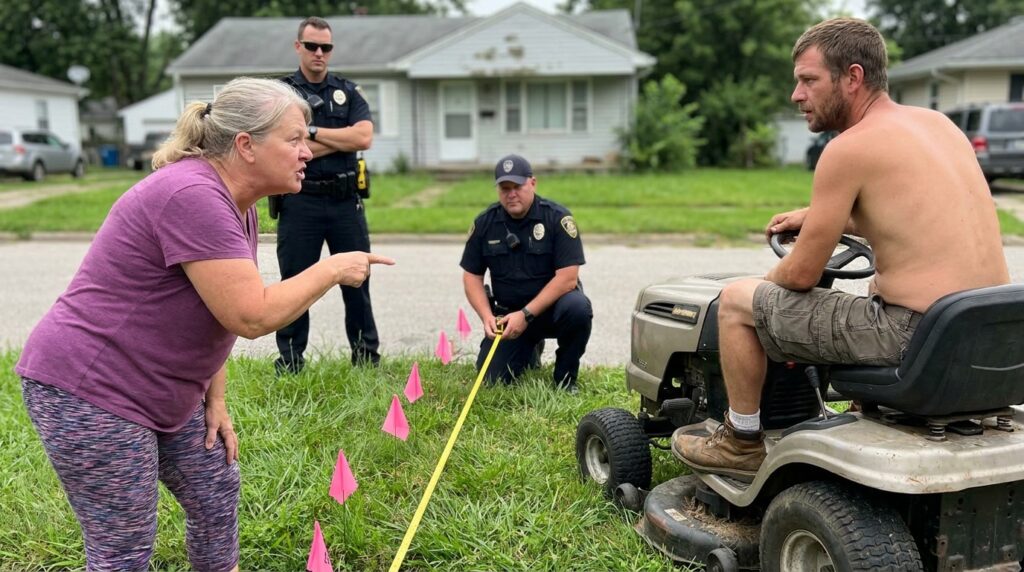
The driver’s side door of the Ford utility cruiser opened with a heavy, mechanical click, swinging wide enough to block the narrow gutter lane. A black leather boot, thick-soled and coated in a dull layer of dried highway dust, hit the sun-baked asphalt. The car didn’t idle like a standard civilian vehicle; it carried a deep, low-frequency thrum from its cooling fans that vibrated right through the soles of the contractor’s work boots, an undercurrent of industrial weight that redefined the empty air between the two properties.
The stocky officer who stepped out didn’t look at the pink flags right away. He adjusted his duty belt with a practiced, double-handed tug, the braided nylon creaking against the steel buckles of his taser holster. His dark uniform cap sat precisely parallel to his brow, casting a sharp, triangular shadow across a clean-shaven face that had spent twenty years hardening under the flat glare of county code disputes.
“Afternoon,” the officer said. His voice was a flat baritone, entirely clear of the theatrical heat the neighbor had been projecting. He walked with a short, measured stride toward the point where the gravel driveway met the wild rye, his eyes tracking the grease-stained chassis of the green mower before stopping on the laminated sheet still pinched between the woman’s fingers.
“Officer,” she said, her posture shifting seamlessly from a lean to an upright, formal stance. The blue plastic folder came up to her chest like an identification badge. “I’m glad you’re here. This contractor is actively ignoring the survey boundary. I’ve requested three times that he disengage his machinery until the township clerk can verify the registration of his LLC, but he’s insisting on moving forward based on a consumer-grade phone application.”
The stocky officer didn’t offer his hand for the folder. He stopped exactly twenty inches from her sneakers, his weight distributed evenly between his heels, his left hand resting loosely on the thick nylon edge of his radio pouch. He looked down at the pink flags, then across the unpaved ditch toward the weathered foundation of the neighboring ranch house.
“Your name?” the officer asked, looking at the contractor.
“Garrett,” the contractor said. He kept his hands visible, flat against the green iron cowl of the engine. The metal beneath his palms was starting to lose its aggressive heat, turning into a dense, passive block of warm iron. “I’m working for the property owner on forty-four. The job order covers the full easement cut down to the concrete margin.”
“The margin is contested,” the woman broke in, her index finger pointing rigidly at the officer’s uniform patch. “My husband was a senior technician with the county water district for thirty-two years. He laid the original stone markers when this plat was separated from the orchard parcel. This man’s blades are going to ruin the grade, and the township ordinance explicitly states that any disruption to the established turf line requires a twenty-four-hour administrative notice to the abutting neighbors.”
The stocky officer turned his head slightly, his sunglasses catching the hard glint of the noon sun. From the passenger side of the cruiser, a second figure emerged—the tall backup officer. He didn’t approach the circle. Instead, he took up a tracking position six feet back, his hips angled away to keep his service weapon clear of the fence line, his dark lenses scanning the windows of the houses across the street. The neighbor with the yellow mug had been joined by a woman in a housecoat; they stood side-by-side on the concrete step, their silence heavy and expectant.
“Let me see the sheet, ma’am,” the stocky officer said.
He took the laminated document by the very edge, holding it up against the glare rather than looking down at it. His thumb ran along the plastic seam. The contractor watched the officer’s face; there was no sudden realization, no shifting of the jaw. But his eyes didn’t stay on the dotted index line she had pointed out. They traveled down to the bottom margin, where the official stamp of the county clerk should have been embossed into the paper. There was only a flat, blue-ink photocopy of a seal, the registration digits slightly blurred from an old machine.
“This is a 2014 field layout,” the officer noted, his voice dropping an octave as he turned his attention toward the ground between them. He walked three steps down the flagged line, his heavy boots pressing into the dry thatch. When he reached the fourth flag—the one where the third marker dipped toward the house—he stopped.
The dark, wet patch was larger now. The sulfur smell had sharpened, a metallic tang that mixed with the odor of scorched grass clippings. The sod around the base of the pink plastic shaft was slightly spongy, the water dark and slick with a iridescent sheen of old mineral deposits.
The officer looked at the neighbor, then back at the contractor. “Garrett, you drop your deck yet?”
“No, sir,” Garrett said, his thumb pointing toward the clean, dry discharge chute. “I was on the first pass when she came off the porch. The blades haven’t touched the dirt.”
“Good,” the officer said. He reached down to his belt, his fingers unclipping a heavy, dull-finish aluminum case from his rear pocket. He didn’t pull a ticket book. He pulled a heavy three-inch steel spring clip that held a hundred-foot retractable measuring line, its silver ring jingling against the iron rivets of his uniform pants. “We’re going to pull the metric from the county pin at the intersection. Hold on, ma’am, we need to check where this line is.”
The woman’s hand went white against the blue folder, her mouth opening to speak, but the backup officer took one step closer, his tall shadow crossing her shoulder like a solid bar.