CHAPTER 7: THE CONFETTI OF PARCHED PLASTIC
The cold iron key clicked forward against the ignition terminals, and the twelve-horsepower block hit the air with an explosive, throat-clearing rattle. A dense, blue-gray cloud of unrefined fuel coughed from the exhaust pipe, hanging thick in the humid space between the machine chassis and the neighbor’s clean concrete driveway. The green iron hull began its rhythmic, teeth-chattering vibration again, the belt under the deck squealing under the sudden tension as Garrett engaged the primary clutch lever.
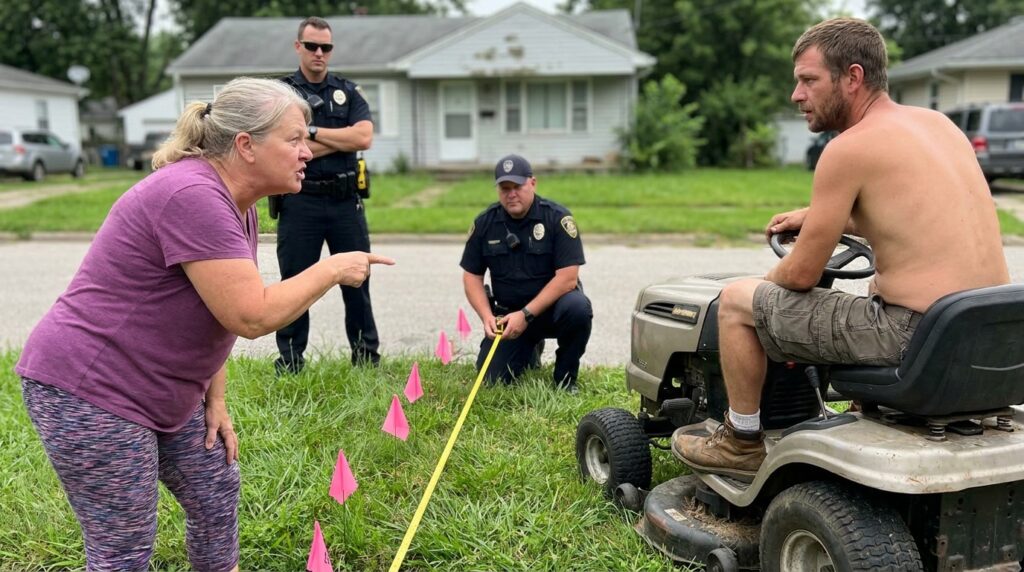
He didn’t wait for the cruiser to back out completely. His heavy work boot pushed the hydrostatic pedal forward, and the riding mower lurked three feet down the ditch, its left front tire crushing the first pink plastic survey flag into the wet, sulfurous silt. The thin plastic shaft didn’t just snap; it split lengthwise with a dry, hollow crack, the bright neon triangular flag flattening into the gray ooze under twelve hundred pounds of green steel and commercial iron.
The neighbor didn’t step into the path of the wheels this time. She stood five feet back on her walkway, the blue plastic folder clamped under her left armpit like an old piece of structural timber that had outlived its purpose. Her eyes stayed locked behind her dark sunglasses, but her lower lip had begun a slow, involuntary twitch that matched the vibration of the diesel engine idling at her feet. As the mower took its second tire-length through the rye, a gust of hot, oil-scented exhaust blew across her clean white sneakers, staining the canvas tongues with a fine layer of soot.
Garrett kept his chin tucked down near his chest, his hands gripping the rubber steering hoop so tightly that the rust crust under his fingernails began to flake onto the green paint. He wasn’t tracking her face. He was tracking the blade engagement line. He reached out with his right hand and hit the toggle.
The three rotating steel blades under the deck dropped into the high weeds with a screaming, high-pitched howl that drowned out the idle of the patrol car. The air went thick with the scent of pulverized dandelion stalks, parched clay dust, and the metallic tang of old mineral scale being shredded by thirty-two inches of spinning iron. When the machine passed over the second and third survey flags, there was no hesitation from the transmission. The blades caught the thin plastic markers, lifting them into the internal vortex of the deck and grinding them into penny-sized pieces of neon confetti that shot out of the side discharge chute in a long, glittering arc.
But as the deck approached the fourth position—the spot right beside the exposed municipal valve cover—the mechanical rhythm broke. The front right tire sank four inches into an unmapped hollow where the gray silt had liquefied into a subterranean pocket. The green machine groaned, the rear drive tires spinning in place, flinging a heavy spray of black, sulfurous mud against the neighbor’s stone mailbox pillar.
Garrett slammed his boot onto the reverse pedal, but the frame didn’t shift. The transmission whined under the sudden friction, the heat coming off the belt housing smelling of scorched rubber and hot iron. Through the high-pitched scream of the blades, a new sound emerged from beneath the mud—a dull, rhythmic clunk-clunk-clunk against the underside of the iron deck, as if something solid and metallic was being lifted out of the earth by the vacuum of the rotation.
He killed the blade clutch instantly, the screaming whine dying into a heavy, gasping rattle.
Through the sudden drop in noise, Garrett looked toward the sidewalk. The neighbor hadn’t moved, but her blue folder had slipped from her armpit. It hit the concrete face-down, the plastic clip breaking free and spilling three sheets of thick grid paper across the wet walk. Garrett’s eyes locked onto the top sheet before she could reach for it. It wasn’t an official county map, and it wasn’t a water district work order. It was a series of hand-drawn survey grids, the ink faded to a dull sepia, with rows of specific numeric coordinates scrawled along the margin in a tight, precise hand—except every single index number on the forty-four lot boundary had been manually scratched out with a black ballpoint pen and replaced with a set of figures that read two degrees farther to the west.
The woman dropped to her knees, her patterned leggings soaking up the muddy gray water from the curb as her short, thick fingers scrambled to cover the altered grid lines before the stocky officer could put his boots back onto the walk.