CHAPTER 8: THE STRIKING OF THE PIN
The cold mud tasted of zinc and rotted mulch. Eleanor Vance did not stay down. The diesel fumes from the idling excavator rolled over her in a greasy wave, but her fingers, stiffened by seventy-eight winters, clamped around the wet shaft of the dropped digging iron. She pushed her weight upward. Her knees ground against the broken fragments of the cedar border, every vertebrae in her spine registering the impact like an overloaded spring.
“Hold the bucket,” the surveyor yelled, his voice cutting through the mechanical rattle. He was kneeling three feet away, his black neoprene gloves tearing frantically at the deep clay exposed by the shovel blades. “The line-scanner is catching something dense under the base layer. Stop the drop!”
The excavator’s hydraulic arm hissed, frozen mid-descent, its blunt steel teeth hanging five inches above Eleanor’s sunhat.
Amanda stood under the brilliant glare of the halogen work lights, her jaw set into a rigid angle. Her black leather belt creaked as she leaned over the concrete seam, her finger trembling against the glass edge of her tablet. “It’s a boulder. I told you, there’s nothing on the old plat maps but un-indexed stone. Tell the operator to clear it. The digital override is already active.”
“It’s not stone,” the surveyor muttered. He pulled a heavy steel wire brush from his tool belt and began scraping at a dark, vertical mass embedded deep within the exposed limestone ledge.
The sound was a dry, screaming hiss—metal on oxidized metal. The rain-soaked grit vanished under the friction, revealing a thick, squared cylinder of solid iron driven straight into the bedrock. It was coated in a dense, dark crust of orange corrosion, but the shape was unmistakable. It was the original seventy-six marker pin, anchored with poured lead four feet beneath the topsoil.
“Look at the benchmark stamp,” the surveyor said, his voice dropping into a flat, professional register that completely stripped Amanda of her administrative leverage. He pointed a thin flashlight beam down into the pit. “It’s a Tier One county monument mark. Cross-referenced under volume four, page twelve. It’s got the original Roman numeral prefix.”
Eleanor leaned heavily on her digging bar, her breath a jagged whistle in her throat. She wiped the gray mud from her chin with the sleeve of her canvas coat. “Read the coordinate line, young man,” she said, her voice dropping like a heavy iron weight onto the pavement. “Read where the true bearing runs.”
The surveyor set his digital transit directly onto the rusted head of the iron pin. A thin, ruby-red laser line shot across the dark yard, slicing through the wet mist with absolute geometric precision. It didn’t track along the edge of the phlox bed. It didn’t follow the thirty-six-inch right-of-way Amanda’s tablet had generated.
The red beam cut directly across the stamped concrete of Amanda’s driveway, traveling past the property line seam, and struck the corner foundation of her detached double-car garage twenty-four inches deep into the structure.
The block went completely silent, save for the low, rhythmic throb of the excavator’s diesel pump.
Amanda’s hand dropped to her side, the tablet screen flickering green against her mud-spattered jeans. The performative mask of community order didn’t just crack; it dissolved into the cold, gray reality of a massive title insurance defect. If the pin stayed where it was, her home was structurally non-compliant, her property lines were fraudulent, and her mortgage equity was a toxic asset.
“The nineteen-ninety-two digital ledger…” Amanda whispered, her eyes tracking the red laser line where it burned against her foundation stone. “The association director told me the archive was updated.”
“The archive had an indexing error from the county migration,” Eleanor said, her voice steadying as she planted the digging iron into the soil beside the true pin. She felt Thomas’s presence not as a ghost, but as the enduring mathematics of the land he had protected. “Your house was built on a clerical mistake, Amanda. My husband knew the line. He kept the paper copies because he knew people like you would eventually come with a digital map to steal what you didn’t have the calluses to build.”
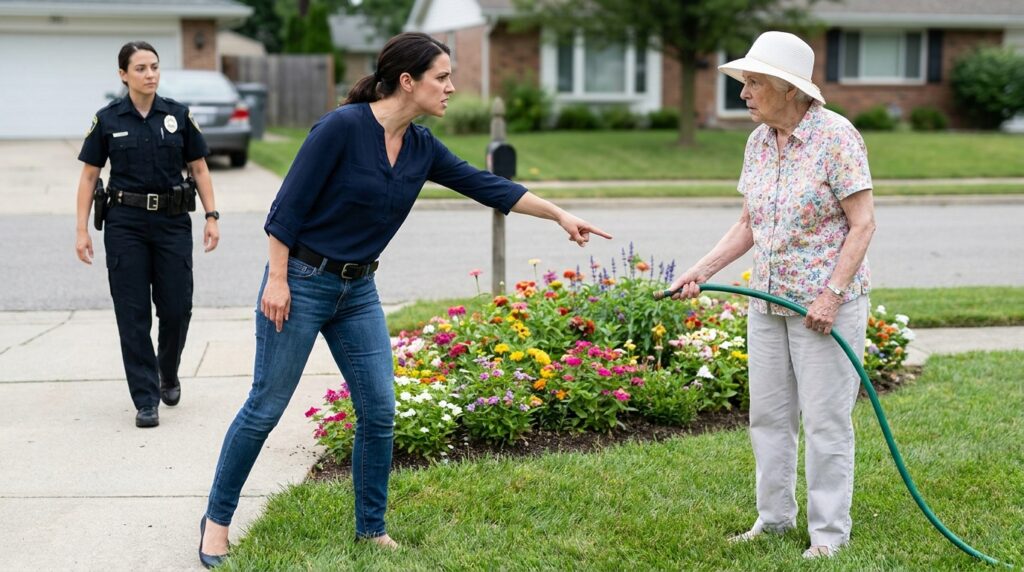
A white municipal police cruiser pulled slowly to the curb, its tires rolling over the wet leaves in the gutter with a heavy, wet hiss. Officer Reynolds stepped out into the glare of the work lights, her standard dark uniform dark with rain, her hand resting naturally against her utility belt. She took in the scene in a single, professional sweep—the excavator, the dug-out trench, the red laser line striking the garage wall, and Eleanor standing upright with her iron bar.
“I thought I told you to keep this gear off the grass until Monday, Ms. Cross,” Reynolds said, her voice flat and entirely unyielding as she stepped onto the turf between them.
Amanda didn’t look at the officer. She looked down at the rusted iron pin, her chest heaving as she slowly took a step backward, ceding the literal and metaphorical perimeter she had tried to erase. “I’ll step back now,” she muttered, her voice breaking as she turned toward her own dark house.
The surveyor began packing his tripods into the unmarked van, his movements quick and silent under the officer’s gaze. The excavator operator reversed his tracks, the heavy iron links clanking with a metallic, defeated roar as the machine backed down the street into the dark.
Eleanor Vance stood alone at the edge of her garden, the rain falling softly across her face, washing the gray clay from her fingers. The phlox beds were torn, the limestone borders were displaced, but the boundary line remained driven deep into the stone of the earth, untouchable and secure.