
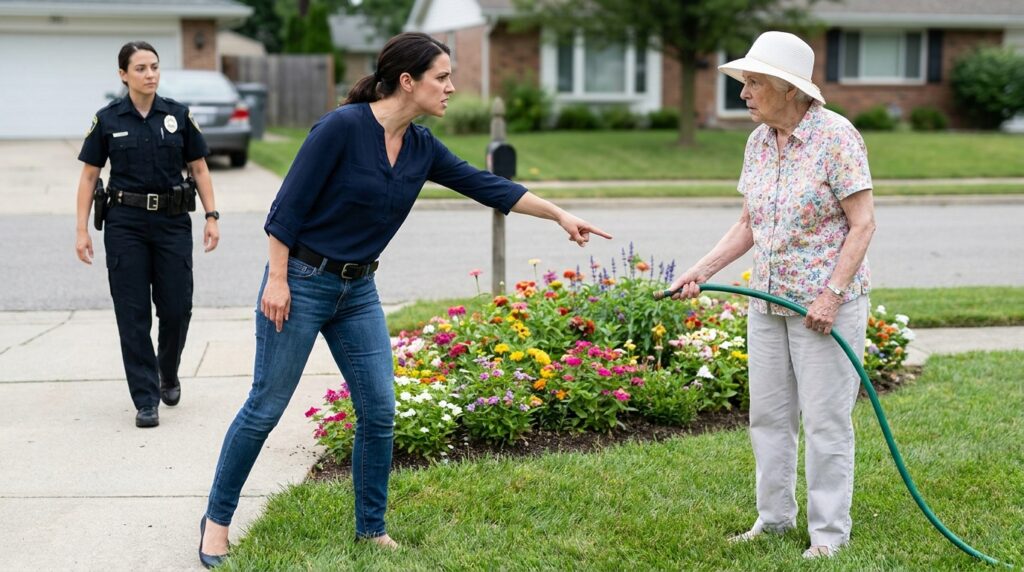
CHAPTER 6: THE DRIVEWAY NEGOTIATION
The rain had come and gone in twenty minutes, leaving nothing but a greasy sheen on the concrete driveway and the suffocating scent of wet, baked mud. Eleanor Vance stood at the exact seam where her pitted asphalt met Amanda’s smooth, slate-grey stamped concrete. Her legs felt hollow from the long journey back from the courthouse, the damp cold from the pavement creeping straight through the worn soles of Thomas’s old leather work shoes.
The headlights of a passing delivery truck swept across the front yard, illuminating Amanda. She stood on her own side of the line, her arms crossed tightly over her navy blouse, a heavy manila folder tucked into her elbow. Her dark hair was slicked back, damp from the recent downpour, giving her features a sharp, predatory symmetry in the failing light.
“The bus ride back must have taken you an hour,” Amanda said. Her tone had lost its high-volume aggression from the morning, replaced by a low, transactional hum that sounded like a motor idling in a closed garage. “You shouldn’t have gone down to the archives, Eleanor. It’s a waste of the little energy you have left.”
Eleanor didn’t adjust her canvas coat, though the wet fabric was heavy against her thin shoulders. She looked at the manila folder in Amanda’s grip. “I saw the signature page, Amanda. I saw what you tried to attach to my lot number.”
Amanda took a half-step forward, her boot resting on the absolute edge of the concrete seam, but she didn’t cross it. The lesson Officer Reynolds had delivered earlier was still written in the tight, defensive hold of her shoulders. “It doesn’t matter what you saw in a paper ledger that haven’t been indexed since the Carter administration. The digital board meeting starts in forty minutes. The zoning variance for the utility conduit has already been loaded onto the screen. It is an automated file progression.”
She paused, the rhythmic hum of her tablet clicking inside her folder. She opened the manila cover just enough to reveal a pale blue sheet of paper—not an enforcement notice, but a bank draft with a perforated edge.
“This is a structural accommodation offer,” Amanda said, her voice dropping another register as she held the paper within Eleanor’s line of sight. “Ten thousand dollars. Paid by the development group’s civil infrastructure fund. It’s listed as an voluntary boundary stabilization grant. You sign the digital waiver on my tablet right now, we withdraw the code violation for the perennial beds, and the city crews will move your greenhouse three feet to the east at no cost to you. They’ll even put a new fiberglass roof on it.”
Eleanor looked down at the bank draft. The amount was exactly what it would cost to repair the chimney flashing and replace the baseboard heaters before the November frosts hit the valley. It was a functional out—a clean, logical exit from a war she was physically too old to fight.
“You’re offering to pay me with the developer’s money because you know what happens if the county surveyor actually drives an iron pin into the ground,” Eleanor said. Her voice was thin, but it held the dry, abrasive weight of a rusted file. “If they find the seventy-six pin under my stone wall, they find out your entire detached garage is sitting twenty-four inches on the wrong side of the deed. You don’t care about the utility conduit, Amanda. You care about your equity.”
Amanda’s mouth thinned until her lips vanished into a pale line. The performative neighborhood courtesy evaporated from her eyes, leaving the cold, naked panic of a suburban homeowner who had extended her credit to the absolute limit. “If my foundation is compromised, the title insurance company pulls the line for the whole block. Every house on this side of the lane goes into administrative probate. Do you think the neighbors are going to thank you for that, Eleanor? Do you think your dead husband’s memory is going to keep the roof over your head when this whole street treats you like a virus?”
“Thomas didn’t build things to be moved by a bank draft,” Eleanor said.
She stepped back from the concrete seam, her boots sinking into the wet turf of her flower bed. As she did, her heel struck something hard and metallic buried beneath the mulch at the base of the phlox. A dull, iron-on-iron clink sounded through the quiet yard.
Amanda’s eyes dropped instantly to Eleanor’s feet. For a fraction of a second, an expression of raw, tactical calculations crossed her face. She looked at her watch, then back at the hidden object in the soil.
“The meeting is at seven-thirty,” Amanda said, her voice flattening into a final warning as she closed the manila folder with a sharp, paper snap. “When the digital vote goes through, the city won’t offer you a dollar. They’ll bring the skid-steers at dawn, and they’ll clear everything from the curb to the fence line based on the nineteen-ninety-two digital overlay. You have forty minutes to realize that nobody is coming to save this grass.”
She turned and walked briskly up her steps, the black leather belt creaking with her pace. The heavy front door shut behind her, the lock clicking home with a sound like a small caliber rifle clearing its chamber.
Eleanor remained in the dark yard. The streetlights flickered on, casting a jaundiced, yellow glow across the wet perennials. She knelt down in the dirt, her canvas coat soaking up the cold moisture from the lawn as she brushed away the wet mulch with her bare fingers.
Her nails caught on a heavy, ancient piece of iron. It wasn’t the surveyor’s pin. It was an old, industrial-grade steel padlock, completely frozen with red rust, hanging loosely from a buried galvanized irrigation box that had been sealed shut before the subdivision was even named. The lock was solid, its keyway packed with dried clay, but stamped into the corroded face of the metal were four digits that didn’t match any year she had lived here: 1971.
The code on her phone chimed again in her pocket—a second automated warning from the municipal app, the countdown clock on the zoning override ticking down to thirty-five minutes. Her актив structural status was fractured. She had the truth from the archives, but the physical ground beneath her feet was already being re-mapped by a machine she couldn’t see.








