CHAPTER 4: THE DIGITAL NOTICE
The five-pound digging iron made a thin, metallic ring when it struck the frost-hardened clay. Eleanor Vance leaned her chest against the top of the rusted bar, her shoulders burning from the sheer effort of lifting it three times. The pine stake hadn’t budged more than a quarter-inch. Her breath came in short, ragged puffs that dissolved instantly into the grey morning air. Her palms, coated in the sticky residue of the pine sap, burned against the pitted metal. She was seventy-eight, and the physics of the earth did not make exceptions for long histories or quiet grief.
Before she could lift the bar a fourth time, a high-pitched, electronic chime cut through the silence from inside her cardigan pocket.
It was the mobile phone her daughter had forced her to buy after Thomas passed—an inexpensive, plastic-cased device that Eleanor rarely used. She dropped the digging iron against the concrete foundation with a dull clatter and pulled the phone out. The screen was blindingly bright in the dim dawn light, reflecting off her old sunhat as she angled the device.
A message from the local municipal board administrative app filled the display. It was a formal notification header, but the digital seal at the top—the standard eagle-and-scales emblem of the county—looked oddly distorted, its margins pixelated as if it had been scanned from an older print copy and compressed.
The text read:
NOTICE OF INTENT TO COMPLY: PROPERTY LANE ACCESS RECONSTRUCTION.
Pursuant to the Amended Easement Agreement of August 1994 (Vance Lot 14), an administrative review has finalized the right-of-way expansion for the western perimeter line. Failure to remove non-conforming plant structures and traditional garden borders within twenty-four hours will result in municipal clearing at the owner’s expense. A physical hardcopy ledger confirmation has been logged by Representative Cross.
Eleanor’s thumb hovered over the glass. Representative Cross. Amanda wasn’t just a loud voice across the driveway; she had positioned herself inside the administrative machinery of the district. The forged waiver Arthur Henderson had found by the hydrangeas wasn’t a threat for the future—it was already traveling through the county’s automated system, converting a lie into legal momentum before the brick-and-mortar archives even opened on Monday morning.
She walked back toward the kitchen door, her steps heavier now, the weight of the plastic phone in her hand feeling like a stone. The house was cold inside. She hadn’t turned the baseboard heaters on yet, saving the electricity for the deep winter months. She sat at the laminate kitchen table, smoothing the folded plastic sleeve Arthur had handed her across the cracked surface.
The watermark in the paper—a faint grid of diamond shapes—caught the low light coming through the small window above the sink. She remembered that watermark. It was from the old legal pads Thomas used when he ran the local hardware store on Main Street before the big box retailers built their concrete warehouses near the highway. It wasn’t county vault stock. It was local retail stock from thirty years ago.
“You didn’t sign this, Thomas,” she whispered into the empty kitchen. The silence of the house didn’t answer, but the specific layout of the room did. Every drawer pull, every square of linoleum, every copper pipe under the sink had been maintained by a man who never signed a document without keeping three photocopies in the iron box beneath the bed.
She didn’t open the box yet. Her energy was finite, and she had to use it like kerosene in a storm. If Amanda had already filed the digital notification, the town board meeting at seven-thirty tonight was the absolute deadline before the code enforcement trucks arrived with their chains and diesel blades.
She went to the phone book—the real one, with the frayed paper spine that sat behind the flour canister—and dialed the number for the municipal office. The line clicked twice before an automated voice informed her that administrative hours would not begin until nine.
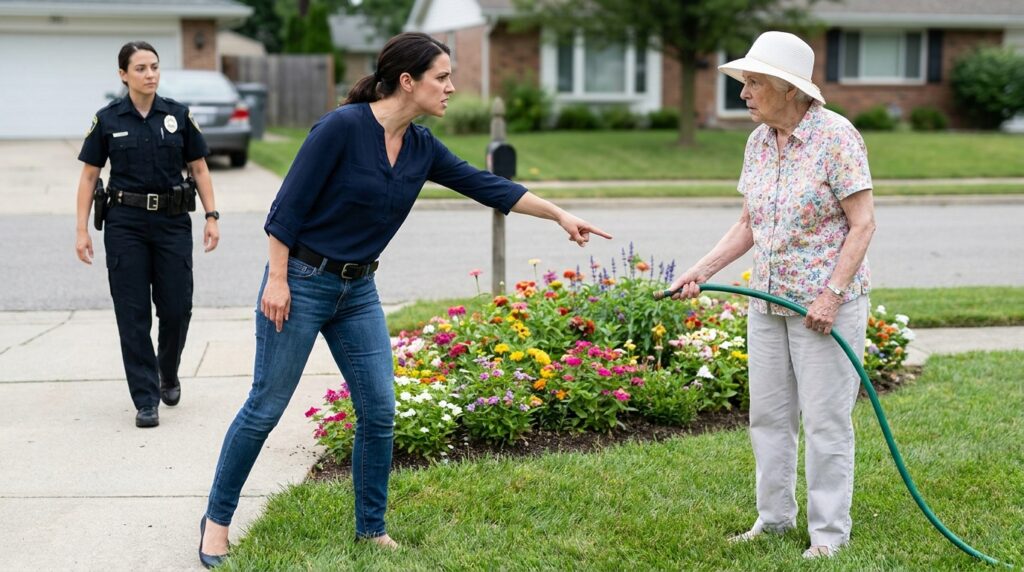
Through the window, she watched Amanda’s house. The grey siding looked dark under the heavy cloud cover. A white utility van, completely unmarked, pulled into Amanda’s driveway, its brakes squealing softly on the cold asphalt. A man in a high-visibility vest got out, carrying a yellow tripod and a digital transit line scanner. He didn’t look at Eleanor’s house. He set the tripod right at the seam of the concrete, his body language brisk, efficient, and entirely authorized.
Eleanor stood up from the table, her wool cardigan falling open. She didn’t put on her sunhat this time; she reached for her old canvas coat, the one with the deep pockets meant for heavy tools. Her active mind was no longer waiting for law enforcement or municipal courtesy. The blue numbers on Amanda’s wrist, the core-sample hole in her phlox bed, and the distorted digital seal on her phone were all pieces of a single mechanical trap. If she stayed on her porch, the trap would close.
She walked out to the driveway just as the surveyor leveled his digital lens toward her greenhouse.
“You’re on the wrong side of the pin, young man,” Eleanor said, her voice thin but carrying flatly across the asphalt.
The surveyor didn’t lower his machine. He adjusted a dial on the side, his fingers gloved in black neoprene. “Just checking the coordinates provided by the association, ma’am. I don’t set the line. I just read what the data says.”
“The data is forty years late,” Eleanor said, her boots stopping right at the edge of the phlox bed, her hand resting inside her coat pocket where the forged waiver sat. “Tell Amanda her paper is thirty years old, and my husband bought his stationery from his own store.”
The man didn’t reply, but his hand hesitated on the tripod adjustment. Inside Amanda’s front window, the blinds shifted an inch, a pale face appearing behind the glass before the slats snapped shut again.