CHAPTER 11: THE DRAINAGE HORIZON
Miller’s hand stayed frozen in the air, his fingers still curved around the silver pen. The metal looked fragile, almost absurd against the backdrop of the yellow excavator and the split limestone trench. He stared down into the darkness of the galvanized irrigation box, his breathing shallow, the smooth charcoal fabric of his suit jacket tightening across his shoulder blades as he leaned forward. The cold, sulfated air rushing up from the brickwork vault ruffled the edge of his combed hair, stripping away the polished immunity of his corporate title.
“A nineteen-seventy-one municipal bypass,” Miller said. His voice didn’t carry its previous administrative weight; it was low, dry, catching on the gritty mist that hung over the lawn. He didn’t look at Eleanor. He looked at the heavy lead tag wired to the copper key, his internal calculus recalculating the structural risk in real time. “The district infrastructure map doesn’t show an active easement line beneath the primary limestone shelf.”
“Because it isn’t an easement for the town,” Eleanor said. Her fingers, wrapped in the tight white compression bandages, closed firmly around the cold ring of the copper key. She stood flat-footed in the wet clay, using the long iron shaft of Thomas’s digging bar to anchor her small frame against the wind. “The town paid my husband to construct the overflow tunnel when the old gravel pits flooded the valley road in seventy-one. He didn’t cede the title. He built a private retention lock. If your jacks break the bedrock without bleeding the hydrostatic head from this valve, the backup will blow the sewer mains out through every floor drain on the eastern half of the block.”
The two men in the gray canvas jumpsuits stopped unhooking the heavy chains from the pneumatic jackhammer unit. One of them, an older worker with grease-stained knuckles and a faded union cap, looked down into the open trench, then back at Miller.
“She’s right, Mr. Miller,” the worker said, his boots scraping against the steel bed of the flatbed truck as he stepped down. “Look at the brickwork down there. That’s old-style municipal masonry—double-course red commons. If there’s a locked head-gate under that greenhouse foundation and we strike the limestone blindly, the back-pressure will liquefy the sub-grade fescue in thirty seconds. We’ll drop the neighbor’s garage right into the hole.”
Amanda Cross’s front door didn’t open, but the white blinds in her large picture window remained open an inch. In the dim reflection of the diesel work lights, her face was a pale, stationary smudge behind the glass—a silent witness to the exact moment her family’s thirty-year digital deception ran headfirst into the rusted iron realities of the earth.
Miller took a slow step backward, his polished calfskin shoe sliding off the wet concrete apron of the driveway and sinking into the gray mud. The grit ruined the leather, but he didn’t look down. He turned toward the surveyor, who was already turning off the red laser transit line. The ruby beam vanished from Amanda’s garage wall, leaving only the dull, natural daylight to illuminate the two-foot structural encroachment.
“Is the state automated file progression clear on this anomaly?” Miller asked, his voice flat, his focus narrowing onto the steel clipboard.
The surveyor didn’t look up from his screen. His fingers moved with a rapid, nervous cadence across the glass. “The database has a blind spot, sir. The ninety-two digital migration overrode all surface lot lines, but it didn’t catalog the subterranean retention deeds from the old county sewer district. The code is clean, but the physical physics don’t match the overlay. If we dig, we violate the state municipal utility safety act. The liability falls entirely on the holding corporation.”
The engine of the compact yellow excavator dropped its RPMs with a low, choking gurgle as the operator pulled the throttle back. The heavy iron tracks sat stationary in the mud, the diesel exhaust pluming into the gray sky like a funeral shroud for the development project’s morning mandate.
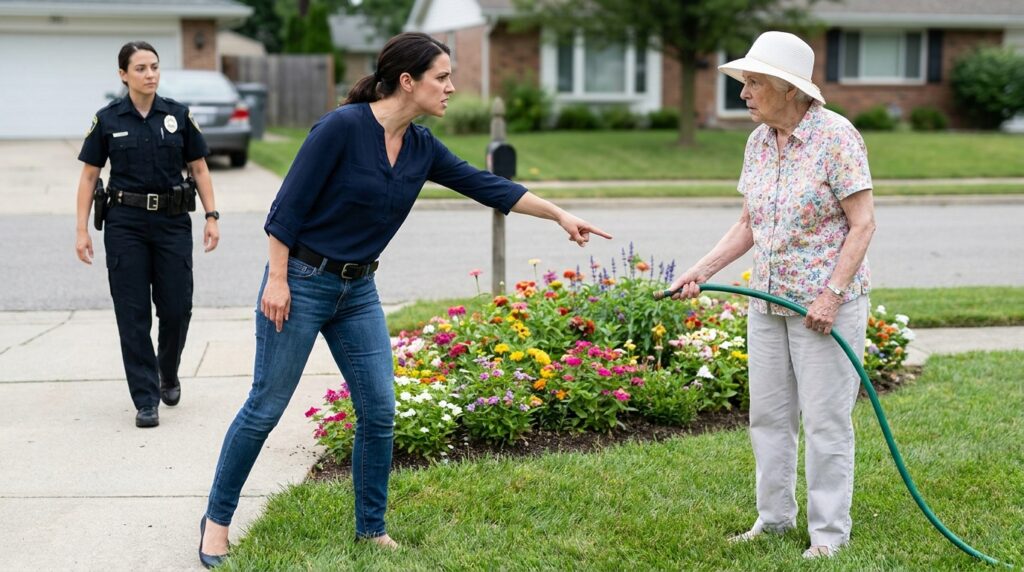
Officer Reynolds moved into the center of the driveway seam, her dark municipal uniform distinct against the yellow steel of the machinery. She pulled her leather-bound report folder from her side pocket and uncapped her pen—not a silver corporate stylus, but a thick, utilitarian plastic ballpoint.
“Mr. Miller,” Reynolds said, her voice dropping into the quiet of the block with the finality of a court order. “You’re going to order your men to load that pneumatic jack back onto the flatbed. If those engines are still idling on this lot in five minutes, I’m issuing a corporate citation for unauthorized hazardous excavation under municipal code four-two-zero. And I’m going to personally deliver a hardcopy copy of this nineteen-seventy-one lead tag to the county magistrate’s office before noon.”
Miller looked at Eleanor one final time. His eyes lingered on the wide white sunhat, the faded canvas coat, and the old green rubber garden hose that still lay looped along the lawn edge—the simple, stubborn anchors of a fifty-year perimeter. He didn’t offer a hand. He didn’t make a final speech about property values or the inevitable expansion of the valley highway. He simply closed his leather folder with a sharp, dry snap that sounded like the closing of an account.
“Clear the lane,” Miller told the crew, his voice dropping into the low register of a tactical retreat. “Move the flatbeds back to the cul-de-sac. We’re pausing the right-of-way construction until the legal division reviews the seventy-one archive ledger.”
He turned and walked toward the black sedan, his mud-caked shoes leaving dark, uneven prints across the gray stamped concrete of Amanda’s driveway. The car door closed with a heavy, pressurized thud, and the vehicle pulled away from the curb, its tires humming smoothly against the wet tar as it vanished into the morning mist.
The workers moved in silence, their heavy steel chains rattling as they hoisted the jackhammer back onto the truck bed. The ramps rose with a mechanical whine, locking into place with a pair of sharp, iron-on-iron clicks. Within three minutes, the diesel roar had retreated down the road, leaving the suburban street to its natural, quiet stupor.
Eleanor Vance remained standing at the edge of the trench. Her shoulders let down two inches, the heavy canvas coat suddenly feeling lighter against her ribs. She looked down at the copper key in her hand, the cold metal grease smudging the white cotton of her bandages. She didn’t drop it back into the box. She slid it deep into her pocket, right beside her husband’s old property tax receipts.
“You need help filling that dirt back in, Eleanor?” Arthur Henderson asked, walking over from the chain-link fence by his clothesline. He carried a heavy iron garden spade over his shoulder, his weathered face showing a grim, pragmatic satisfaction.
“The phlox needs to be reset before the sun gets too high, Arthur,” Eleanor said, her voice dry but carrying the steady, unbreakable rhythm of a long life’s work. “The roots are tough, but they don’t like the cold air.”
She knelt once more in the wet gray earth, her bare fingers reaching out to touch the torn fescue. Under the soil, the rusted iron pin remained driven four feet down into the solid limestone bedrock—unseen, un-indexed by the digital world, but holding the entire weight of her home against the horizon.