CHAPTER 10: THE PROBATE SHADOW
“The bank executed the default clause at midnight, Mrs. Vance, which means Amanda Cross no longer holds the title or the authority to negotiate this seam,” the man in the charcoal suit said. His leather folder was unclasped, the crisp sheets of high-grade corporate bond paper rustling softly against the cold wind. He didn’t step on the mud; his polished calfskin shoes remained firmly on the cracked apron of the driveway curb. “My name is Miller. I represent Vance-Cross Development Holdings. The state utility expansion corridor is already bonded. We are exercising the grandfathered corporate easement recorded in October of nineteen-ninety-two.”
Eleanor Vance stood three inches from him, her canvas coat zipped to her throat, her bandaged hands resting flat across the cold, rusted T-handle of her digging iron. Her joints burned with a dry, deep ache that made every breath a calculated effort. “That ninety-two filing is fraud, Mr. Miller. My husband’s signature wasn’t on the original ledger sheet in the archive basement.”
Miller didn’t blink. His expression had the smooth, desaturated permanence of a concrete retaining wall. “The physical ledger sheet has a manual notation, Mrs. Vance. But the digital record has been the active regulatory baseline for over thirty years. In the eyes of the state infrastructure board, the digital file is the property line. A court injunction to challenge a thirty-year-old data migration will cost ninety thousand dollars in statutory filing fees alone. Your house will be condemned for municipal right-of-way clearance long before a judge looks at your husband’s paper receipts.”
He pulled a heavy, silver-plated pen from his breast pocket and held it out, the metal catching the flat, gray glare of the morning sky. “We are prepared to assume the existing probate debt on Amanda’s lot and clear your outstanding municipal tax liens. One hundred and twenty thousand dollars, moved into a blind escrow account today. All we require is your signature on a clean civil boundary release.”
Behind him, a second flatbed truck rumbled to a halt at the curb, its heavy steel ramps dropping onto the asphalt with a deafening, metallic clang. Two men in unmarked gray canvas jumpsuits began unhooking the heavy chains from a pneumatic jackhammer unit. They weren’t waiting for the town board; they were operating on a private corporate timeline that moved faster than the local police could process.
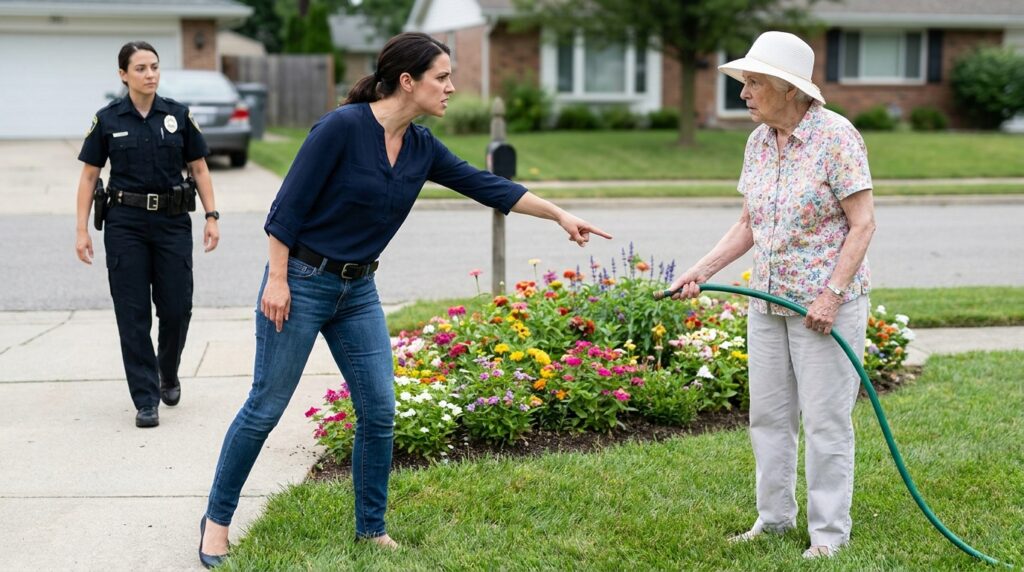
Officer Reynolds stepped forward, her hand dropping onto the hard polymer grip of her utility belt. “Mr. Miller, I told the previous crew that no heavy machinery operates on this lawn without a county sheriff’s warrant. The seventy-six pin is a marked historical benchmark.”
“This isn’t a zoning dispute anymore, Officer,” Miller said, not even turning his head to look at her badge. He pointed a leather-gloved finger toward the foundation of the old greenhouse behind Eleanor’s house. “The infrastructure bond gives us automatic structural access to any subterranean utility line within Sector Four. We aren’t digging for the pin. We’re clearing the path for the high-pressure drainage bypass. If you interfere with an active state infrastructure grant, your department will be liable for the daily delay penalties. That’s twelve thousand dollars every eight hours.”
Reynolds paused, her jaw tightening as she looked down at the digital tablet in her hand. The state database was already updating, a flashing red warning label appearing over Eleanor’s lot number: STATE INFRASTRUCTURE EXEMPTION ACTIVE.
Eleanor looked from the heavy jackhammer unit to the skeletal galvanized frame of her greenhouse. Her active mind didn’t panic; it calculated the friction of the machine. They were rushing. They weren’t trying to clear a path for a pipeline that wouldn’t be laid for months; they were trying to destroy something beneath her soil before her legal documents could be verified by a real magistrate.
“The greenhouse isn’t sitting on a drainage path, Mr. Miller,” Eleanor said, her voice thin but possessing the hard, scraping resonance of dry stone.
“The digital survey says it is,” Miller replied, his silver pen remaining extended in the cold air between them like a needle.
Eleanor didn’t look at the pen. She turned her back on him, her flat-soled leather work shoes sinking deep into the wet, torn turf as she walked toward the greenhouse foundation. Every step was a heavy labor, the pain in her knees radiating up to her ribs. She reached the rusted iron padlock she had dug up the previous evening—the one stamped 1971 that sat on top of the buried galvanized irrigation box.
She knelt in the gray mud, her fingers clawing at the thick, cold clay packed inside the lock’s ancient keyway. She didn’t have the key, but she had Thomas’s five-pound digging bar. She dragged the iron rod over, jammed the wedge-shaped point directly into the corroded shackle of the lock, and threw the entire weight of her small frame against the bar.
The rusted metal gave way with a sharp, dry snap that echoed like a breaking bone through the yard. The lid of the galvanized box creaked open, the iron hinges groaning as sixty years of sediment spilled down into a dark, cavernous void below.
A heavy, rushing draft of cold, stagnant air blasted upward into Eleanor’s face, smelling of old iron, damp concrete, and the deep, chemical sulfur of the town’s ancient subterranean overflow system.
Inside the box, resting on a small concrete ledge right above the dark, rushing water of an old municipal drainage brickwork artery, was a vintage copper vault key. It was wrapped in a greasy oilcloth, a heavy lead tag wired to the ring. Stamped into the lead were the words: MUNICIPAL SEWER 1971 – MAIN ARTERY ACCESS EXTENSION. PRIVATE PROPERTY MAINTENANCE RIGHTS RETAINED BY T. VANCE.
The drainage system wasn’t a modern state utility right-of-way. It was a traditional municipal utility piece built by the town fifty-five years ago, and Thomas had locked the main structural valve inside his own lot line before the state development corporation had even drafted their corporate charter. If the developer’s jackhammers struck this limestone ledge without using this specific copper key to bleed the pressure valve, the sudden release of subterranean water would collapse the structural foundation of every modern house on Amanda’s side of the street.
“You can’t dig here, Mr. Miller,” Eleanor said, standing up slowly and holding the cold copper key out in her mud-stained bandage. Her eyes were sharp beneath the brim of her hat. “If you crack the limestone without the private key to the main artery valve, your infrastructure line will be forty feet underwater before your men can reach the curb.”
Miller’s smooth face finally twitched, his eyes locking onto the lead tag in her hand with a sudden, freezing recognition of an absolute physical checkmate.