CHAPTER 8: THE DRY GRAY RESOLUTION
The sound of the code enforcement unit’s air brakes was a loud, flat pneumatic hiss that rolled across the manicured sod of Evelyn’s yard. The yellow light bar on the secondary utility rig cut through the rhythmic crimson and blue flashes, overlapping them with a heavy, sickly amber pulse. The cul-de-sac felt entirely enclosed now, locked beneath a dome of high-voltage strobe light that bared every crack in the aggregate stone, every patch of dry clover, and every centimeter of the unyielding concrete seam.
Evelyn had not picked up her blue folder. The cheap plastic document pockets lay splayed across the limestone gravel at her feet, the loose white sheets of unapproved fence dimensions and trash-bin citations lifting slightly in the hot exhaust of the idling cruiser. Her brown sandals remained fixed in the decorative pine bark, her heels pressed flat against the stone rim of her flowerbed as if she could physically hold the original boundary of her sovereign lane.
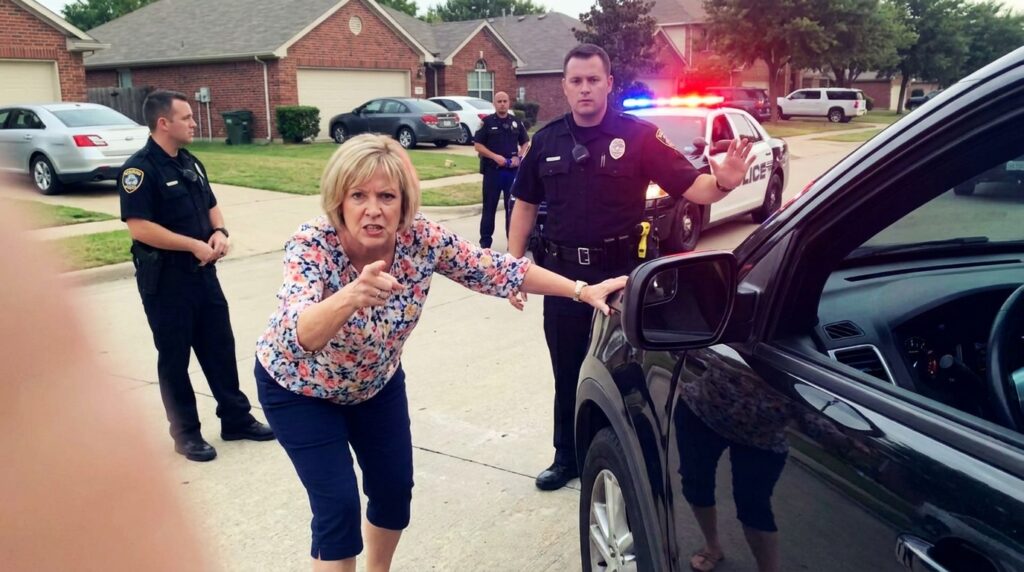
The lead officer stood directly on the concrete expansion line, his tall, solid mass casting a long, mechanical shadow across her spilled papers. His leather duty belt gave off a dry, heavy creak as he detached his digital interface from his shoulder strap. He didn’t look down at the documents. His eyes remained fixed on the yellow survey stake driven five inches into the frost line, then shifted to the pale matrix screen inside his partner’s door panel.
“The district supervisor is setting the probes at the upper culvert, Miller,” the lead officer said, his tone carrying the cold, transactional weight of a city intake desk. “We’re logging the citation under the state environmental code for a non-permitted graywater discharge. Tell the county rig to hold the line until the core drill is set.”
Miller leaned out of the cruiser’s passenger door, his stocky shoulders blocking the glare of the terminal log. His palms were still coated with the fine, brick-colored rust dust from the buried main cap. He looked across the concrete gap at the white-cased phone that hung uselessly from Evelyn’s fingers, its lens pointing dead into the dirt.
“The supervisor checked the administrative ledger, boss,” Miller called out, his voice flat and unhurried across the quiet lawns. “The ninety-four modification rider wasn’t just soft. The developer’s liaison used the old ninety-two benchmarks because the county grid monument had been clipped by a grading tractor during the initial phase. The whole road curve is sitting four feet over the northern coordinate line. Every foundation on this side of the court is out of plat.”
The revelation settled into the dry air of the cul-de-sac like a physical weight. Evelyn’s short blonde bob didn’t move. Her jaw remained tight, but her limestone rigidity had shrunk into a defensive hunch, her shoulders pitched forward under her floral blouse as if she were trying to block the line of sight from the neighboring porches. Down the lane, three separate homeowners stood by their mailboxes, their profiles completely motionless, their phones held level at chest height to document the precise moment her performance collapsed.
I stepped away from my truck’s heavy steel tailgate, the scuffed leather of my boots making a low, grinding sound against the aggregate stone. I didn’t reach for the laminated deed folder beneath my arm; the fasteners were cold against my ribs, their purpose already served by the data blinking on the patrol car’s screen.
“This isn’t your neighborhood sandbox anymore, Evelyn,” I said, my voice leveled to match the low, greasy hum of the diesel engines. “The survey stakes are right where the town grid put them. The police can read the map. Your board didn’t spend thirty thousand dollars to clear a utility corridor; you spent it to hide the fact that your own garage is sitting four feet onto the agricultural tract.”
She didn’t lift her eyes to look at me. Her sunglasses had slipped to the bridge of her nose, her pupils small and tracking the slow rotation of the amber strobe on the utility truck’s roof. Her authority had been built on the unyielding compliance of carbon copies and arbitrary notices, a fragile grid of paper that had just been crushed by the iron reality beneath her lawn.
The lead officer reached down to his duty belt, pulling a heavy, ink-stamped municipal citation book from his rear pocket casing. The paper gave off a sharp, chemical snap as he tore the top carbon leaf from the binding. He didn’t offer it to her hand; he placed it flat on top of the blue plastic folder lying in the dirt by her sandal.
“Ma’am,” the officer said, his voice absolute and procedural. “This is a formal notice for an unpermitted lateral bypass and public mischief regarding a fraudulent emergency dispatch. Code enforcement will remain on site until the drainage collar is plugged with concrete. Keep your person on the residential lot.”
Evelyn didn’t reach down for the paper. She turned slowly, her sandals dragging a trail of dark mulch across her manicured turf as she retreated toward the gray shade of her entryway. Her fingers were still twitching against her sides, her white phone swinging by its lanyard like a dead pendulum. She didn’t look back at the flashing units, nor at the neighbors who remained on their lawns to watch the final uncoupling of her sovereignty.
I climbed back into the dark cab of my truck, the door frame solid and unyielding under my grip. The window rolled up with its familiar, dry, scraping groan, shutting out the scent of hot diesel and wet subsoil. Through the windshield, the yellow survey stake stood perfectly straight, its high-visibility vinyl ribbon catching the dying glare of the noon sun. The concrete seam was silent now, its limits locked, its boundary defended by nothing more than an inch of driven iron.