CHAPTER 4: THE CHROMIUM STROBE
“The county grid isn’t open to interpretation by patrolmen who can’t read an engineering legend!”
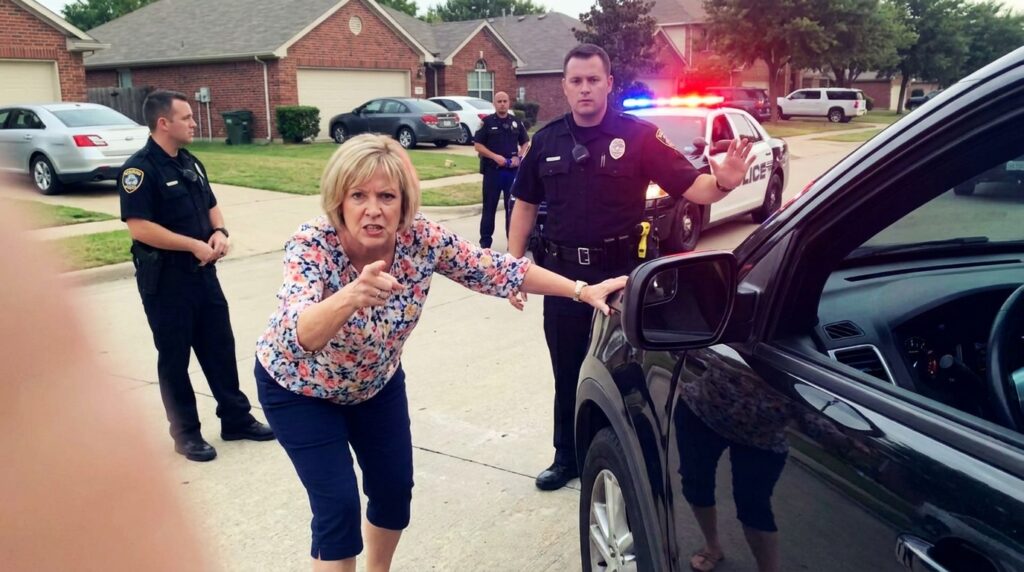
Evelyn’s voice cut through the steady, mechanical clicker-clicker of the cruiser’s flashers. She took two sharp steps away from her flowerbed, her brown sandals snapping against the curb’s concrete lip. Her right arm came down hard, the blue folder slicing a violent arc through the humid air as if she could physically beat back the rust-colored powder coating Miller’s fingertips.
The lead officer didn’t blink. The red strobes caught the polished silver of his badge, sending sharp, bleeding beams across the driveway’s aggregate surface. The leather of his duty belt gave off a dry, heavy creak as he shifted his weight, his solid stance remaining anchored exactly on the property seam.
“Ma’am,” the lead officer said, his tone dropping an octave into a cold, transactional rhythm that belonged to city intake desks rather than suburban cul-de-sacs. “The county code is very specific about unmapped infrastructure. If my partner is looking at a lateral extension that doesn’t clear the main plat, this call ceases to be an administrative tow request. It becomes an unauthorized worksite issue.”
“It’s a private improvement authorized under the ninety-two subdivision covenants,” Evelyn said, her words rushing out, her lips white and dry along the edges. She pulled her sunglasses down an inch, her eyes bloodshot and small in the glare of the noon light. She wasn’t looking at the officer; she was staring down into the darkness of my open cab door, where the laminated deed folder still lay flat across the gray vinyl passenger seat. “The resident knows exactly what’s under that slab. He’s been attempting to block infrastructure access since the frost broke.”
I stepped around the corner of my truck’s heavy steel tailgate, the friction of my boots on the gritty driveway concrete making a low, scraping sound. I held my phone out, the screen displaying a clean, high-resolution digital log of county building permits spanning from 1990 to the previous winter.
“There are no private improvement riders attached to this lot number, officer,” I said. My thumb scrolled through the scanned rows of ink-stamped ledger sheets. “The developer closed the final permit pool in October of ninety-four. If Evelyn’s board ran a sleeve under this concrete after that date, they did it without a county inspector signing off on the depth. They bypassed the trench regulations.”
Miller stayed on his knees near the hostas, his thick fingers working through the root systems with the blunt precision of a mechanic adjusting a valve. He used a small, flat-bladed tool from his pocket kit to strike the side of the exposed domestic main cap. The sound that came back up was hollow, a dead, ringing clink that indicated an empty cavity below the iron plate rather than a packed gravel bed.
“The collar’s fresh,” Miller called out, squinting up through the flashing blue light spill. He pointed with the tip of his tool toward the inner diameter of the drainage casing. “The iron is pitted on the outside, but look down the throat. Someone applied a high-zinc cold galvanizing spray to the threads within the last forty-eight hours. The overspray is still tacky on the silt line.”
The lead officer turned his full attention back to Evelyn. The limestone rigidity of her posture seemed to shrink slightly under the steady, alternate pulse of the roof rack. The neighborhood porches were silent now; three separate residents stood by their mailboxes down the lane, their profiles dark and motionless against the white vinyl fences. The cul-de-sac had become a closed system, its legal and physical boundaries tightening around her like a tightening winch.
“Evelyn,” the lead officer said, his voice level but unyielding as he stepped into her personal space, his shoulder line cutting off her view of the tow driver. “We need the structural variance log. Not the association newsletter. The actual engineering waiver with the municipal seal.”
“The records are at the management office,” she said, her fingers twitching against the cardboard backing of her folder, her defensive stance beginning to reveal the exhaustion of a long, calculated gamble. “They aren’t open on Mondays. The clerk is out until Wednesday morning.”
“Then the truck stays exactly where it’s parked,” I said, leaning my elbow against the bed rail of my truck, feeling the heat of the dark paint transfer through my sleeve. “And Bob takes his flatbed out of my driveway before his oil pan leaves a mark on the stone.”
Bob didn’t wait for Evelyn to give the word. He hit the hydraulic release valve on his deck with a loud, pneumatic hiss, the steel ramp sliding back into its road frame with a metallic clatter that shook the loose gravel near the curb. He climbed into his cab without looking back, his diesel exhaust leaving a greasy black cloud over the top of her prize-winning hostas.
The lead officer watched the tow truck pull away, then looked back at the fresh survey stakes driven into my sod. “Miller, pull the digital map for the ninety-four plat pool on the terminal screen. Let’s see what the county grid actually recorded before someone started spraying zinc down the throat of this drain.”
Evelyn didn’t move, but her sandals shifted slightly, her heels crossing back over the concrete expansion joint into the public gray of the street. The secret was still locked down in the dark under the slab, but the first seam had begun to open.