CHAPTER 6: THE FORCED LATERAL
“Turn your shoulder away from the door frame, Evelyn. The lane is clear.”
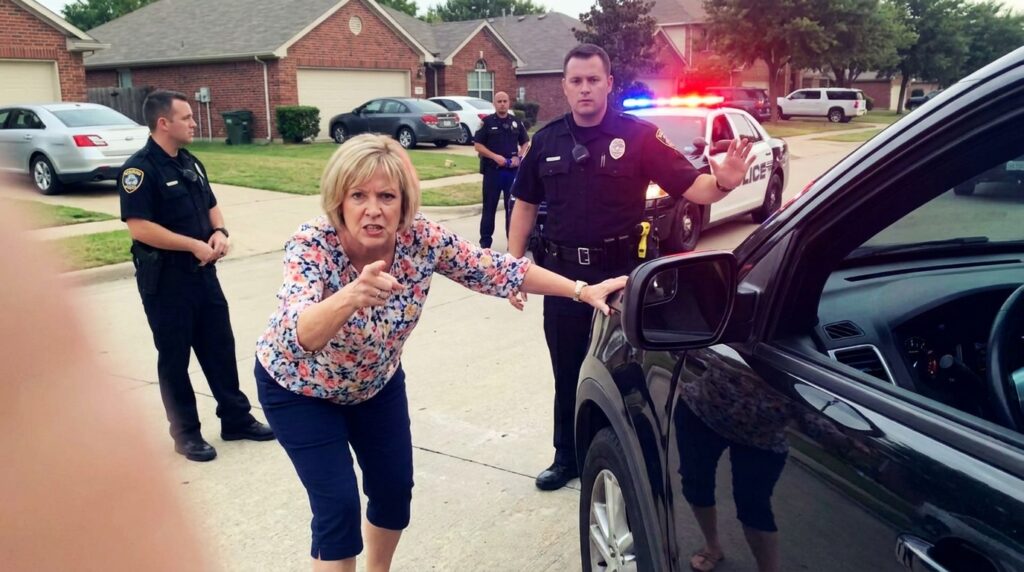
The lead officer didn’t shout, but his boots made a distinct, heavy grating sound as he shifted his weight into the soft sod of her flowerbed. His uniform sleeve, dark and rigid with dried starch, remained a solid wall between Evelyn’s floral blouse and my open truck cab. The strobes overhead continued their relentless, hypnotic sweeps, bleeding indigo light across the aggregate stone like a liquid stain.
Miller didn’t take his hand off his utility belt. He stepped into the gap from the left, his stocky build leaning slightly into the lane of her retreat to ensure the separation remained absolute. His fingers brushed the heavy canvas of her blue folder, guiding her back toward the public curb with a cold, professional indifference that broke her remaining momentum.
“The grid reference points are locked on the county terminal, ma’am,” Miller said, his eyes scanning the horizon of neighboring roofs rather than her limestone expression. “We aren’t going to debate the administrative drift on this driveway lot. You need to clear the access seam now.”
Evelyn’s brown sandals skidded slightly on a patch of loose gravel at the edge of the asphalt. Her jaw remained tight, but her breathing had turned ragged, a shallow, whistling intake that rattled the plastic rings of her document folder. She looked down the suburban lane, where the silhouette of an unmarked municipal utility truck was already rounding the far corner of the cul-de-sac, its yellow light bar pulsing a slow, sluggish amber.
“The association hasn’t cleared the budget for a full resurvey,” she whispered, her voice dropping into a dry, defensive rasp that stripped her of her usual administrative clarity. “The developer’s surveyor died in ninety-eight. If the coordinate index is shifted, then every fence line from here to the county road is out of compliance.”
“That’s a civil matter for the title insurers, ma’am,” the lead officer replied, his palm remaining flat and level at chest height as he backed her another three feet onto her own grass. “Right now, my concern is the unauthorized utility work my partner noted in the drainage throat. We’re holding the perimeter until the district supervisor verifies the seal.”
I stepped completely down from the driver’s side threshold, the scuffed leather of my boots finding the grit of the concrete seam. I didn’t open the laminated deed folder; I held it beneath my forearm like an anchor, the cold weight of the brass fasteners pressing into my ribs. The active dashcam behind the glass continued its steady, crimson wink, logging the precise sequence of her displacement.
“Evelyn,” I said, leaning my hips against the truck’s heavy steel tailgate, watching her sandals settle into the mulch of her prize-winning hostas. “The private developer didn’t make an error in ninety-four. They used the old county stakes from the ninety-two pool because it saved them four hundred feet of trenching along the northern easement. You knew the line was soft when you ordered the zinc spray.”
She didn’t deny it. Her fingers simply twitched against the frayed cardboard edge of her folder, her short bob shaking as she tilted her head to avoid the glare of the cruiser’s roof rack. Her phone stayed lowered, its lens pointing uselessly at the dry sod, its power to bully or fine completely uncoupled from the physical space she had tried to govern.
Miller walked back toward the curb line, his heavy boots crunching through the ornamental bark. He bent down one more time near the drainage grate, his thick fingers tracing a small, faded mark that had been carved directly into the underside of the concrete lip—a crude, non-standard red chalk notch that matched the numbering on the brass shim I had found earlier.
“We got a secondary bypass marker down here,” Miller called up to the lead officer. He wiped a fresh smear of heavy, grease-filmed silt off his thumb onto his trousers. “The lateral connection isn’t even tied into the main sewer line. It’s an overflow discharge line that empties straight into the culvert under the resident’s lot. If this thing backed up during a frost, it would have flooded his foundation within twelve hours.”
The lead officer looked from the chalk notch back to Evelyn’s pale, tight mouth. The amber pulse of the arriving utility unit began to mingle with the crimson strobes, turning the dusty gray of the suburban afternoon into a muddy, vibrating orange. The performance of her neighborhood sovereignty hadn’t just collapsed; it had turned into an actionable code violation under the state’s environmental protection codes.
“Miller, get the camera out of the unit,” the lead officer instructed, his leather belt creaking as he turned his back on Evelyn entirely, sealing her out of the active scene. “We’re going to log every inch of this trench line before the county team drops their probes into the stone.”
Evelyn stood motionless on her lawn, her sandals buried in the damp mulch, her authority stripped away in full view of the silent porch watchers whose phones were still recording from the shade of their eaves. She had crossed the boundary looking for a violation, and the earth had opened up to show her own signature on the fraud.