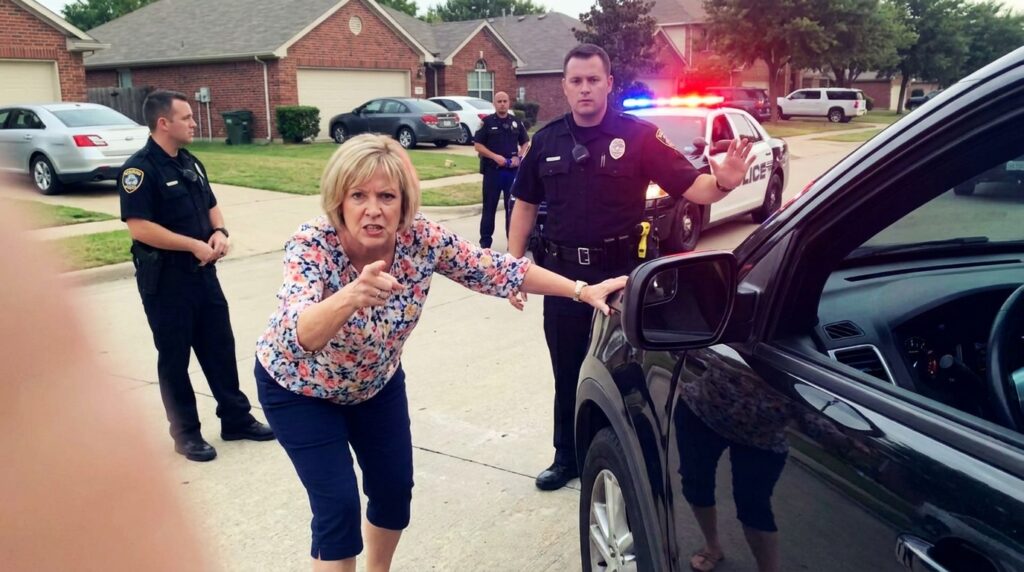
CHAPTER 3: THE RUSTED APPARATUS
The flash of the first cruiser’s roof rack hit the vinyl siding of the house opposite us, transforming the sun-baked cul-de-sac into an arena of rhythmic, artificial indigo and crimson. The diesel rumble of Bob’s tow truck was eclipsed by the high-frequency click of a local municipal engine dropping into park. Doors slammed in sequence—two crisp, mechanical cracks that signaled the arrival of institutional gravity.
Evelyn didn’t move her boots from the concrete expansion joint, but her fingers adjusted their grip on the blue folder, tightening until the cheap plastic rings groaned. The limestone mask was back on her face, though a thin bead of sweat had begun to track through the powder on her temple, cutting a tiny, clean line down to her jaw.
“About time,” she muttered, her voice recovering its practiced sharpness as the lead officer cleared the bumper of her sedan. “Officer, this resident is actively obstructing a documented municipal utility access route. He’s placed unauthorized physical markers into the common-area turf and has threatened commercial recovery operators.”
The lead officer was tall, his black local uniform stiff with starch that had already dried crisp under the midday sun. His duty belt gave off a heavy, shifting leather creak as he stopped at the precise line where my aggregate driveway met the public street asphalt. His eyes didn’t look at Evelyn’s face; they dropped immediately to the yellow vinyl ribbon fluttering on the survey stake, then to the uncoupled flatbed hook dangling three feet from my front bumper.
“Ma’am,” the officer said, his voice flat, professional, and entirely drained of neighborhood politics. “We received a call regarding a hostile dispute over a vehicle blockage. Who is the registered property owner here?”
“I am,” I said. I stood by the open cabin door of my truck, my hand resting on the warm, scuffed steel of the door frame. “The deed is in the passenger seat. The state-certified survey markers were driven yesterday morning at eight o’clock. The vehicle is situated exactly fourteen inches inside the private boundary line.”
Evelyn stepped forward, her brown sandals grinding a stray piece of limestone gravel into the concrete with a dry, crunching screech. She thrust her phone toward the officer’s face, her short bob shaking with the sudden expenditure of her defensive energy. “The survey is invalid. The association charter signed in ninety-two reserves a six-foot easement from the primary water main for infrastructure maintenance. Look at the record. He’s blocking the county grid.”
The backup officer, a stocky man with a shaved head and a quiet, watchful stance, moved laterally along the curb line. He wasn’t looking at the phone screen. His boots brushed past the edge of Evelyn’s meticulously manicured lawn, his eyes scanning the low ground where her prize-winning hostas grew in dense, dark green clusters right against the property line. He stopped, his toe tapping a half-buried piece of iron.
“Evelyn,” I said, shifting my gaze from the lead officer to the blue folder in her hand. “The ninety-two charter you keep citing was superseded by the ninety-four extension when the developer put in the secondary drainage culvert. If this is a utility easement, where is the iron access cap?”
“It’s registered under the common plat,” she snapped, her knuckles turning a bloodless white against the plastic folder. “It doesn’t need to be visible to be legally binding.”
“Everything structural has an inspection footprint, ma’am,” the lead officer remarked, his hand resting casually but firmly on his utility belt. He turned his head slightly toward his partner. “Miller, you see a municipal cap over there?”
The backup officer bent down, his thick fingers parting the broad, waxy leaves of the hostas. The dry earth gave off a faint, dusty smell as he cleared a layer of decorative pine bark. There was a metallic scrape—the sound of a boot heel striking old, pitted iron. When he stood back up, his palms were covered in a fine, brick-colored rust dust.
“Got a domestic main cap down here,” Miller said, looking over his shoulder at the lead officer. “But it isn’t six feet from the curb. It’s nearly ten. And it looks like someone ran an unmapped iron sleeve from the lateral line straight under this driveway extension.”
The lead officer’s eyebrows narrowed, his gaze shifting back to Evelyn’s face. The blue and red lights continued their relentless, silent rotation, casting long, mechanical shadows across her floral blouse. The atmosphere in the cul-de-sac had changed; the weight of the dispute was shifting away from an unapproved vehicle parking violation and down into the rusted, hidden plumbing of the development itself.
I reached into the cab, my fingers wrapping around the edge of the laminated deed folder, pulling it into the glare of the noon sun. “The ninety-four amendment locked the utility corridor to the northern boundary, officer. If there’s an iron sleeve under this concrete, it was laid after the plat map was filed. And it wasn’t laid by the county.”
Evelyn’s phone dropped two inches, the screen reflecting the high, unblinking glare of the midday sky. Her mouth opened slightly, but no administrative rule came out. She looked at the tow driver, then at the rusted dust on Miller’s fingers, her fingers twitching against the frayed edge of her secret.