
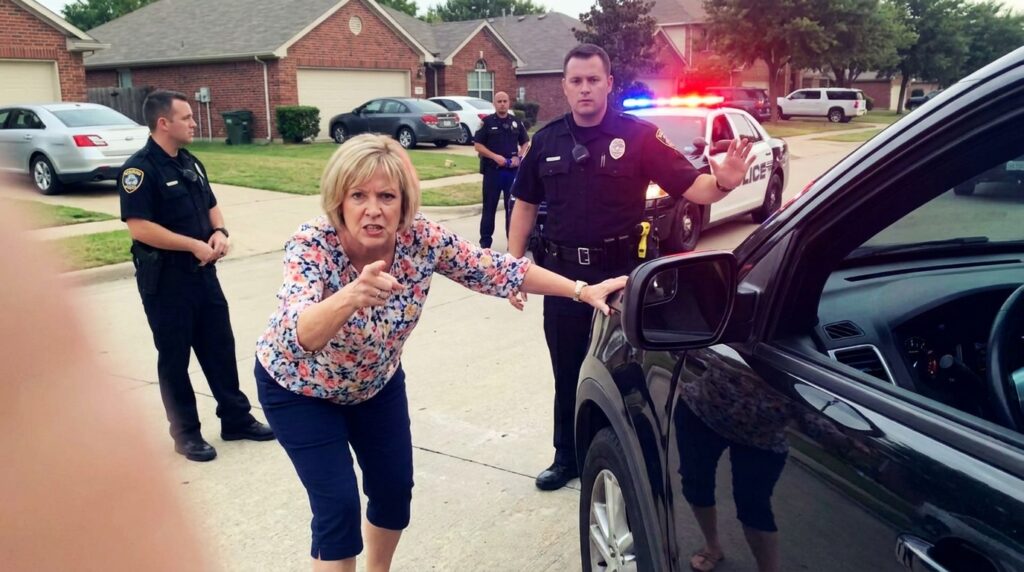
CHAPTER 2: THE TWISTED LINK
“He’s backed up to the curb, Evelyn! You want me to hook the front axle or the chassis?”
The voice cracked through the midday heat, thick with grease and tobacco. The flatbed tow truck sat idling at the lip of the cul-de-sac, its diesel engine emitting a low, rhythmic rattle that vibrated through the floorboards of my cab. The driver, a stocky man in an oil-stained neon vest, stood with his boots planted on the public asphalt, his hand resting on the hydraulic lever assembly of the flatbed. The steel cable hung slack from the winch, a heavy, rusted hook clinking against the diamond-plate steel deck.
Evelyn didn’t turn around to look at him. Her eyes stayed locked on my windshield, her reflection distorted by the dust clinging to the glass. She tapped her phone screen twice with a manicured nail—a sharp, plastic click that sounded like an insect hitting a window.
“The chassis,” Evelyn said, her voice dropping into that flat, administrative tone she used when she was citing a homeowner for an unapproved shade of porch paint. “It’s a persistent obstruction of a designated utility easement. The bylaws are clear, Bob. Hook it and pull it to the impound lot.”
I reached across the console, my fingers brushing the cold, textured vinyl of the laminated deed folder. The brass fasteners felt heavy, slightly rough where the plating had worn away from years in the dark cabinet. I pulled the folder into my lap, the pages of the 1994 tract map crinkling under my palm. There was a specific weight to reality—the exact density of paper, the iron-gall ink of county stamps, the physical presence of three-quarter-inch steel survey pins driven deep into the clay. Evelyn’s world was built on three-part carbon copies and neighborhood association minutes; mine was anchored in the geology of property markers.
The window rolled down with a dry, scraping groan, the internal gears gritting against the fine silt that blew off the development’s unfinished retention basin. The smell of hot diesel and sun-baked rubber rolled into the air-conditioned cabin.
“The winch cable isn’t long enough to clear the private property line, Bob,” I said, my voice leveled to match the low hum of the truck’s engine. I didn’t look at Evelyn. I looked past her bobbing blonde hair, straight at the tow driver whose hand was still hovering over the hydraulics. “If your iron crosses that yellow stake, you’re operating an unauthorized recovery on a private lot. The state licensing board has an administrative form for that. It costs about five grand on the first offense.”
Bob hesitated. His boots shifted on the asphalt, his eyes dropping to the yellow vinyl ribbon tied around the survey stake. The ribbon fluttered in the hot exhaust, a bright, synthetic slash against the dusty gray of the concrete seam. He knew the look of an official marker. He also knew the look of a lawsuit. He pulled his hand back from the lever, wiping his palm on his thigh. “She said it was a common area, man. I’m just executing the dispatch order.”
“The dispatch order is based on a falsified complaint,” I replied, opening the door.
The weight of the door frame was solid under my grip, the ungreased hinges giving off a sharp, metallic squeak as I pushed it into the gap between my vehicle and Evelyn’s hip. She didn’t move back until the steel edge was three inches from her floral blouse. Her jaw tightened further, the skin around her mouth turning the color of dry tallow. She held the blue folder up like a shield, the paper corners soft and frayed from her constant, nervous handling.
“It is a common area,” she hissed, her finger snapping down toward the base of the curb. “The utility easement extends six feet from the water meter. The association charter from 1992 explicitly gives the board the right to clear any vehicle obstructing structural access. You think because you hired some cut-rate surveyor to pound sticks into the dirt that you can rewrite the map of this development?”
I stepped out onto the concrete, my boots finding the grit. The heat of the sun-baked driveway radiated through my soles. I didn’t answer her. Instead, I walked past her shoulder, my shadow cutting across her Capris as I moved toward the drainage grate near the curb.
Something had been wedged into the iron slats—a small, dark object that didn’t belong to the street’s standard debris. I knelt down, the heat of the curb pressing through my jeans. It was an old, oil-stained brass shim, three inches long, stamped with a series of faded, non-sequential numbers that didn’t match the county code. It had been driven into the concrete seam right where the original curb had been cut and refaced years ago. When I touched it, the metal was burning hot, the surface pitted with rust and road salt.
“Evelyn,” I said, my fingers tracing the rough edge of the brass wedge. “Who poured the concrete for the cul-de-sac extension back in ninety-four?”
She froze. The phone in her hand tilted downward, the camera lens pointing blankly at her own brown sandals. For a fraction of a second, the limestone rigidity of her face cracked, revealing something old, dry, and carefully guarded behind her sunglasses. She pulled the blue folder closer to her chest, her knuckles turning white against the cardboard.
“That has nothing to do with your truck,” she said, her voice rising an octave, losing its cold, bureaucratic precision. “Bob, hook the axle. Now.”
But Bob wasn’t looking at her anymore. He was looking down the street, where the first rhythmic pulse of a crimson and blue light was beginning to paint the brick facades of the neighborhood.








