CHAPTER 7: THE REVERSAL AT THE SITE
The high-pitched electronic whine of a digital transit unit cut through the heavy idling rhythm of the county utility truck. A yellow-vested surveyor from the county engineering pool didn’t look at Evelyn or Arthur; his focus was entirely clamped onto the red laser dot striking the lower rail of the cedar fence. He adjusted the brass thumb-screws of his tripod, the small metal teeth clicking with mechanical precision against the aluminum legs. Behind him, the responding police officer stood dead center on the gravel seam, his fingers unhooking a heavy leather ledger from his duty belt.
“The bedrock datum line doesn’t lie, Ma’am,” the surveyor said, his voice flat, dry, and bleached of any personal interest. He tapped the digital readout on his screen, where a wireframe grid of the subdivision shifted into alignment. “The iron pin your neighbor found under the leaves is the primary benchmark for the block. It hasn’t shifted an inch since the winter of eighty-four. Your privacy fence is sitting exactly twenty-four inches past the public easement boundary.”
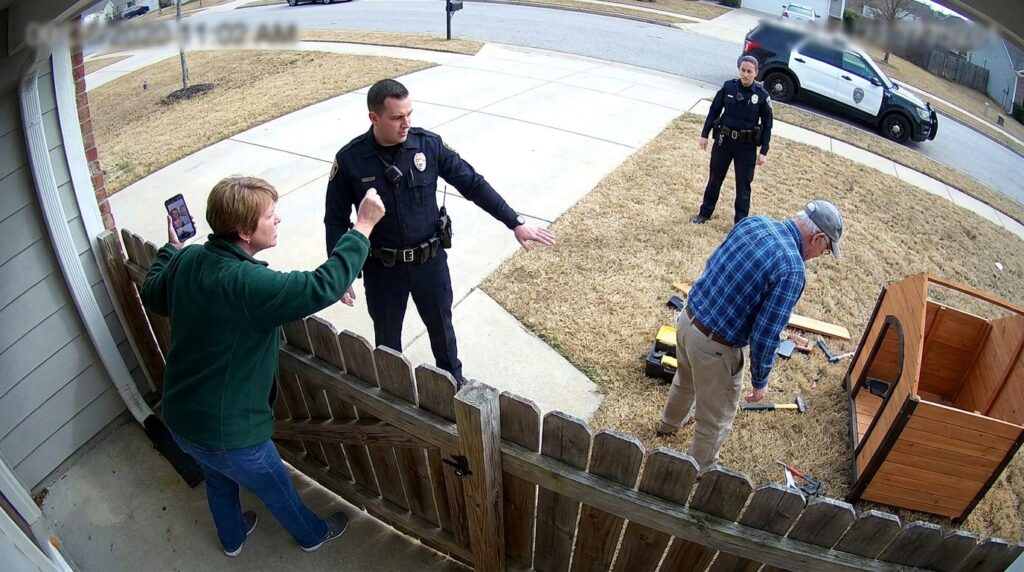
Evelyn didn’t move away from the wood gate. Her hands were jammed deep into her green fleece pockets, her knuckles bulging through the soft fabric until the stitching screamed. She looked at the red laser beam dotting her clean cedar wood like a tiny drop of fresh ink. Her face remained a rigid, chalky white behind her oversized sunglasses.
“That’s an administrative error from the regional registry,” she said, her voice dropping into a tight, frantic whisper that rattled the papers inside her folder. “My husband was the chief structural inspector. He audited this entire sector before the cul-de-sac was even named. He wouldn’t have poured three yards of high-early concrete inside a public utility right-of-way unless the variance was legally certified by the town board.”
Arthur slowly turned his head, his rounded shoulders shifting against the cold autumn air as he wiped a line of dry gray clay from his thumb. He didn’t offer her his leather wallet this time; he didn’t need to. He reached down and picked up his heavy brass-bound folding ruler, the metal joints unfolding with a dry, internal scrape that cut through the electronic hum of the transit.
“Bill didn’t care about the variance, Evelyn,” Arthur murmured, his voice level and matching the steady drone of the county truck. “He cared about his foundation. Look at the pitch on your concrete driveway header. It’s leaning three degrees toward the old ditch line. If he didn’t anchor that corner post into the utility main’s sleeve, the whole west wall of your garage would have slid into the silt during the ninety-six floods.”
The responding officer stopped writing. He took two steps across the gravel line, his heavy black boots pressing deep into the soft rye grass right beside the unfinished doghouse frame. He didn’t look at the screen on Evelyn’s phone; he looked down at the exposed base of the third post, where Martha’s iron digging bar had left a deep, jagged gash in the packed subsoil. Through the split earth, a thick, dark layer of gray mastic coating showed on the underlying iron pipe sleeve—the unmistakable protective seal used by the county water depot to cover structural fractures in high-pressure conduits.
“Mr. Vance,” the officer said, his voice dropping into the center lane of the dispute with absolute finality. “Is that your signature on the eighty-four installation log for this segment?”
“It is,” Arthur said, his eyes fixed on the rusted iron scales flaking off the angle brace. “I held the chain when we drove the pins. Bill knew the bedrock fault was shallow here. He tried to hide the settlement by shifting the fence line over the public main, thinking nobody would ever dig deep enough to expose the steel.”
The backup officer stepped into the driveway lane, her wide stance cutting off Evelyn’s line of retreat toward her front porch. Her hand stayed clamped over the nylon clasp of her taser, her posture locked in an alert monitoring position as a small crowd of porch watchers began to gather along the opposite sidewalk.
“Ma’am,” the responding officer said, turning his torso completely toward Evelyn until his shadow fell across her manila folder. “The county engineer’s report is clear. This fence constitutes a willful encroachment and a hazardous obstruction to a public utility line. Under Section twelve of the municipal civil code, we’re going to have to issue a formal citation for property line falsification and civil harassment based on the emergency call you placed this morning.”
Evelyn’s folder slipped out from under her arm, the heavy cardboard buckling as it struck the wet gravel boundary. The white carbon paper from her citation pad scattered across the grass, catching the autumn wind and rolling like dry leaves toward the base of Arthur’s unfinished red cedar panels. She didn’t reach down to catch them. Her mouth opened slightly, but no sound came out except a short, ragged breath that dissolved instantly into the gray morning mist. She stood entirely alone on her own asphalt, stripped of the institutional authority she had spent twenty winters weaponizing against the block.