
CHAPTER 5: THE FROZEN SITE
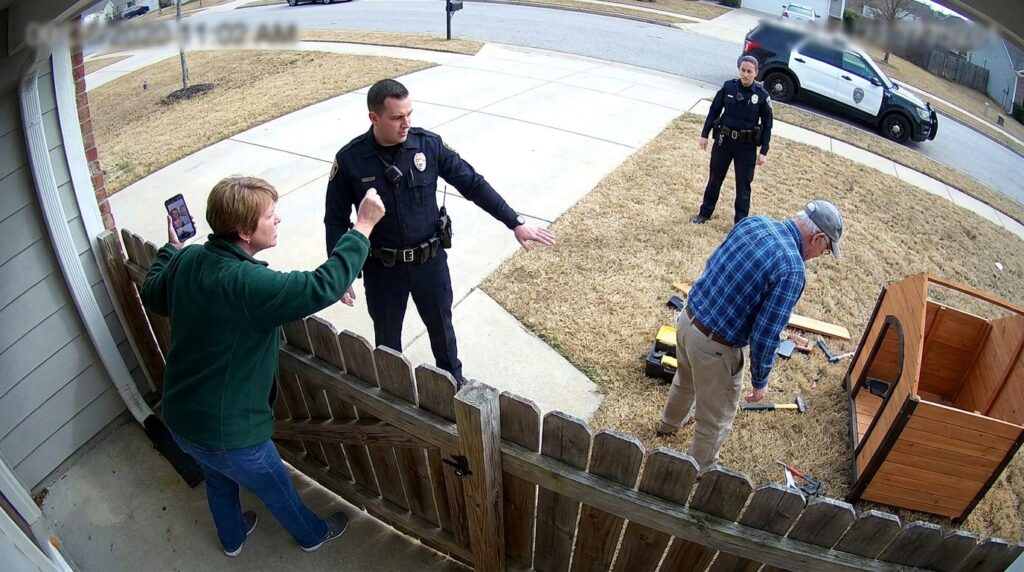
The responding officer didn’t look up when the compact sedan braked at the curb, its small tires kicking up a brief spray of dry roadside gravel. He kept his gloved hand resting flat against the upper frame rail of Arthur’s doghouse, his weight leaned slightly forward to press the raw cedar wood into the clay. The impact driver sat exactly where Arthur had left it, the dark grease on its rubber handle gleaming under the pale morning sun.
“Step back, sir,” the officer repeated, his eyes fixed on Arthur’s boots. “Leave the driver right there on the timber. Until we clear up the coordinates, this frame stays static.”
Arthur stood perfectly still, his long, curved spine remaining locked in a defensive hunch against the autumn wind. He let his thumb trace the cold brass edge of the folding ruler inside his pocket, his mind measuring the distance between the officer’s heavy black boots and the exposed tip of the rusted survey pin. He didn’t answer. He didn’t need to. He could hear the car door click shut behind him, followed by the crisp, dry rattle of rolled drafting paper being pulled from a rear seat.
Evelyn took two steps forward, her dark green fleece bunched tightly at her elbows as she pointed her citation pad at the street. “This is a private legal matter, Officer. He’s calling his family in to clutter the scene. I want it noted that this is a residential zone, not a public hearing. My husband spent twenty years keeping this specific side of the street free of administrative interference from people who don’t hold county licenses.”
“Ma’am, I told you to hold your lane on the asphalt,” the backup officer said, her voice dropping into a hard, professional register as she stepped between Evelyn and the gravel strip. Her utility belt gave a sharp, metallic click as she shifted her stance, her fingers resting lightly against the heavy nylon casing of her radio. “The ground is frozen for everybody until the primary check is done.”
Arthur’s daughter, Martha, didn’t stop at the edge of the lawn. Her work boots were old, the leather stained with grease from her own job at the township water depot, and she carried a blue plastic tube under her arm like an iron pipe. Her face was identical to Arthur’s—lined, wind-burnt, and completely devoid of the frantic energy that tightened Evelyn’s shoulders. She dropped the rolled blueprints onto the raw cedar top-rail with a heavy, hollow thud that made the impact driver bounce against the wood.
“The engineering stamps are on the third sheet, Officer,” Martha said, her voice matching the flat, unhurried cadence of her father. She didn’t look at Evelyn. She unclipped the plastic cap of the tube with a sharp snap. “Nineteen eighty-four utility grid layout. Before the subdivision developers re-graded the ditch lines for the modern pavement.”
The responding officer took his hand off the frame, his gloves making a faint sticking sound against the fresh sap of the cedar. He didn’t reach for the blueprint immediately; he looked down at the gray clay dust that covered Arthur’s trousers, then back to the sunken earth at the base of Evelyn’s third fence post.
“Eighty-four is forty years out of date, lady,” Evelyn said, her voice rising an octave as she tapped the screen of her phone with the plastic tip of her pen. “The county GIS map has the digitized parcels updated as of last winter. Bill checked the server himself before the illness took him. Your father’s sitting exactly eighteen inches into the civil easement, and that drainage line belongs to my plot.”
“The server took the data from the ninety-two resurvey, Evelyn,” Martha replied, her fingers flattening the edge of the blueprint against the raw plywood panel. “The one your husband signed off on when the township ran the secondary sewer line. Only he didn’t check the iron pins. He checked the fence line he’d already put up.”
The responding officer bent his knees, his torso lowering until his eyes were level with the top of the blue sheet. He pulled a small, silver stream-light from his duty belt, the beam cutting through the morning haze to illuminate the faded white grid lines of the document. His finger tracked a thick, hand-drawn vector marked Main Utility Conduit – Segment B. At the margin of the line, a small, circular ink stamp had bled into the paper, its letters faded but readable: County Surveyor Office – Calibrated Reference Anchor #3.
Arthur looked down at the paper. He didn’t need the light to see it. He had been the one holding the chain when the surveyor drove that rusted iron angle brace into the gray clay forty winters ago. He knew the exact weight of the sledgehammer it took to drop that steel three feet down into the hardpan soil.
“Mr. Vance,” the officer said, his light flicking from the paper down to the mud-stained iron pin poking through the weeds by Evelyn’s post. “This drawing shows the anchor point sitting exactly twenty-four inches east of the current asphalt edge.”
“It does,” Arthur murmured.
“And where’s the post?”
“The post is sitting right on top of it,” Arthur said. “He built the concrete footing straight around the iron so nobody could drop a plumb line down to check the true zero.”
Evelyn’s phone slipped out of her hand, the black casing striking the gravel with a sharp, plastic clatter that made the backup officer turn her head. She didn’t reach down to pick it up. Her fingers stayed frozen in the air, her face dropping its matted red color until it matched the dry, chalky gray of the turned clay beneath her boots.
“That’s a fraudulent map,” she whispered, her voice shaking so hard the papers in her folder began to snap against her fleece. “Officer, my husband was a senior inspector. He wouldn’t risk his county pension for two feet of rye grass. They’re setting a trap. They dug that iron up this morning before the sun came up.”
The responding officer didn’t answer her. He stood up slowly, his joints making no sound at all as he tucked the flashlight back into its nylon sleeve. He looked at Evelyn, his expression completely blank, his hand resting flat against his utility belt right above the steel cuffs.
“Nobody’s digging anything up in this clay without a backhoe, Ma’am,” the officer said quietly. He turned his head toward his partner. “Call the county engineer’s office. Tell them we need the field investigator down here with the digital transit. We’ve got a discrepancy on the primary benchmark.”








