CHAPTER 6: THE REVEAL AT THE LAWN
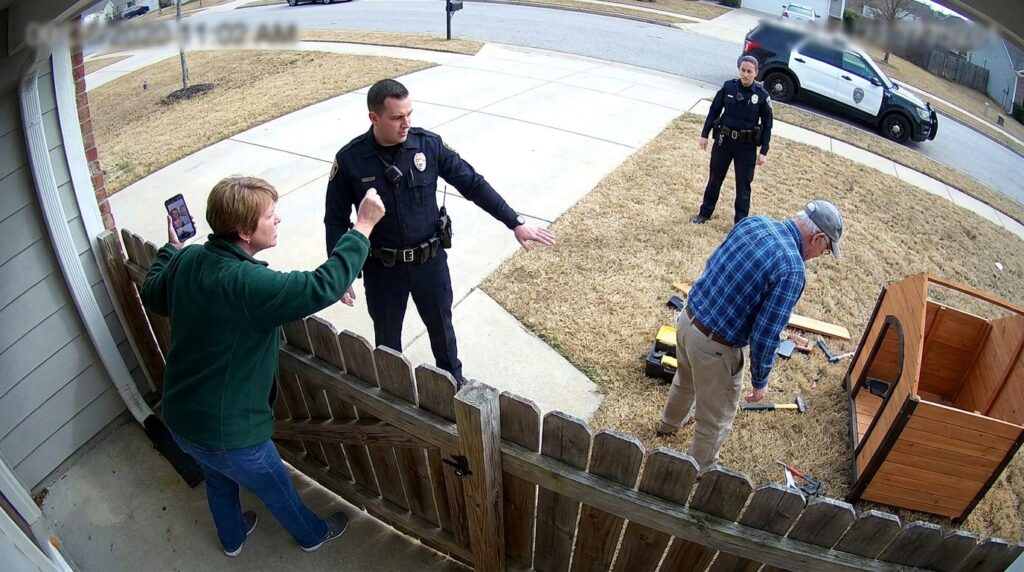
“The local map doesn’t overrule a signed county registry, Arthur,” Evelyn said, her voice thinning to a sharp whistle as she kicked at her dropped phone on the gravel. She didn’t pick it up. She left the screen down in the dirt, her fingers curling into the pockets of her dark green fleece until the seams strained. “Bill spent twenty-six years in the administration building. He knew every deviation from Elm to the bypass. If there was an unmapped alignment, he would have filed a permanent correction before the cul-de-sac was even asphalted.”
The responding officer didn’t look at her fingers. He took a slow, heavy step back from the cedar frame, his boot heel grinding a crust of dry clay against the raw grain of the lumber. He kept his right hand balanced on the top-rail of the doghouse, his thumb tracing the blue-line margin where Martha’s maps were pinned by the weight of a rusted iron anvil.
“The county registry is exactly what we’re looking at, Ma’am,” the officer said, his voice flat as an old tie-strap. He didn’t turn his head to look at her; his eyes stayed on the white engineering stamp. “Your husband’s name is on the ninety-two revision, sure enough. But this eighty-four print has the state seal on the corner datum block. That means the easement was locked before the subdivision was cleared for water lines.”
Martha reached down into the heavy canvas tool sack sitting beside the doghouse frame. She didn’t hurry. Her fingers, stained dark with pipe grease and sulfur from the city water treatment plant, wrapped around a long, solid steel digging bar. The metal tool was cold, five feet of solid octagonal iron with a sharp chisel tip that had been worn down by forty winters of subsoil maintenance. She dropped the tip onto the grass with a hollow, deep thud that vibrated through the gravel.
“He didn’t just build the fence on top of the pin, Evelyn,” Martha said, her voice level and devoid of any heat. “He set the corner post inside a three-foot sleeve of corrugated iron pipe and filled the gap with high-early concrete. He didn’t want anyone dropping a standard plumb bob down to verify where the public easement split from the residential deed.”
The backup officer stepped closer, her wide stance cutting off the center lane between Evelyn’s driveway and the dug-out clay. Her hand didn’t move away from her radio clip, the small plastic latch clicking as she watched Martha lift the iron bar. “Sir,” she told the responding officer, her voice dropping into a professional monotone. “Dispatch says the field investigator from the county engineering pool is out on the state highway. They’re thirty minutes out with the digital transit rigs.”
“We don’t need a transit to see thirty inches of theft,” Arthur murmured. He hadn’t moved from his square of split garden foam. His long, curved spine stayed bent over the red cedar base plate, his bare fingers resting on the old brass hinges of his pocket ruler. “The zero-mark on the main main line is exactly sixty feet from the fire hydrant on the corner. If you clear the leaves away from the bottom rail of that third section, you’ll see where Bill notched the wood to keep his own line from showing the curve.”
Evelyn took two steps backward, her boots catching on the lip of her clean asphalt driveway. Her face had gone from a mottled red to the color of wet limestone, her lips dry and thin against her teeth. She pulled her hands out of her fleece pockets, her fingers reaching blindly for the iron latch of her fence gate as if she could hold the wood together by weight alone.
“You’re fabricating the coordinates, Arthur,” she whispered, her voice dropping into a harsh, trembling whisper that barely carried over the idling diesel engine of the police cruiser. “My husband kept his records clean. He was a senior inspector for this whole district. He wouldn’t leave an open discrepancy on his own property.”
“He didn’t leave it open, Evelyn,” Martha said. She jammed the chisel tip of the iron bar into the turf right at the base of the red cedar post, the metal shearing through packed rye grass and striking the buried iron pipe sleeve with a sharp, ringing clack that sounded like a rifle shot in the narrow space between the houses. “He buried it under forty bags of ready-mix so the township wouldn’t see that his own foundation was shifting into the public drainage ditch.”
The responding officer leaned over the blue paper, his stream-light cutting through the shadow of the fence to focus on the corner block where the original county engineers had signed off on the parcel layout. His finger stopped on a handwritten notation from 1984, signed with a heavy grease pencil that had bled through the fiber of the blueprint: * Easement Shifted 24 Inches West due to Bedrock Fault Line. Final Boundary Locked at Anchor #3.*
He stood up slowly, the nylon of his uniform uniform scraping against his duty belt. He didn’t check his screen this time; he looked directly at Evelyn, his eyes cold and level under the stiff brim of his cap.
“Ma’am,” the officer said, his voice dropping into the heavy, transactional register of an official warning. “The state documents say your husband’s ninety-two revision didn’t include the bedrock variance. If that fence is sitting inside the locked easement line, it’s a Class A civil obstruction on a public water utility pathway. I suggest you go inside and call your legal representative before the county crew arrives with the cutting torches.”