CHAPTER 2: THE SCREAMING TEETH
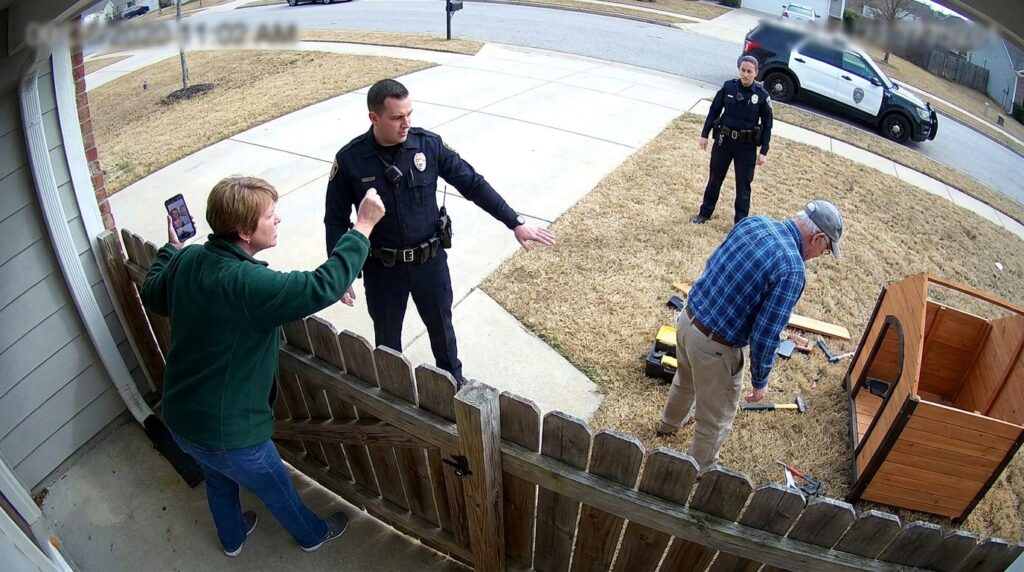
The circular saw didn’t whine; it screamed, a high-register growl of ancient gears and dry bearings that drowned out the rhythmic clicking of Evelyn’s heels on the property line. Arthur kept his left hand flat against the cedar plank, guiding the heavy metal shoe of the saw through the chalked line. The friction threw a rooster-tail of sweet-smelling red dust over his knuckles, the fine powder settling into the deep creases of his skin and the rusted hinge of his brass ruler. Through the vibration in his palms, he could feel the engine laboring, the smell of hot copper winding mixing with the scent of burnt sap.
Evelyn didn’t move back. She stood exactly four inches from the edge of his foam kneeling pad, her face a pale knot of rage behind her oversized sunglasses. In her hand, the manila folder was gone, replaced by a pink municipal citation pad she had pulled from the depths of her green fleece—a relic from her brief tenure on the township zoning board three years ago. Her pen hovered over the carbon paper, the tip trembling but ready.
“You’re being documented, Arthur,” she shouted over the mechanical roar. “Every cut. Every inch of encroachment. The dispatcher has the cross-streets. They’re running the vehicle tags on that truck in your driveway right now.”
Arthur released the trigger. The blade spun down with a hollow, metallic hiss, the teeth clicking against the metal guard as it settled. The sudden silence on the driveway was heavy, filled only by the distant hum of the interstate and the sharp, ragged intake of Evelyn’s breath. He didn’t look up at her. He reached down with a gloved thumb and cleared a clump of wet, gray clay dust from the blade’s depth-adjustment lever. The clay was cold. It had been turned up from three feet down when he dug the corner footings for the structure, and it carried the sour smell of stagnant groundwater.
“The truck’s legal, Evelyn,” Arthur said. His voice was too quiet for the open air, forcing her to lean her head down to catch the words. “Taxes paid through December. Tires are inside the curb.”
“The lumber isn’t,” she shot back, pointing the plastic tip of her pen toward the stack of six-by-six posts resting on the narrow gravel strip between his driveway and her lawn. “The county code clearly states that uninstalled commercial building materials cannot be staged on an unpaved easement for more than forty-eight hours. It’s a civil nuisance. It attracts rodents. My husband spent twenty years keeping this side of the street clear of industrial waste.”
Arthur stood up slowly, the joints in his hips popping with a sound like dry kindling. He was nearly a head taller than her, but his shoulders were rounded by forty winters of structural ironwork, his spine curved into a permanent defensive posture against the elements. He wiped his palms against his thighs, leaving two wide gray streaks on his khaki trousers.
His eyes traveled past her, tracking the straight line of her privacy fence. It was built from clear-heart cedar, expensive and heavy, coated in a dark, blood-red stain that had begun to peel near the soil line where the moisture stayed trapped. At the base of the third post—the one directly aligned with the center of his doghouse build—the earth was slightly sunken. A small, dark gap showed between the pressure-treated lumber and the dry gray clay.
He took two steps toward the post, his boots crunching on the loose gravel.
“What are you doing?” Evelyn demanded, her boots shifting on the asphalt as she turned to follow him. “Don’t touch that fence. That’s private property. I have the camera logging every contact.”
Arthur didn’t answer. He dropped to one knee, the stiff fabric of his pants straining against his thigh. He reached out with his bare fingers, ignoring the splinters from the rough-cut bottom rail of her fence, and cleared away a thick mat of rotting oak leaves. His knuckles brushed against something hard, cold, and entirely unyielding.
It wasn’t stone. It was steel.
A heavy piece of old angle iron had been driven deep into the dirt, wedged tightly between the concrete footing of Evelyn’s fence post and the buried clay drainage tile that ran under both their lots. The iron was badly pitted by rust, its edges flaking off in orange scales that stained Arthur’s skin, but near the top, three deep notches had been cut into the metal with a cold chisel. The marks were old, filled with gray silt, but they were precise.
Arthur’s thumb traced the notches. He knew this iron. He had driven hundreds of them during the utility expansion of eighty-four when the township put in the main water lines. This wasn’t a standard grade stake. It was a primary reference pin used by the county engineers before the developers ever poured the first residential foundation on the block. And according to the layout of those three notches, the fence post next to it wasn’t just slightly out of alignment—it had been placed directly on top of the public main.
“Arthur!” Evelyn’s voice rose an octave, her shadow falling across his hands as she stepped over the gravel line. “Get away from there. The police are turning onto the avenue right now. I can hear the engine.”
He didn’t pull his hand back. He pressed his index finger deeper into the mud at the base of the iron, feeling the way the metal tilted. It wasn’t upright. It had been intentionally hammered at an angle, bent toward his property line as if someone had tried to force the reference point to look like it sat two feet further west than it actually did.
The low, rumbling thrum of a heavy diesel V8 vibrated through the soles of his boots. From around the corner of Elm Street, the blue-and-white nose of a municipal police cruiser appeared, its roof lights dark but its stance heavy and deliberate as its tires dropped over the broken edge of the curb.