CHAPTER 4: THE ANCHOR INCIDENT
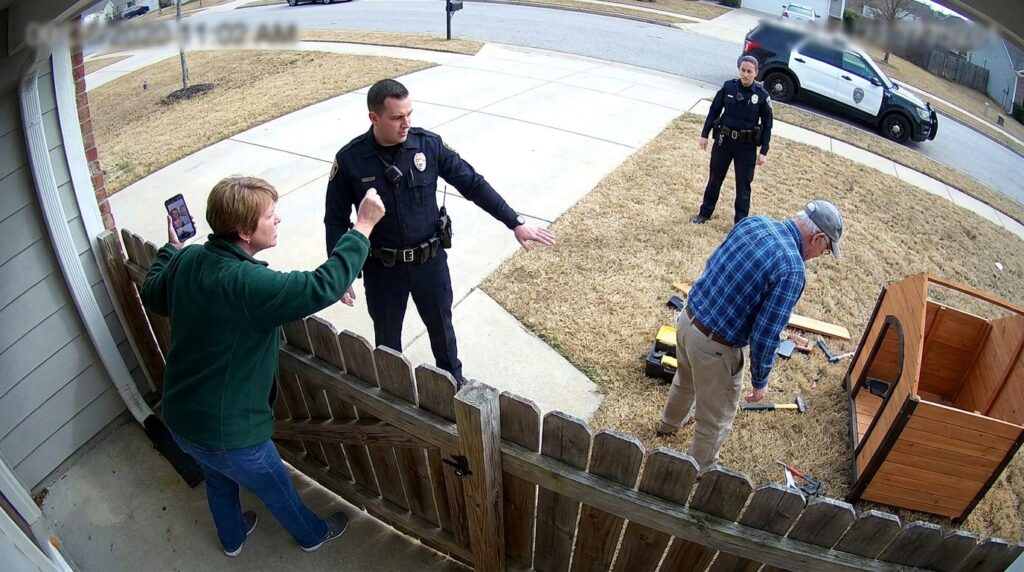
The cruiser’s engine dropped into a low, oily idle, the radiator fan blowing a warm, metallic draft across the gravel seam. Evelyn didn’t step back; she stood rigidly at the wood fence gate, her body angled like a surveyor’s stake driven into the wrong lot. She threw a sharp hand toward the gate opening, her voice cracking against the wide suburban silence.
“He’s extending the frame past the utility boundary right now, Officer,” she said, her chest heaving underneath the dark green fleece. “Look at the alignment. It’s an explicit civil trespass. He knows my camera caches every movement across this line, and he’s doing it because he thinks nobody will enforce the easement on an old man.”
Arthur didn’t rise from his foam pad immediately. He kept his palms flat against the cold cedar timber, his eyes fixed on the responding officer’s boots as they stopped exactly where the gray asphalt met the rye grass. The officer’s uniform belt creaked, a heavy, transactional sound of nylon and steel clips. He didn’t look at Evelyn’s folder; he looked at the raw wood, the scattered zinc screws, and the small patch of turned earth where the ancient angle iron poked its rusted nose through the clay.
“Ma’am, step back,” the responding officer said, his arm rising in a flat, horizontal sweep that took the center lane between the two lot lines. His voice was calm, but it had the heavy weight of a county man who had spent twenty winters sorting out driveway wars. “I need everyone calm. Nobody moves across the gravel until we establish the baseline.”
“I am calm,” Evelyn shot back, though her fingers were white where they gripped the pink citation pad. “But I want it on the incident report that he was warned. He was warned before he laid the first joist.”
The backup officer took her position by the right midground, her eyes scanning the unfinished roof panels and the yellow extension cord that snaked into Arthur’s open garage. She didn’t look at Arthur’s face; she watched his hands, checking the weight of his posture against the heavy iron anvil sitting in the grass.
Arthur slowly pulled his hands back from the wood frame. The cedar dust was dry and sweet in the back of his throat, a sharp contrast to the sour smell of wet subsoil that clung to his boots. He let his fingers brush the stiff brass hinges of the ruler in his pocket. He didn’t need to look at the paper map Evelyn was shaking; he could feel the true line through the soles of his boots, inherited from forty years of tracking the iron water mains under these exact driveways.
“The frame is inside my deed, Officer,” Arthur said, his voice flat as an unplaned board. “Twenty-six inches from the post face. The drainage tile runs clear under both houses, and the easement allows for removable domestic structures.”
“It’s not removable if it’s framed with six-by-six anchors, Arthur!” Evelyn shouted, her voice rising until a porch watcher across the street stopped their mower to listen. “He’s trying to establish a physical footprint before the town board reviews the development variance next month. It’s a deliberate land grab.”
The responding officer didn’t look at the phone she was trying to push into his line of sight. He stepped directly onto the mud patch Arthur had cleared, his heavy boot heel crushing a wet oak leaf against the flaking orange rust of the angle iron. He looked down, his eyes lingering on the three cold-chisel notches that marked the steel. His brow furrowed slightly, his thumb hooking into his leather duty belt right above his holster.
“What’s this metal here, Mr. Vance?” the officer asked, his voice dropping into a quieter, probing register.
“County survey pin from eighty-four,” Arthur replied, his voice level. “Before the tract was laid out. The township engineers used it to calibrating the water main grade.”
Evelyn took a sharp, aggressive step forward, her boot coming down hard on the gravel boundary. “That’s ancient history. That pin was superseded when the cul-de-sac was paved in ninety-two. Bill recorded the new coordinates himself. The current line runs straight through the center of that doghouse.”
The backup officer shifted her stance, her hand resting lightly on her hip as she watched Evelyn’s forward lean. “Ma’am, I told you to keep your feet on the pavement. Step back behind the gate post.”
Evelyn stopped short, her face flushing a deep, mottled red under her sunglasses. She crossed her arms tightly against her chest, her jaw setting into a hard line that matched the unyielding red cedar of her own fence. “This is absurd. I’m the one who called you. He’s the one violating the civil peace, and you’re treating me like the suspect.”
Arthur didn’t look at her embarrassment. He reached down and picked up a loose piece of string from his tool kit, tying a small knot at the end by habit. He knew the layout better than any map in the clerk’s office. He knew that if the officer looked closely at the angle of that iron stake, the whole geometry of the fence line would start to twist. The decoy was already out in the open—the paper deeds and the digital parcel screens that Evelyn relied on to enforce her will—but the physical iron under the grass didn’t care about town ordinances or dead inspectors. It stayed exactly where the hammers had left it.
From the end of Elm Street, the low, steady hum of a four-cylinder engine began to grow closer, the tires of a compact sedan crunching against the loose gravel at the edge of the block. Arthur didn’t turn his head. He knew the sound of his daughter’s car, and he knew what she had in the trunk.