CHAPTER 6: THE RECKONING OF LOT FOUR
The sound of the cedar rail splitting wasn’t a damp groan; it was the dry, violent crack of ancient wood giving up its tension all at once. The white splinters of the fence rail sprayed across the ditch, peppering the stagnant water in the trench with tiny wooden needles.
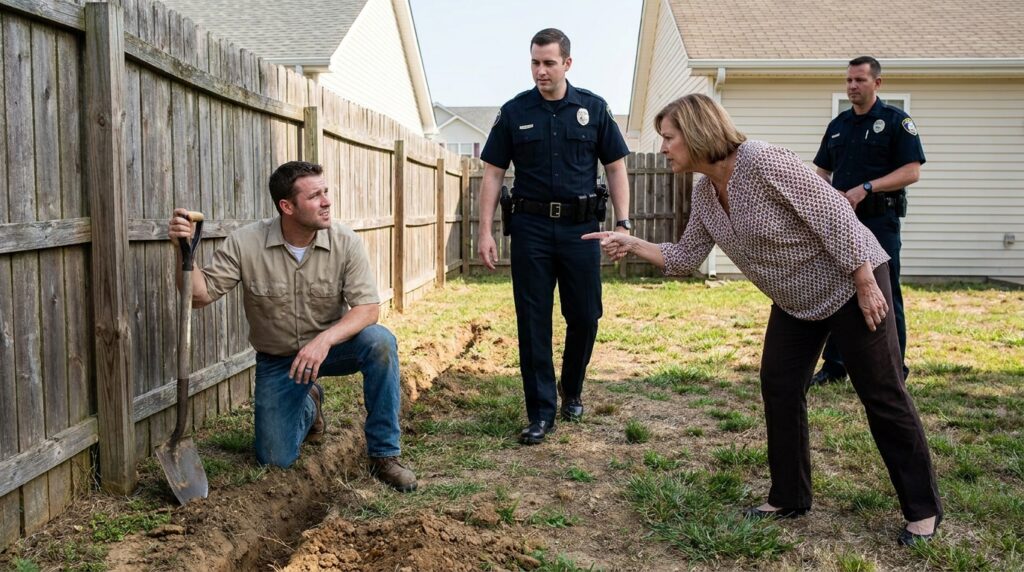
Arthur didn’t jump back. He dropped the blue folder onto the dry clover, his boots instinctively widening their stance on the edge of the slope. Before the echo of the break could leave the narrow lane between the houses, the weight of the hill shifted. It was an incremental, silent subsidence—a three-inch drop that dragged the bottom rail of the fence into the fresh muck. Across the line, the lower course of brick on Eleanor Gable’s garage wall bulged outward, a handful of crumbling gray mortar dust puffing from the zigzag fissure like a dying breath.
“Miller!” the backup officer shouted, his arm extending to latch onto the iron latch of the side gate as the ground vibrated under his boots. “Get her off that walkway! The whole retaining line is pivoting!”
Officer Miller didn’t wait to argue. His thick leather gloves closed around Eleanor’s forearm, his weight leaning backward to pull her off the gravel path just as the second course of brickwork sheared cleanly away from the foundation. The blue plastic folder slipped from Eleanor’s grip, its crisp white pages scattering across the damp grass, their typed threats and bold administrative warnings instantly stained by the gray silt drifting up from the trench.
“Let go of me!” Eleanor’s voice was high, a thin, jagged rasp that lacked any of her practiced bureaucratic control. Her large tortoiseshell sunglasses flew from her face as she stumbled, hitting the grass with a heavy, ungraceful thud. Without the dark plastic lenses, her eyes looked small, pale, and entirely undone by the sudden collapse of her perimeter. “My husband… the variance… it’s on the record!”
Arthur stepped down into the settling dirt, his boots sinking past the ankles into the cold, saturated clay. He didn’t look at her. He didn’t need to see the panic to know the math had run out. He drove his spade straight down between the shifted concrete footing and the newly exposed bronze benchmark disk under the oak tree. The steel spade struck something flat and non-yielding—not stone, but a heavy, galvanized iron plate that had been driven vertically into the soil four decades ago to hide the original corner stake.
“It’s not a variance, Eleanor,” Arthur said, his words coming out slow, balanced by the rhythmic, heavy thump of his heart against his ribs. He leaned his full weight onto the shovel handle, using the leverage to pry the rusted iron plate back until the wet earth groaned and released its hold. “Your husband didn’t grandfather this wall. He hit the county right-of-way marker in seventy-four, and instead of moving the slab back four inches, he buried the benchmark and ran his drainage straight into my dirt to wash away the evidence.”
Miller stood over the edge of the ditch, his breath coming in short, ragged bursts through his teeth as he looked down into the pit. The yellow steel tape measure was still gripped in his hand, its tip coated in the gritty brick dust that continued to settle over the mud.
“Arthur,” Miller muttered, his fingers tracing the line of the exposed bronze disk where the chiseled strike-through was now completely visible under the noon glare. “That’s a regional survey node. If that building is sitting on a county benchmark grid line…”
“It means her garage isn’t just an encroachment on my lot,” Arthur said, his thumb brushing a thick layer of wet loam off the old abstract page he had pulled from his own file. He pointed directly to the purple ink stamp from 1974—the unrecorded municipal charter entry that Eleanor had spent thirty years hiding behind fake HOA notices and empty legal noise. “It means the entire northern wall of her house is sitting inside the unrecorded public easement strip. The county owns the four inches under her foundation.”
The silence that followed was total, broken only by the thin, persistent trickle of gray water leaking from the severed iron pipe.
Eleanor remained on the grass, her hands dug into the dry clover as she stared at the white white shards of her split fence. Her patterned blouse was smeared with dark backyard loam, and her short styled hair was grayed by the fine mortar dust that had drifted over the boundary. She looked at the backup officer, who was already back on his radio, his voice dropping into the flat, transactional tone of an official logging a code violation that couldn’t be settled with a signature or a warning.
“Delta-Two to dispatch,” the backup officer said, his boots crunching against the split timber as he stepped across the line. “Cancel the standard code car. Notify the county surveyor’s office and the district engineer. We have a structural failure involving an intentional obstruction of a regional grid point at 414 Oak. The encroaching structure is going to require an immediate condemnation order for the secondary perimeter.”
Eleanor didn’t speak. Her mouth opened, her jaw working silently as she looked from the split wood to the clean, straight edge of Arthur’s shovel blade. The manufactured authority that had governed the block since 1994 had evaporated in the space of six inches of dug clay.
Arthur pulled his spade out of the mud, the cold iron dripping with the thick, gray topsoil of Lot 4. He didn’t look for an apology. He didn’t look for a retreat. He simply planted the blade of the shovel three inches inside his own side of the orange surveyor’s stake, his boot pressing down on the iron shoulder until the metal was set firm.
“The line stays exactly where it is,” Arthur said.
The wind caught the loose sheets of Eleanor’s folder, rolling them down the slope until they caught against the sharp splinters of the broken fence, the typed rules finally turning gray under the shadow of the rotting cedar.