CHAPTER 4: THE ANATOMY OF A COLLAPSE
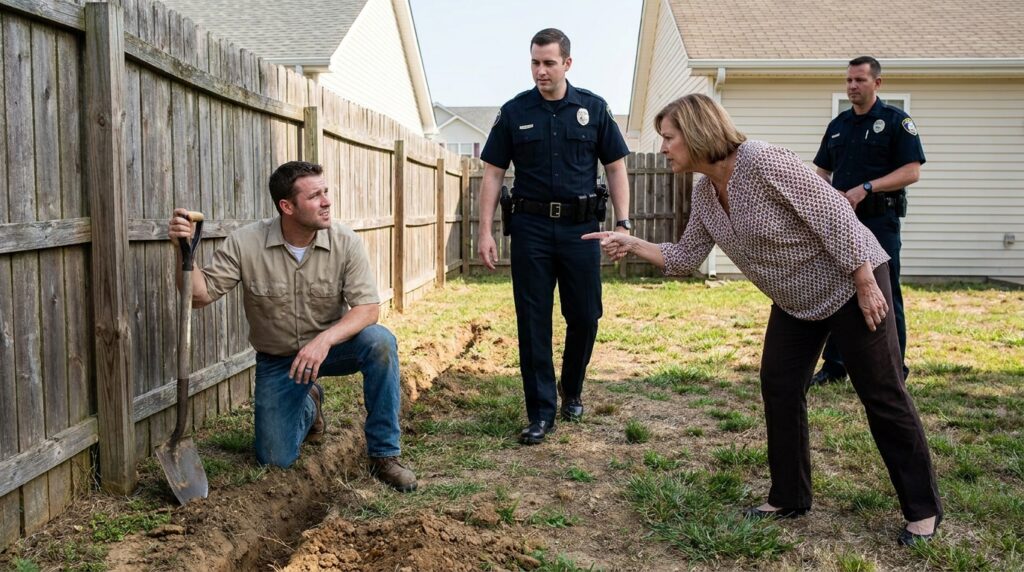
The steel spade didn’t bounce; it hit with a dead, heavy thunk that traveled up the hickory shaft and jarred Arthur’s elbows. It was the distinct sound of tempered metal striking forty-year-old structural stone.
Arthur dropped to one knee in the fresh mud of the ditch, ignoring the wet clay that soaked instantly through his denim. He scraped back a thick wedge of dark, sulfurous topsoil with his bare fingers, his nails tearing against the rough aggregate beneath. There, twelve inches below the surface and clear across the transit line, lay a massive, poured-concrete footing. It wasn’t an isolated post pad. It was a continuous, monolithic gray shelf, rough-formed and reinforced with corroded iron rebar that extended laterally out from beneath Eleanor Gable’s secondary garage wall.
“Step back from the trench, sir,” Officer Miller barked, his boots pivoting in the clover as he leaned over the property line. His hand didn’t drop to his holster, but his fingers twitched near the clip of his secondary tactical light. “Arthur, don’t clear any more of that structural mass until we establish what it’s carrying.”
“It’s carrying her wall,” Arthur said. His voice was hoarse, his lungs catching on the damp, alkaline tang of old cement dust and rotting cedar. He forced his fingers under the cold edge of the concrete shelf, feeling the absolute solidity of the encroachment. “Look at the pour marks, Officer. This isn’t a county pipe easement. The entire sub-base of her building is sitting on Lot 4.”
Eleanor didn’t move an inch away from her gravel path, but her shadow tightened. Her sunglasses caught the dull flash of the backup officer’s radio clip. She didn’t shout; her voice retained that polished, transactional weight that had kept the neighborhood compliant for three decades.
“The structural footings were stabilized during the 1978 zoning override, Officer Miller,” she said, her fingers curling around the blue folder until the plastic gave a short, sharp snap. “The architectural layout was preserved under a grandfather clause. If Arthur disrupts the earth beneath that retaining shelf, the lateral load of the masonry wall will shift toward his foundation. That’s an engineered liability.”
“There’s no clause on the deed registry, Eleanor,” Arthur muttered, his jaw locked as he stood up, using the shovel to lift his weight out of the trench. His shirt was gray with silt, the fabric stiffening across his shoulder blades. “A private building cannot sit eighteen inches across a residential pin line without a recorded variance. The city clerk would have flagged it during the permit audit.”
Miller looked down at the exposed gray stone, then back at Arthur’s blue city folder. The official silver seal on the permit was clean, its embossed borders sharp under the noon glare. The line on the plat map was a mathematically perfect vector; it didn’t curve to accommodate an over-poured slab.
“The map doesn’t show an override, Mrs. Gable,” Miller said, his boots sliding slightly on the damp grass as he moved down the fence line to inspect the angle of the garage wall. He tapped the heel of his boot against the base of the wood fence where the cedar posts were bowing under the pressure of the rising hill. “And this grade is moving. The dirt’s pushing the timber out of the ground.”
“The dirt is moving because he’s digging an illegal moat,” Eleanor shot back, her tone sharp, losing its administrative veneer completely. She cut her hand toward the backup officer. “Call the city inspector out here. Now. He’s undermining a permanent structure.”
The backup officer didn’t pull his phone. He stood at center-depth, his face expressionless under his brimmed cap, his eyes tracking a thin, zigzag fracture that ran from the exposed footing up through the first three courses of brick on Eleanor’s garage.
Arthur saw it too. The line was fresh—the interior of the crack was white and dry, free of the moss and dirt that lined the older masonry seams. His shovel hadn’t caused it; the slow, decades-long rot of the cedar fence and the unchecked discharge of the buried gray-water pipe had softened the clay under the slab until the heavy wall began to hinge on its own weight.
He took two steps along his side of the trench, his boots sinking into the black muck where the pipe was still weeping its soapy discharge. He drove the spade down once more, not to dig, but to clear a section of the old cedar fence post that had snapped off at the ground level. As the wood fell away, it revealed a second marker—a flat, bronze disk set into a square of cracked concrete, buried beneath the roots of the old oak tree.
It wasn’t a surveyor’s pin. It was an old county benchmark from 1974, and the top of the bronze disk was stamped with a single, clear warning phrase that had been struck through with a cold chisel.
Arthur reached down to touch the cold bronze, but before his hand could clear the remaining silt, a low, grinding sound vibrated through the earth beneath his feet. A tiny shower of red brick dust fell from the garage wall, settling like dried blood across the fresh gray dirt of his trench.