CHAPTER 5: THE PRECINCT AND THE PERIMETER
The grinding sound didn’t repeat, but the silence that followed was worse. A single, gray chunk of masonry mortar detached from the joint above the exposed footing, hitting the rusted cast-iron pipe below with a dry, sharp clink.
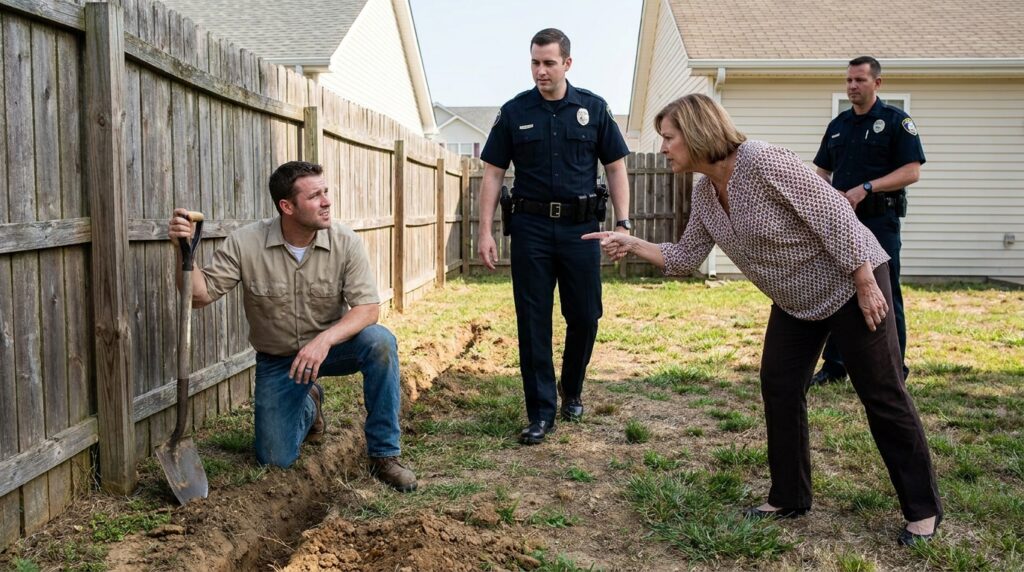
Officer Miller took two fast steps back from the trench line, his heavy service boots tearing into the clover. “Nobody touches anything,” he commanded, his voice dropping its conversational tone entirely, replaced by the flat authority of a scene commander. “Arthur, get out of the ditch. Move over to the patio lane. Now.”
Arthur didn’t pull his boots out of the muck immediately. He stayed low for three more seconds, his fingers remaining locked onto the cold, corroded edge of the 1974 county benchmark disk. The chiseled line across the bronze surface wasn’t fresh; the groove was packed tight with decades of fine, gray silt and fossilized oak root casings. Someone had intentionally defaced the marker before the subdivision’s topsoil had even been graded.
He climbed out onto the grass, the heavy clay sucking at his heels until his knees strained. His tan shirt was damp and dark across the ribs, stiffened by the sulfurous gray water that continued to leak from Eleanor’s private gray-water line.
“This whole corner is unstable, Miller,” Arthur said, wiping his palms on his jeans. The grease from the bronze disk left two metallic streaks on his thighs. “The footing is resting on expanding clay. When that pipe leaks, the ground liquefies. She isn’t just sitting over my line—she’s sliding down it.”
Eleanor Gable hadn’t moved back, but her posture had gone rigid. The blue folder was pressed so hard against her patterned blouse that the plastic corners left sharp white dimples in the fabric. Her oversized sunglasses glinted under the sun, hiding her eyes, but the thin muscles along her neck were twitching.
“The structural integrity of my property is protected under the municipal stabilization act of 1976,” she stated, though the polish in her delivery had begun to crack around the vowels. Her voice was too high, too fast. “If your unapproved digging causes a shift in the load-bearing timber, the city’s insurance pool is liable for the full replacement cost. I have the board minutes from the original development phase right here.”
She shoved the sheets of white paper toward the backup officer, but he didn’t reach for them. He was already on his radio, his shoulder mic crackling with static that cut through the hot backyard air like dry brush catching fire.
“Precinct 4, this is Delta-Two,” the backup officer muttered, his eyes never leaving the zigzag crack in Eleanor’s brickwork. “We have a civil property dispute at 414 Oak, escalating to structural compromise. Notify building code enforcement. We need a structural inspector with a transit out here within the hour. The secondary residential structure is showing active foundation failure.”
“It is not a failure!” Eleanor snapped, her sandals skittering on the loose gravel of her walkway as she took a full step toward the trench. “It’s a minor settling seam. It’s been there for twelve years!”
“It wasn’t white inside twelve minutes ago, ma’am,” Miller said, his boots planted firmly on Arthur’s side of the boundary stake. He reached into his pocket and pulled out a heavy steel tape measure, its yellow ribbon clicking sharply as he extended it from the orange surveyor’s pin directly to the face of the encroaching concrete shelf. “Eighteen inches clear over the line. No grandfather clause covers an active trespass of structural concrete, Mrs. Gable. Not without a registered easement deed signed by the current parcel holder.”
Arthur watched the numbers on the yellow tape. The steel ribbon vibrated slightly in the hot air. He wasn’t thinking about the litigation or the insurance; he was looking at the way the old cedar fence bowed out toward his kitchen window. The weight of her entire double-car garage was leaning against his property, held back by nothing more than six inches of rotted cedar posts and thirty years of silent overreach.
He moved toward his porch steps, his fingers tracking the edge of his blue city permit folder. The documents inside were clean, verified by the county registrar three weeks ago. But as he flipped past the current plat map to the historical abstract page, his thumb caught on a small, purple ink stamp from 1974 that had been partially obscured by a newer staple.
It read: Subject to unrecorded municipal charter restrictions – Volume 3, Page 89.
The words matched the blocky, old-style font stamped on the defaced bronze disk under the oak tree. The decoy was her claim of a zoning override—she had used the fake HOA notices and the old bylaws to keep him from looking down into the clay. The real secret wasn’t just the buried gutters or the leaking pipe. It was the charter itself. The entire block had been laid out on a flawed grid, and Eleanor’s husband hadn’t just over-poured a footing; he had built her legacy on land that belonged to the county’s public right-of-way.
Before Arthur could point out the purple stamp, a high-pitched, metallic snap echoed from beneath the garage floorboards. The wood fence shuddered, its top rail splitting cleanly down the middle with a sound like a pistol shot.