CHAPTER 3: THE STRATAGEM OF THE PORCH
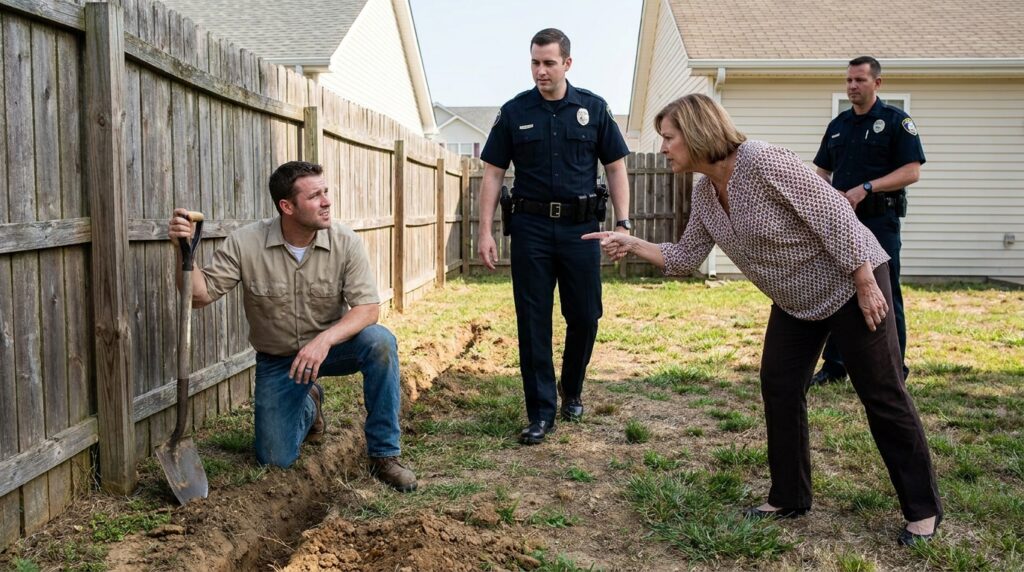
“Keep your hands right where they are on that handle, sir,” the first officer said.
The weight of his boots on the lawn was heavy, the crunch of dry clover signaling a deliberate, measured approach. He didn’t unholster his sidearm, but his right hand rested naturally against the stiff cordura nylon of his utility belt. The second officer remained three paces back, his eyes tracking the fence line, mapping the geometry of the dispute with a cold, professional squint.
Arthur didn’t let go of the ash wood. He felt the cold iron of the spade deep under the clay, a physical anchor pinning him to Lot 4. “I’m on my own property, Officer,” he said, his voice dropping into a low register that sounded like stone grinding against stone. “The county markers are right by your left heel.”
The responding officer—his badge reading Miller—didn’t look down at the bright orange cap immediately. He looked at Eleanor Gable. She had already shifted her stance, her forward lean softening into the practiced vulnerability of a citizen seeking protection. The blue folder was tucked under her elbow now, and she held a single sheets of crisp, white paper out toward the uniform.
“He’s digging up the infrastructure, Officer Miller,” Eleanor said, her tone smooth, stripped of the raw heat she had used seconds ago. “I’ve issued three separate administrative warnings regarding the shared drainage easement. He’s deliberately violating the neighborhood covenants to divert municipal water into my foundation.”
Miller took the paper, the dry cellulose crinkling under his thumb. Arthur watched the officer’s eyes track the typed lines—the formal headers, the dense, pseudolegal jargon Eleanor had spent the last three weeks pasting onto Arthur’s screen door with industrial tape.
“Arthur, is it?” Miller asked, turning his gaze back to the trench. The local uniform didn’t have a county patch, just the clean, silver insignia of the precinct. “You got a permit for this excavation?”
“On the porch steps,” Arthur said. “Blue folder. City engineering stamp is on the first page.”
The backup officer moved toward the porch, his heavy boots making the wooden steps groan as he retrieved the file. Arthur didn’t track his movement; he kept his eyes on Miller, watching the way the officer’s gaze flicked between Eleanor’s typed notice and the dark, wet hole at the bottom of the ditch where the sheared iron pipe was still weeping grey water.
The air between them felt thin, choked by the smell of the damp cedar rot and the dry, metallic tang of the rusted crescent Arthur had tossed onto the grass. Eleanor stood perfectly still, her large sunglasses masking whatever calculation was happening behind her eyes, but her fingers were tapping a silent, rapid rhythm against the blue plastic under her arm.
“Officer,” Arthur said, his hand tightening on the shovel until the wood grain bit into his calluses. “Take a look at the orientation of that cast-iron line. It doesn’t run toward the street storm drain. It angles backward, straight from her downspouts into my perimeter.”
Miller knelt, his uniform trousers taut against his knees as he leaned over the fresh edge of the trench. He didn’t mind the mud. He reached down, his gloved finger tracing the rough, flaking rim of the old conduit. When he pulled his hand back, the tip of his glove was coated in the same soapy, sulfur-smelling sludge Arthur had unearthed five minutes ago.
“This isn’t a county main,” Miller muttered, looking up at Eleanor. “This looks like a private gray-water tie-in.”
“It’s an established historical runoff path,” Eleanor corrected instantly, her voice rising slightly, losing a fraction of its administrative polish. “It was built into the plat when the subdivision was cleared in the seventies. My husband’s signatures are on the original covenant filings.”
The backup officer returned from the porch, holding Arthur’s blue folder open. He didn’t speak; he simply held it out so Miller could see the red ink of the city engineer’s layout. The map inside didn’t show an easement. It showed a clean, unencumbered boundary line, a straight black ink stroke that sliced directly through the center of the old wood fence and gave Arthur three more inches of dirt than he currently possessed.
Arthur watched Miller’s face settle into the hard, pragmatic mask of a beat cop who had seen fifty variations of the same backyard cold war. The officer stood up, brushing a fleck of dry clay from his knee, his eyes locking onto Eleanor’s folder.
“Mrs. Gable,” Miller said, his voice dropping the polite deference. “We need to look at your original deed registration. Because right now, this city permit says your drainage system is sitting eighteen inches deep inside this man’s lot.”
Eleanor didn’t flinch. She pulled her shoulders back, her jaw locking as she gripped the blue folder until the plastic bent. “The city didn’t audit the historical charters, Officer. If he keeps digging that trench, he’s going to unearth the structural footings for my entire secondary garage lane. And I assure you, nobody wants to see what happens when that shifts.”
Arthur felt a sudden, cold weight drop into his stomach. He looked past her, toward the massive brick-and-timber garage lane that sat at the high point of her slope. The structure was old, its foundation laid long before he bought Lot 4. He had always assumed the building stopped right at the edge of the cedar fence. But looking at the curve of the old oak tree and the angle of the weeping iron pipe, he realized the concrete slab under her garage didn’t stop at the boundary line at all. It was buried deep under his grass.