CHAPTER 2: THE ANATOMY OF A TRESPASS
The iron fragment didn’t want to leave the clay. Arthur kept his boot jammed onto the shoulder of the spade, his weight leaning forward until the ash handle creaked under the strain. Beneath the top layer of scorched fescue, the earth was hard as brick, packed tight by thirty years of residential settling and the rhythmic, daily vibrations of Eleanor Gable’s industrial-sized pool pump across the line.
With a dull, scraping groan, the spade dislodged the metallic chunk. It flipped over into the fresh trench, a jagged, semicircular crescent covered in red flaking rust and wet mud. The scrap of yellow caution tape attached to it was brittle, tearing into flakes between Arthur’s dirty fingers. It wasn’t standard utility marking. The font was tight, blocky, and old—the kind of marking municipal crews used before the county consolidated its records in the late seventies.
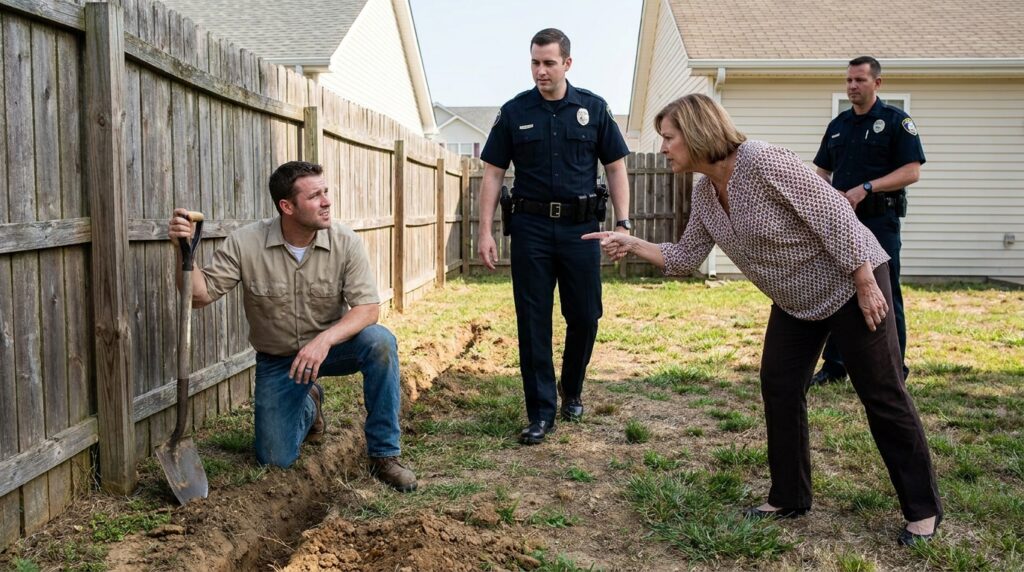
“You’re destroying the structural grade,” Eleanor said, her voice dropping from the property edge like an anvil. She hadn’t moved an inch back toward her patio. Her shadow, elongated by the early afternoon sun, stretched directly across the shallow ditch, cutting right over Arthur’s boots. “That iron is part of the original drainage foundation. If you pull that out, you’re responsible for the collapse of the northern retaining slope.”
Arthur didn’t answer. He picked up the heavy iron piece, the weight of it surprisingly dense for its size. The rust came off on his palm in a gritty, orange smear that smelled sharply of stagnant water and deep-earth decay. It was a section of a five-inch cast-iron pipe, the rim sheared off cleanly by a mechanical force that had happened decades ago. Beneath it, inside the dark pocket where the iron had rested, the soil wasn’t dry clay. It was black, slimy muck, smelling faintly of sulfur and laundry detergent.
He looked at the orange surveyor’s stake three feet away. The pine was dry and clean. The transit line didn’t lie; the county pin was absolute. But this pipe was running parallel to the fence, fully eighteen inches inside his legal boundary, and it was actively leaking.
“The grade is already gone, Eleanor,” Arthur said. He tossed the iron piece onto his side of the grass with a heavy, hollow thud. He didn’t look at her sunglasses; he kept his eyes on the wet pocket of earth. “This line is discharging into my lawn. It’s been doing it long enough to rot the cedar from the bottom up.”
“That’s an existing easement by prescription,” she countered instantly. She took half a step forward, her leather sandals stopping exactly where the clover met the fresh dirt ridge. She held the blue plastic folder tighter against her chest, her knuckles turning the same chalky white as the trim on her house. “My property has held open and notorious use of that drainage line since before you signed your deed. You touch that line, and it’s a civil tort. I have the injunction template ready to file.”
Arthur stood up straight, using the shovel as a crutch to ease the ache in his lower back. He wiped the sweat from his forehead with his forearm, leaving a dark streak of soil across his brow. He didn’t know about prescriptive easements, but he knew the weight of his mortgage, and he knew the city building code folder sitting on his porch stairs had an official, raised silver seal on the cover.
He could see her calculation in the way her jaw remained clamped shut between sentences. She wasn’t just angry about a visual blemish on her perfect perimeter; she was defending the pipe. Her house sat higher on the ridge, its pristine white vinyl siding reflecting the harsh sun like a mirror, but somewhere beneath that manicured lawn, her gray-water system was taking a shortcut through his dirt.
“The county pin says this is Lot 4,” Arthur said, his voice dropping into the quiet, rhythmic tone of a man who worked with tools. “Lot 4 doesn’t have an easement listed on the title report. I checked before I started digging.”
“Title companies miss unrecorded historical infrastructure all the time,” Eleanor said, her chin tilting up. “My husband was on the zoning board when this plat was laid out. We know exactly where the authority sits, Arthur. You’re playing with things you don’t understand.”
He noticed then a slight discrepancy in the fence line itself. Three yards down, where the old cedar posts met a massive, knotty oak tree, the wood didn’t follow a straight line. It dipped slightly inward toward his house, an intentional curve that looked like it had been built to dodge something buried beneath the roots.
Before he could drive the shovel back into the clay to trace the pipe further, the low, distinct crunch of tires on the gravel driveway at the front of the house broke the backyard silence. A low, electronic chirp echoed between the houses—the short, professional squawk of a municipal radio.
Eleanor’s shoulders dropped just a fraction of an inch, a subtle relaxation of her defensive posture that felt entirely victory-coded. “That will be the local precinct,” she said, her finger pointing back toward the side gate. “I told them you were altering the municipal runoff line without a supervisor present.”
Arthur didn’t drop the shovel. He kept his fingers locked around the ash handle, his boots planted firmly in the fresh trench as the heavy side gate clicked open and the shadow of two local officers fell across the dry grass.