
CHAPTER 5: THE LAST ALIGNMENT
The diesel exhaust from the yellow loader hung like a low, greasy ceiling over the mouth of the alley. It was 4:55 PM. The sky between the brick buildings had gone the color of a wet slate shingle, cold and desaturated, pressing down on the damp corridor until the air felt thick enough to choke on.
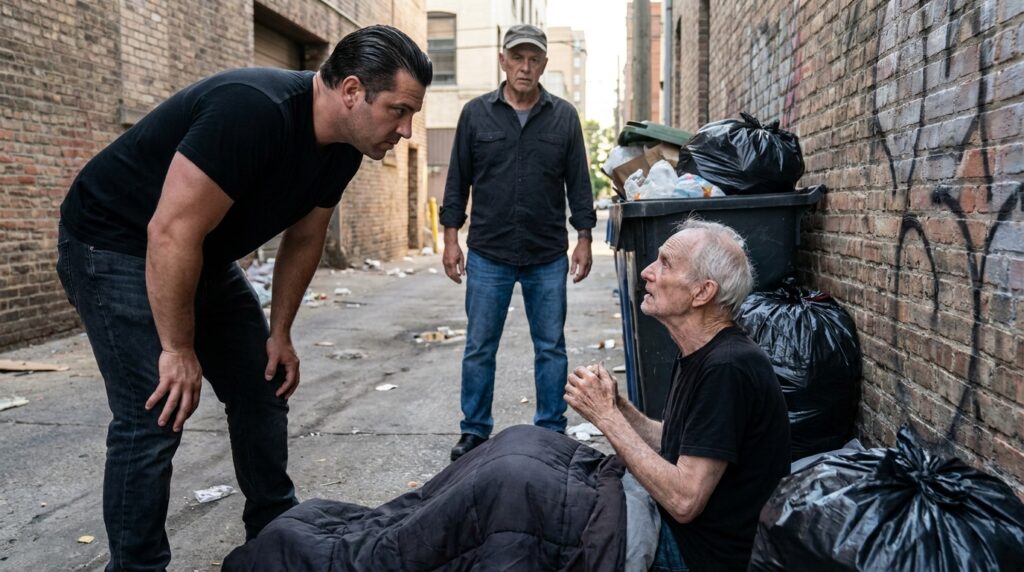
Isaiah hadn’t moved. He sat on his bundle of canvas, his back pinned against the flaking brick, his wool coat pulled tight around his knees. His root-like fingers were still inside his pocket, but the click-clack of the radiator key had stopped. He was just holding it now, a fixed point of old brass in a world that was turning into iron and ash.
Miller came down the center lane alone. His work boots didn’t feel ground into the asphalt anymore; they felt like lead weights, dragging through the silt. He didn’t have his tools. His hands were tucked deep into his canvas coat, his fingers clamped around the yellow carbon paper he had ripped from the construction office ledger. The paper was dry, whispering against his palms like an old ghost trying to find its tongue.
The loader crawled to the lip of the passage, its iron tracks grinding over the curb with a high, metallic shriek that echoed off the fire escapes. Vance walked beside the steel bucket, his hand resting carelessly on the hydraulic arm. Behind him, three city marshals stood with their hands hooked into their tactical vests, their faces empty under the shadows of their caps.
“Five minutes, Miller,” Vance called out, his voice sharp against the rumble of the engine. “The sheriff’s deputy logged the easement papers. The machine doesn’t wait on two old men who don’t know when a building is dead.”
Miller didn’t answer Vance. He stopped three feet in front of Isaiah, his shadow falling across the old man’s knees. He pulled his right hand out of his coat pocket, holding the yellow carbon voucher out between them. The paper trembled in the cold draft pulled by the loader’s radiator fan.
“I found the book, Isaiah,” Miller said. The words came out slow, dry, scraping his throat like sand. “The real one. The internal ledger from ninety-six.”
Isaiah looked at the paper, his watery eyes reflecting the yellow glare of the loader’s headlamps. He didn’t reach for it. He didn’t even look surprised. He just let out a small, raspy breath that smelled of old tea and dry bread. “I told you not to look under the cloth, Miller.”
“It has my name on it,” Miller whispered. The engine behind him roared as the driver tapped the throttle, a cloud of black soot settling over his gray hair. “I took the twelve thousand. I cleared my markers with the developers on Fourth. I told myself you’d be dead or gone before they ever built the clinic, and I signed your name on the clearance line.”
The silence that followed was wider than the alley. It wasn’t the silence of peace; it was the heavy, dead space that comes after a structural pillar shears through its core.
Isaiah slowly drew his hand out of his wool pocket. He held up the old brass radiator valve key, its square tip worn round from thirty years of his skin friction. He didn’t point it like a weapon; he just held it in the space between his chest and Miller’s chest, a tiny piece of the city’s old bone.
“I knew the night you signed it, Miller,” the old man said softly, his voice cutting clean through the low thrum of the diesel engine. “The builder’s office clerk was my cousin. He saw your name on the voucher before the fire took the building. He came down here and told me I was sold.”
Miller’s knees buckled a fraction, his hand dropping the yellow paper. It didn’t fly away; it fell into the greasy puddle by the iron trap, the purple ink beginning to blur and run into the black water. “You knew? For thirty years, you sat in this dirt and let me bring you blankets? Let me play the protector while you had the forge-mark right in your pocket?”
“A neighborhood doesn’t survive on clean hands, Miller,” Isaiah said, his eyes finally rising to meet Miller’s face. “It survives on who stays when the walls come down. You stayed. You built the retaining walls on Third. You fixed the fire escape when the city stopped sending inspectors. You thought you were paying off a debt to a ghost, but you were just keeping the brick from falling on the kids who live on the block now. If you hadn’t been carrying that sin around like a lead block, you’d have left this district for the suburbs twenty years ago like the rest of the builders.”
“Miller! Get out of the bucket path!” Vance shouted, his boot heel striking the iron track of the loader. The driver raised the hydraulic lift, the steel edge of the bucket rising to the height of Miller’s chest, its teeth caked with dried gray mortar.
Miller didn’t move back. He stood between the machine and the old man’s blankets, his spine straightening until he felt the cold draft of the radiator hitting his neck. He reached down, picked up the wet, oil-soaked yellow paper from the puddle, and stuffed it into the iron grease trap beside his boot, shoving it down into the dark mud until it was gone.
“The easement is still occupied, Vance,” Miller said, his voice coming back strong, the gravel in it turning to solid stone. He didn’t look at the marshals. He looked straight into the enforcer’s eyes, using the predatory calculations he had spent a lifetime learning. “You tell the board that if they want to clear this corridor, they’re going to have to file a structural variance for my body along with his. I designed the foundations for the three buildings connected to this wall. If I draw the city inspector down here to look at the structural shift from your tractor, this whole block gets quarantined for six months before you can pour a pint of concrete.”
Vance’s face hardened, the skin around his jaw turning the color of old lard. He looked at the marshals, then back at Miller’s empty, calloused hands. The tractor idled, its black smoke curling around the fire escapes like a shroud, but the bucket stayed up, frozen in the narrow lane between the past and the machine.
The whistle at the yard on Fourth blew five times, its long, mechanical wail trailing off into the cold slate sky, but the alignment remained blocked, held by two men who shared a sin that was older than the asphalt beneath them.








