
CHAPTER 2: THE ANATOMY OF AN ANCHOR
“What did he mean by the ledger, Isaiah?”
Miller’s voice didn’t rise, but it had the stiff, dry rattle of iron filings sliding down an old chute. He stayed where he was, his boots pinned to the edge of the shadow where Vance’s footprint still dented the dust. The noon sun had moved a fraction of an inch, just enough to strike the rusted lip of a heavy iron grease trap set into the brickwork. It smelled of rancid lard and decades of rainwater.
The old man didn’t look up. His thumb kept working the brass radiator key inside his pocket, the click-clack slower now, heavier, like the mechanical timing of a clock losing its mainspring. “Vance speaks for the people who pay him, Miller. He always did. Even when he was ten years old stealing copper pipes out of the basement of the old Saint Jude’s.”
“He had the black book,” Miller said, taking one slow, deliberate step forward. The leather of his boots creaked against the grit. “The water works log. The one from the year the grid was redrawn. Nobody’s supposed to have that. The city records clerk told me it was turned to gray ash when the main office went up.”
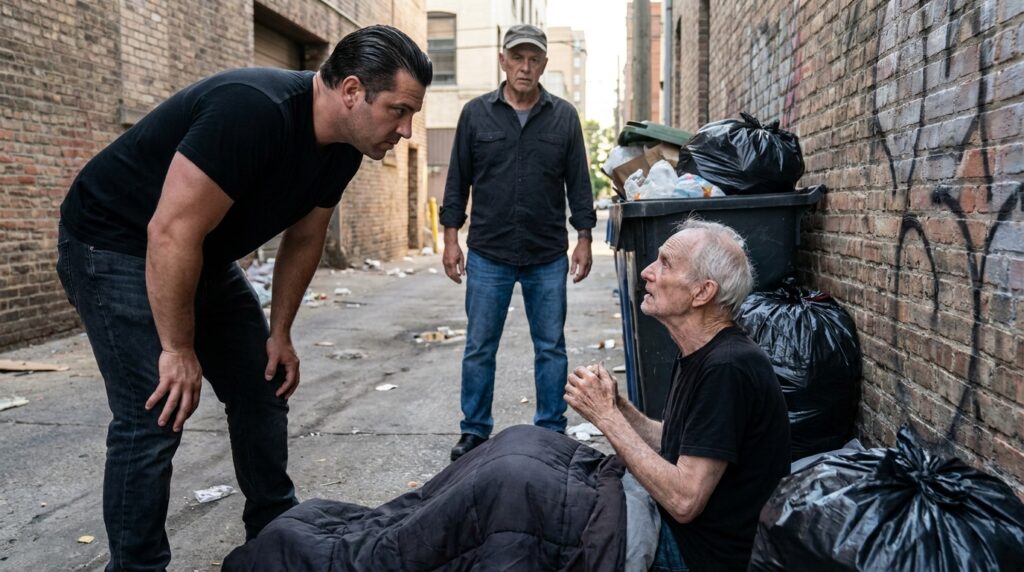
Isaiah finally stopped his hand. He drew his fingers out of his coat pocket, leaving the brass key hidden inside the wool. His palm was stained a dark, metallic orange—the fine, oily rust that lives inside seventy-year-old steam pipes. He laid both hands flat against the top of the canvas bundle he sat on. The fabric was coarse, the color of weathered river stone, but beneath the gray grime, a stiff, dark outline square showed through the weave. It was the distinct, rigid shape of a binding.
“A city doesn’t burn everything when it fires a building,” Isaiah muttered, his eyes fixed on Miller’s work shirtsleeves, where the faded blue cotton was worn white at the elbows. “Some things get carried out the back door while the smoke is keeping everyone looking at the front. You know that better than most, Miller.”
Miller felt a sudden, cold prickle of sweat break across his shoulder blades, despite the heavy heat trapped between the brick walls. He reached out, his thick fingers grasping the edge of a rusted iron fire escape ladder to steady himself. The metal was rough under his skin, flakes of old brown paint peeling off like scabbed skin. “Let me see what’s under the canvas.”
“No.”
The word wasn’t a challenge; it was a simple statement of fact, solid as a structural column. The old man shifted his weight, his thin frame pressing harder against the bundle. “If you touch this cloth, Miller, you’re opening an account you can’t pay back. You think you’re standing in this alley because you’re a good man protecting an old neighbor. You like the weight of that harness. But you forgot who built the stable.”
Miller’s jaw tightened until the old scar beneath his ear pulled white. “Vance is coming back at five with the eviction crew. He’s got the district signatures. If I don’t know what he’s holding against you, I can’t block the tractor when it turns the corner.”
“He isn’t holding anything against me,” Isaiah said softly. He reached down and pulled the edge of his oversized wool coat down, covering the canvas shape completely. “He’s holding it against the land. Go down to the old pump house on Third. The one with the boarded-up archways. Vance’s uncle kept the old maintenance logs there before the county split the water district. If Vance has the black book, he got it from the dry well under the floorboards.”
Miller let go of the fire escape ladder. His palm left a clean, pale print in the red-brown rust of the iron rail. The subtext between them was a physical pressure now, a shared history that neither man wanted to drag into the noon light because both knew how much rot it would show.
“The pump house was locked up by the city marshal three years ago,” Miller said, his eyes narrowing as he calculated the distance to Third Street. “The structural timbers are gone. The whole roof is dropped into the basement.”
“The side door still has the old drop-bolt,” Isaiah replied, his voice slipping back into that raspy, dry whistle. “The one you put on it yourself when we were trying to keep the scrap iron thieves from lifting the copper meters. If you still have the touch for your own iron, you can get in before Vance sends his boys to clear my blankets.”
Miller turned without another word, the friction of his boots against the asphalt sounding like teeth grinding in the silence. He didn’t look back to see if Isaiah was watching him. He kept his eyes on the narrow strip of gray sky at the end of the corridor, his mind running through the old municipal maps he had tried to forget for thirty years. Every step he took away from the old man felt heavier, his boots dragging through the invisible dust of a neighborhood that was being ground into gravel beneath their feet.
The street outside the alley was blinding after the brick shadow. The air smelled of hot tar and gasoline from the delivery trucks idling along the curb. Miller pulled his cap down low over his eyes, his hand sinking into his pocket to find his own keys. His fingers brushed against an old brass ring, the metal cold against his skin, carrying the specific, unforgettable weight of an iron drop-bolt key he hadn’t used since the winter the city changed its name.








