
CHAPTER 3: THE NIGHT VISIT
“You shouldn’t have come here, kid.”
Arthur didn’t pull his hands out of the sink. The well water was ice-cold, running over a split engine block gasket he was cleaning with an old wire brush. The smell of kerosene and well water filled the narrow space of the trailer, thick enough to compete with the musk of wood rot behind the baseboards.
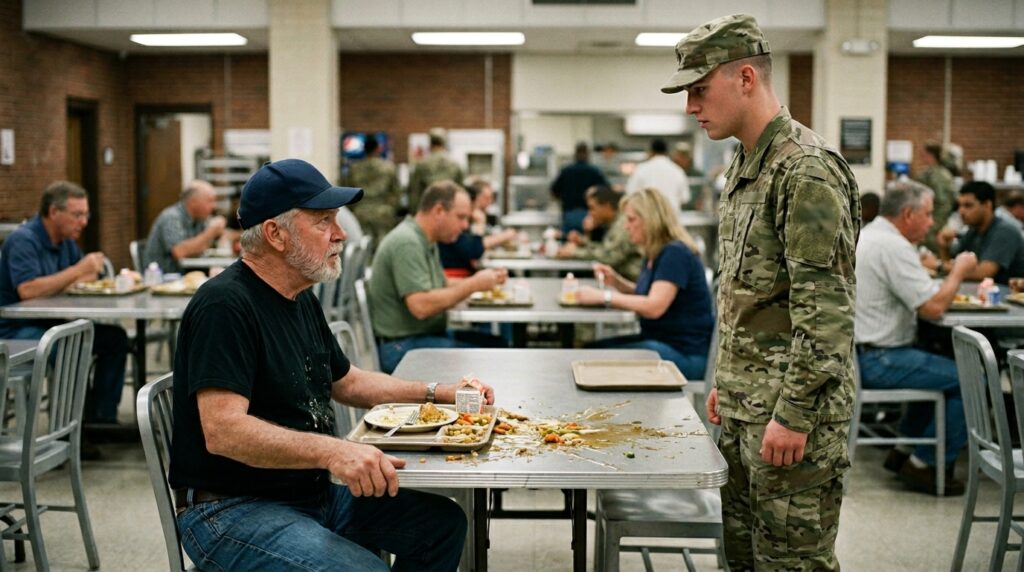
Vance stood in the doorway, his silhouette cutting off the pale moon-glow that managed to penetrate the rusted screen. He had stripped off his camouflage blouse; now he just wore the olive-drab undershirt, dark with sweat at the collar, and his grease-streaked trousers. In his left hand, he held Arthur’s faded navy cap. The cloth had been rinsed, but the stiff salt outline of the cafeteria chili remained like a scar across the brim.
“You dropped this when you hit me,” Vance said. His voice lacked the cafeteria’s edge. Without the battalion watching, he sounded like what he was—a twenty-two-year-old kid from an Ohio coal town who was realizing the machinery he signed up to fix had teeth. “And you left your tailgate down. A man from the scrap yard could lose his tools that way.”
Arthur shut off the tap. The pipe rattled in the drywall with a dry, shuddering thump. He took a grease-blackened rag from the counter and wiped his hands slowly, focusing on the rough skin around his knuckles where the hair had been scarred away by a battery explosion twenty years ago.
“The tools on my truck stay where I put them,” Arthur said, turning around. He didn’t offer the boy a seat. The trailer didn’t have many—just a single vinyl bench that served as his kitchen table and his workbench. On the formica surface lay an old grease-gun and three five-pointed brass nuts that matched the spanner wrench from Vance’s bag. “Why are you here, Vance?”
The boy stepped into the room, the floorboards groaning under his combat boots. He laid the cap down on the edge of the sink, his fingers lingering on the faded fabric.
“My unit commander came down to the MP station after they let you go,” Vance said quietly. He kept his eyes on the floor, tracking the dark trails of iron dust Arthur had tracked in from the salvage yard. “He didn’t ask about the fight. He didn’t ask if I was hurt. He wanted to know if you looked into my bag. He wanted to know if we talked before the tray went over.”
Arthur picked up the grease-blackened rag again, rolling it into a tight cylinder between his palms. “And what did you tell him?”
“I told him it was just an old man with a bad temper.” Vance looked up then, his eyes wide and hollow under the single yellow bulb hanging from the ceiling. “But he didn’t care about that. He had a file on his clipboard, Miller. A real old one. It had the red flag-tags on the corner—the kind they use when an inventory line goes missing from the reserve stocks. He said if you came within five hundred yards of the sector four perimeter again, the gate guards aren’t supposed to call the local cops. They’re supposed to detain you under an internal logistics warrant.”
Arthur felt his chest tighten, an old, familiar sensation that had nothing to do with age. It was the feeling of the wire drawing close. He looked at the window behind the sink. Out in the dark scrub, three miles past his property line, the silhouette of the ridge cut a black tooth against the stars. Below that ridge lay the entrance to the old Cold War ammunition depot—a place that was supposed to be filled with dry sand and concrete aggregate thirty years ago.
“The captain’s an engineer,” Arthur said, his voice dropping into the low register he used when calculating the tolerances on a heavy crane lift. “He don’t have the clearance for an internal warrant. Not unless someone at the supply depot gave it to him.”
“He had the wrench’s serial number on his desk, too,” Vance muttered. He reached into his pocket and pulled out the five-pointed brass tool, setting it down next to the nuts on Arthur’s table with a heavy, metallic clink. “They’re clearing out the lower cells under sector four. They told us it was a routine decommissioning—just pulling out old copper lines and zinc plates. But they’re moving the crates at night, Miller. Heavy crates. The kind that require the old three-ton hydraulic lifts. And they’re using our logistics manifests to log them out as scrap iron.”
Arthur walked over to the table. His thumb brushed the rusted surface of the brass tool, feeling the cold, greasy residue of preservation compound. This wasn’t scrap. It was active ordnance storage equipment, preserved in cosmoline.
“They’re using your battalion to clean the house before the inspectors come from the district office,” Arthur said, his mind clicking through the logic like an old accounting machine. “They give you a fake manifest, you haul the crates to the commercial railhead, and when the audit happens, the missing inventory gets blamed on a Cold War discrepancy.”
“But why you?” Vance asked, his voice rising slightly before he checked himself, looking toward the dark screen door. “Why did the captain have your name flagged? He told the MPs you were discharged back in ’78 for black-market diversion. He said you were part of an old ring that stole fuel bladders from the depot.”
Arthur laughed—a short, dry sound that had no humor in it. He reached into his pocket and pulled out the rusted Zippo, his thumb flicking the wheel until the flame lit the deep lines around his mouth.
“In ’78, kid, I was the only sergeant who wouldn’t sign the delivery receipts for fuel that never arrived at the line,” Arthur said. “They didn’t discharge me. They put me in a room with three officers from the logistics branch and told me my file was being archived under a classified quarantine. They told me if I stayed in this county and kept my mouth shut about the empty tanks, my pension would hit the bank every first of the month. If I talked, the file would become a dishonorable discharge for theft.”
He clicked the Zippo shut, the dark settling back into the corners of the kitchen.
“The file your captain’s holding is the lie they built thirty years ago to keep me on the porch,” Arthur said, his hand closing around the brass spanner wrench. “And now they’re using it again because they’re doing the exact same thing they did back then. Only this time, they’re using your name on the modern electronic manifests.”
Vance went pale, his hand dropping away from his pocket. “I signed the digital logs for three trailers yesterday afternoon. They told me it was just old zinc casing panels.”
“You signed for whatever’s inside those bunkers,” Arthur said, stepping toward the door. “Which means when the audit line goes red, you’re the one who goes to the brig, not your captain.”
Before Vance could answer, the gravel road leading up to the trailer groaned. The sound of a heavy vehicle, its headlights doused, running over the dry washboard ruts at the edge of the property line, rattled the small tin windowpane above the stove.
Arthur caught Vance by the shoulder, his grip like an old iron clamp, pulling the boy away from the center of the room.








