
CHAPTER 2: THE PERIMETER LINES
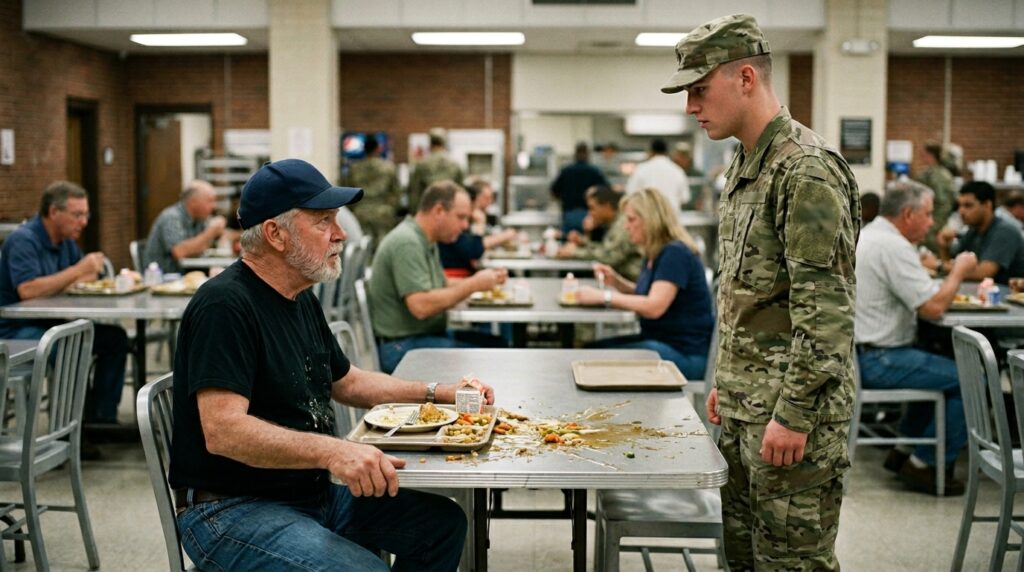
The heel of the MP’s black leather boot caught the edge of the service tray Arthur had upended, sending a half-eaten loaf of cornbread skittering across the grease-filmed tile.
“Hands where I can see them. Old man, get off him now.”
The voice was young but trained to mimic the blunt, flat bark of a drill instructor. Arthur didn’t snap his head around. He let his weight linger for one more breath on Vance’s ribcage, feeling the boy’s shallow, terrified inhalations rattle against his own shin. He slowly rolled his weight off the soldier, his left knee popping with a sound like a dry branch snapping underfoot. The floor was cold through his worn jeans, slick with spilled grease and the wet, gray grit tracked in from the motor pool outside.
Arthur rose by sections, his spine stiffening until his weathered build reached its full six-foot frame. He didn’t raise his hands like a captive; he simply turned them palms-out at his sides, the flaking rust-colored oil stains from his morning shift at the salvage yard embedded deep within the creases of his palms.
Two military policemen stood in the aisle, their nylon duty belts creaking with the weight of plastic handcuffs, heavy radio blocks, and black steel batons. The lead investigator, a corporal with a face like an unbaked biscuit, had his hand hovered over his holster.
“Step back from the soldier,” the corporal ordered, his boots crunching on the dry salt crystals scattered near the entryway.
Arthur looked past him. The entire cafeteria had become a gallery of silent, watching faces—hundreds of young men and women in identical digital patterns, their eyes shifting between Arthur’s faded navy cap, which lay ruined in a pool of congealing chili, and the dark, wet grease stain covering the chest of his black shirt.
“The boy dropped his tray,” Arthur said. His voice was low, carrying the vibration of a low-idle diesel engine. “He needs to learn how to carry his load.”
Vance scrambled to his feet behind Arthur, his breath coming in ragged, whistling gasps. He didn’t look at Arthur. He was frantically tucking his olive-drab undershirt back into his trousers, his hands shaking so violently he missed the belt loop twice.
“Sir, he… he just came at me,” Vance muttered, his voice cracking as he looked at his peers. The shame was setting in now, thicker than the fear. A private first class pinned by a gray-bearded civilian in front of the third battalion was a career-killing stigma.
“Shut up, Vance,” the corporal snapped. He looked at Arthur, his eyes lingering on the thick, square set of the old man’s shoulders and the distinct, deliberate spacing of his feet—a classic defensive stance that no civilian factory ever taught. “We know who you are, old-timer. You’re Arthur Vance—no, wait. Arthur’s the name on the truck out front. You’re Miller, aren’t you? The one from the scrap yard near the old ammunition dump.”
Arthur didn’t give him the satisfaction of a blink. “The name’s on the registration.”
“Yeah, well, the base commander’s got a standing order about off-base personnel creating disruptions inside the perimeter,” the corporal said, his hand finally dropping away from his weapon as he realized Arthur wasn’t going to lunge. He reached into his pocket and pulled out a pair of heavy plastic flex-cuffs. “We’re going to take a walk down to the gate house until we get this cleared up.”
“You aren’t putting those on me,” Arthur said. The words weren’t a threat; they were a statement of property. He looked down at the corporal’s boots. The leather was too shiny, synthetic. It didn’t have the deep, oil-soaked smell of real hide. “I’m walking out the same way I came in. On my own leather.”
The second MP, older, with three stripes on his sleeve and a face lined by two tours in the desert, placed a hand on the corporal’s shoulder. He looked at Arthur’s hands, then at the faded navy anchor logo stamped on the rusted Zippo protruding from Arthur’s pocket.
“Let him walk, Corporal,” the sergeant said quietly. “He’s going to his truck. We’ll follow him to the line.” He turned his eyes directly to Arthur. “But you don’t come back inside this gate, Miller. Not for the cafeteria, not for the commissary. You’re done using the base facilities. Consider yourself barred.”
Arthur reached down, his fingers brushing the wet tile as he retrieved his cap. He didn’t bother shaking the chili from the brim; he just gripped it by the crown, the wet cloth heavy and cold against his thumb. As he turned to leave, his boot brushed against Vance’s unzipped canvas kit bag, which had tumbled from the bench during the scuffle.
Through the gap in the nylon zipper, something caught the light. It wasn’t the standard-issue aluminum flashlight or the olive-drab cleaning kit. It was a heavy, five-pointed brass spanner wrench, its surface covered in thick, green oxidation, stamped with a specific eight-digit serial number that Arthur hadn’t seen since the winter of 1974 at the nuclear storage depot.
Arthur’s eyes narrowed, his internal calculation shifting gears instantly. That wrench didn’t belong to a modern transport unit. It was an ordnance tool for high-yield casing bolts—something that shouldn’t exist on an active active-duty logistics base in 2026 unless someone was digging into the old cold-war subterranean bunkers near the ridge.
He looked up at Vance. The boy was staring at the open bag, his face turning an unwholesome shade of gray. He quickly kicked the bag shut with his boot, but the metallic clink of the brass tool against his canteen was unmistakable.
“Movin’ along, Miller,” the sergeant warned, his hand guiding Arthur toward the exit.
Arthur walked out through the double glass doors, the heavy, humid air of the southern afternoon hitting him like a wet wool blanket. The gravel parking lot was filled with the glare of windshields under a desaturated sky. Fifty yards away, his sixty-nine Ford pickup sat like an island of flaking blue paint and pitted chrome among rows of aerodynamic plastic sedans.
He could hear the MPs behind him, their radios spitting static and code strings into the heat. He didn’t look back until his hand closed around the pitted iron door handle of his truck. The metal was hot enough to sting, the latch releasing with a dry, ungreased groan that echoed across the asphalt.
He climbed into the cab, the cracked vinyl seat whistling as it compressed under his weight. He threw the ruined navy cap onto the floorboards and pulled the Zippo from his pocket, his thumb rolling the flint wheel until the yellow flame danced in the stagnant air. The smell of lighter fluid didn’t mask the smell of the cafeteria grease on his shirt.
Through the rearview mirror, he watched the MP cruiser pull up behind him, its roof lights remaining dark but its engine idling with a low, predatory purr. They weren’t arresting him. They were herding him.
Arthur turned the key. The starter ground three times, a harsh, metal-on-metal screech, before the big V8 caught, clearing its throat with a plume of blue smoke that settled over the gravel. He shifted into reverse, the transmission clunking with the heavy, unyielding resistance of an old machine that refused to die.
As he backed out, he saw Vance standing by the cafeteria doors, his kit bag slung over his shoulder, watching the truck with an expression that wasn’t anger. It was the look of a man who had just realized he was holding a live shell with a short fuse.
Arthur turned the wheel, pointing the truck’s rusted nose toward the perimeter fence where the highway ran north into the dry, red-dirt scrub. The real trouble wasn’t the spilled food or the barred access. The trouble was that five-pointed wrench. Someone was reopening the holes in the ground that Arthur had spent thirty years trying to forget, and they were using kids like Vance to do the digging.








