
CHAPTER 1: THE FRICTION OF METALS
“Pick it up.”
The gravel in Arthur’s voice didn’t just scrape; it carried the weight of a thirty-year burial.
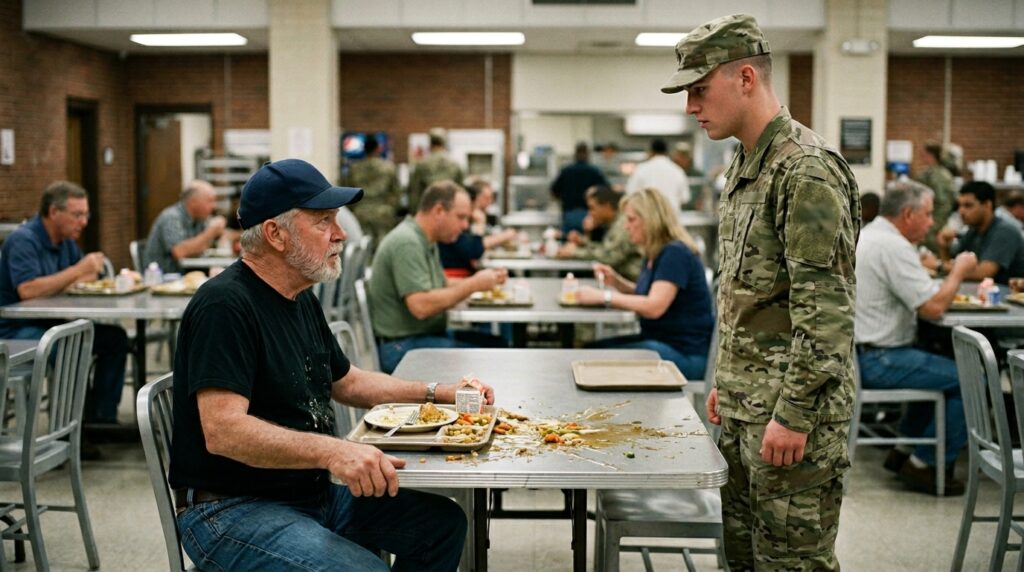
The kid didn’t move. He stood there in his pristine digital camouflage, the fabric stiff and smelling of unwashed warehouse starch, his patrol cap perfectly aligned two inches above his brow. On his tray, the plastic bowl of institutional chili had flipped cleanly, painting the chest of Arthur’s black cotton shirt in an ugly, greasy smear. The smell of scorched onions and wet tin rose between them, mixing with the sharp bleach odor of the cafeteria floor.
Around them, the low hum of five hundred active-duty soldiers scraping forks against plastic trays slowed down. A fork dropped onto a laminate table four rows over with a distinct, ringing chime.
“I said,” Arthur repeated, his fingers tightening against the lip of the formica table until the yellowing skin over his knuckles turned the color of lard, “pick it up, son.”
“It was an accident, sir,” the boy said. His voice was too loud, defensive in the way only a private first class with six months off the bus could manage. He looked around for an audience, his boots shifting on the wet tile. “The floor’s slick. You don’t need to—”
Arthur didn’t wait for the rest of the sentence. The modern army taught these kids how to read spreadsheets and grease the tracks of transport vehicles that cost more than Arthur’s hometown. They didn’t teach them about the weight of a hand that had spent three winters clearing bunkers with nothing but an entrenching tool and a short-barreled Colt.
The table didn’t slide; it lifted. Arthur rose with a dry, mechanical hitch in his left hip—the old shrapnel wound from Hue groaning against the sudden leverage. His faded navy cap tumbled off his gray hair, hitting the spilled chili with a soft thud.
The young service member’s eyes widened, his hand dropping instinctively toward a hip that held nothing but a nylon webbing belt.
Arthur closed the distance before the kid could chamber air. His left hand caught the stiff collar of the digital blouse, twisting the fabric until the boy’s throat met the brass eyelets of his own dog tags. With his right, Arthur hooked the back of the kid’s knee—a movement so ancient, so buried beneath decades of cheap beer and factory shifts, that it felt less like a thought and more like an old engine catching spark after a frost.
The impact was heavy. The kid’s back hit the industrial tile with a hollow, wet slap that knocked the breath clean out of his lungs.
In a fraction of a second, Arthur was down, his sixty-eight-year-old frame settling like a sack of iron ore across the boy’s ribs. His right forearm pinned the soldier’s throat, pressing just hard enough against the carotid artery to make the world blur at the edges.
“You should have left well alone,” Arthur hissed. The heat of his own breath bounced off the clean, shaven jawline of the boy beneath him. “You think that uniform makes you heavy? I’ve buried men twice your size in dirt that didn’t have a name.”
The kid’s fingers clawed at Arthur’s thick, calloused wrists—the skin there split from years of turning wrenches on diesel combines. But the grip didn’t break. The boy’s chest heaved, his eyes rolling back slightly until they locked onto Arthur’s. The arrogance was gone. In its place was the cold, white terror of a horse that had smelled the slaughterhouse.
“Sir,” the boy choked out, his chest collapsing under the old man’s unyielding mass. “Sir… apology. My fault.”
Arthur stared down at the smooth face, the pristine skin that had never seen a sun that wasn’t monitored by an air-conditioned command tent. The silence in the dining facility was absolute now. The entire room had frozen into a landscape of green cloth and pale faces.
Arthur felt the small, sharp edge of his Zippo lighter pressing into his thigh from his front pocket. The metal was hot against his skin. He looked down at the boy’s nametag, stitched in neat black thread: VANCE.
Then, from the double doors near the scullery, the sharp click-clack of high-gloss lowquarters began to accelerate toward them.
Arthur didn’t look up. He let his forearm sink a millimeter deeper into Vance’s throat, catching the sudden, frantic tremor in the boy’s pulse.
“Don’t look at them,” Arthur whispered, his voice dropping below the register of the approaching boots. “Look at me. You remember this smell. Because the next time you drop something in front of me, I won’t just take the floor.”
In the corner of his eye, the silver reflection of an MP’s badge caught the fluorescent light, turning the world the color of old tin.








