CHAPTER 6: THE TRUE RECORD LOCKED
“Look at the screen, ma’am,” Vance said.
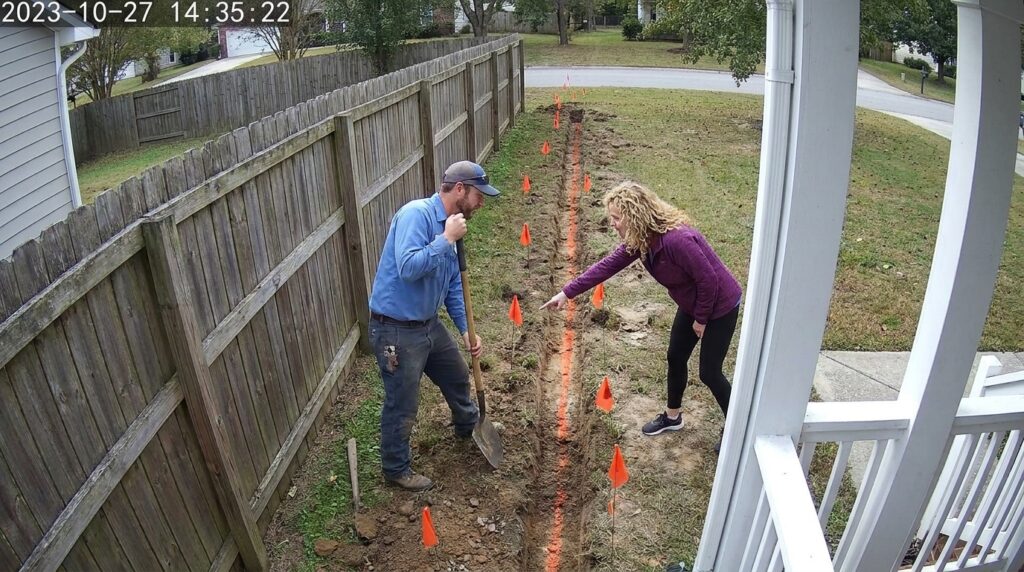
His voice didn’t carry the high pitch of an accusation. It had the heavy, flat finality of a court reporter reading a deposition back into a silent room. He didn’t point the tablet at her face; he held the ruggedized casing flat, three inches above the freshly cleared dirt where the brass cap sat embedded in its ring of wet, white hydraulic cement. On the glass, the green infrastructure line didn’t bend. It cut straight through the middle of the red brick pavers on the other side of the fence, splitting her third-tier terrace completely in half.
The neighbor didn’t look at the screen. Her eyes were fixed on the vertical core hole he had unearthed beneath the bag-bought mulch—the neat, cylindrical void where the true property marker had been drilled out of the underlying limestone bedrock. A small smear of dried grey slurry still clung to the bottom rail of the wood fence, matching the exact diameter of a commercial diamond-core bit.
“The lane was vacated,” she repeated, but the rhythm had dropped out of her speech. Her right hand, still clutching the smartphone, drifted down until the screen touched the synthetic fabric of her leggings. The blonde curls on her forehead were damp from the noon glare, stuck to her skin in thin, irregular lines. “The association president gave us written permission to extend the foundation footprint. We have the document on file.”
“The association president doesn’t sign for state utility grids,” Vance said, his thumb scrolling down the digital ledger until the historical deed signatures locked into place. “This pin is a primary reference benchmark for the entire north-sector line loop. Moving an infrastructure marker to clear an unpermitted structural encroachment isn’t a zoning dispute, ma’am. It’s a Class E felony under the state code.”
The technician stayed down in the trench, his stocky frame braced against the dry clay wall. He reached down with the edge of his spade, catching a loose corner of the white hydraulic cement and prying it upward. The fresh plug cracked with a short, sharp snap, breaking away from the underlying stone to reveal the original, weathered hole where the county pin had slept for thirty years before it was forcibly extracted.
He didn’t say a word. He lifted his leather-gloved hand, showing the inspector the fine, grey powder clinging to the broken fragments.
The quiet homeowner from Lot 4 finally stepped off the driveway, his sneakers crunching softly as he stopped beside Vance’s high-visibility vest. He looked down into the ditch, then past the pickets toward the red pavers that sat four inches from his living room window. “So the fence is three feet into my lot?” he asked, his voice cautious but steady, the initial hesitation hardening into a clear, defensive reality.
“Three feet seven inches, sir,” Vance said, adjusting the straps of his vest. “Her entire retaining wall is sitting on your deeded turf, and the whole mess is sitting right on top of our high-pressure line. If that brickwork settles another half-inch, it pinches the regulator sheath.”
The neighborhood watch coordinator didn’t arrive. The marshal’s unit didn’t turn the corner. The only movement on Crestview Drive was the shifting of the window blinds in the house across the street, three different neighbors watching from behind their screens as the city inspector unclipped a formal, neon-orange violation pad from his clipboard.
The neighbor looked at the technician, her designer sunglasses catching the glare of the utility truck’s amber strobes. Her mouth opened, her fingers tightening on the edge of her phone as if searching for one final administrative bluff to hold the line, but the words didn’t come. The space she had spent a decade controlling had shrunk down to the width of a steel spade blade. She turned back toward her house, her sneakers dragging through the premium cedar mulch, the purple jacket appearing small and heavy against the massive red scale of her illegal terrace.
“Technician,” Vance said, turning the digital tablet toward the truck. “Log the coordinates. Call the vacuum excavator unit out here to clear the rest of the line. We’re opening the whole easement.”
“Copy that,” the technician said.
He stood up, his boots planted firmly in the bottom of the ditch, and took the yellow receiver off his belt. He didn’t look after her. He reset the toggle, the locator device returning to its steady, mechanical tick as it picked up the pure, undivided signal of the copper wire running deep beneath the true, legal boundary.