CHAPTER 4: THE OFFICIAL MAP
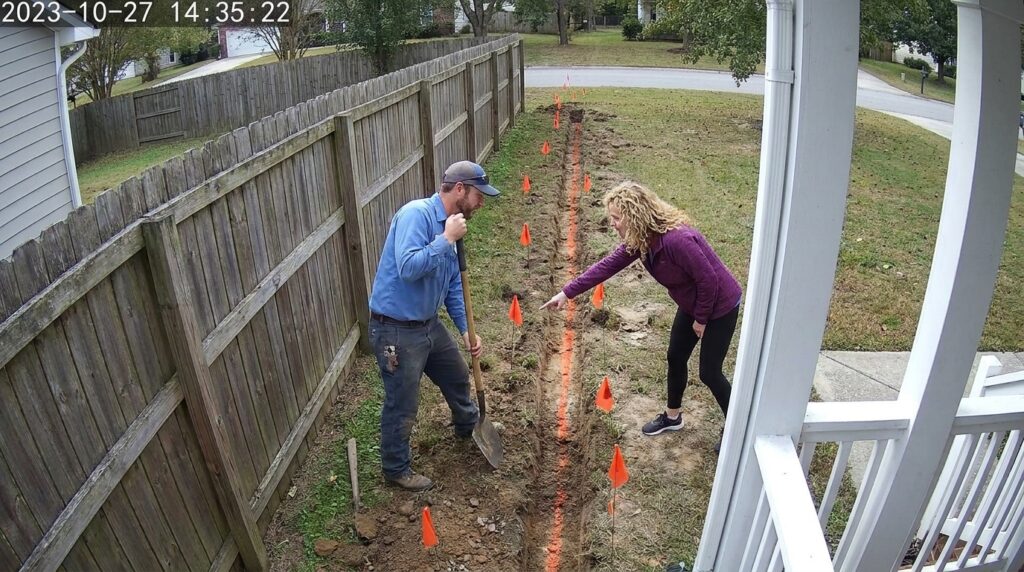
The white city SUV stopped short, its front tires catching the dry slope of the curb with a heavy, rubbery crunch. Before the engine even cut, the municipal seal on the door vibrated with the sudden drop in RPM. The man who climbed out didn’t move like the marshal the neighbor had requested; he was wider, graying at the temples, wearing a high-visibility lime vest over a thick canvas shirt that had salt lines under the armpits. A digital survey tablet was clipped to his belt, its screen glare caught in the noon sun.
“Alright, let’s hold the iron right there,” the inspector said. He didn’t look at the neighbor. He walked straight toward the trench, his boots kicking up two small puffs of gray dust from the curb line. He stopped at the edge of the orange flags, his eyes dropping to the exposed lead line and the tool marks scarred into the soft metal. “Who put a spade into the service lateral?”
“He did,” the neighbor said, her purple sleeve cutting through the humid air as she stepped toward the vehicle. The smartphone in her hand was still dark, but her fingers remained clamped around the casing. “I called the hotline twenty minutes ago. This technician is excavating outside the marked utility lane and threatening the structural integrity of our perimeter installations. He’s claims the fence isn’t the boundary.”
The technician didn’t stand up. He kept one hand buried in the cold, bag-bought soil, his fingers still resting on the smooth, unyielding cylinder of brass he had found behind the new iron sleeve. The metal was too cold for the July ambient temperature, drawing the heat out of his palm through the thick cowhide. “The tracer wire splits here, Vance,” he said, his gravelly voice staying low, flat, identical to his opening dispatch log. “The receiver is pulling twin signals. One follows the modern high-pressure feeder, but the ground current is bleeding into this lead line. It’s cutting under the fescue toward Lot 5.”
Vance, the city inspector, squatted down on the opposite side of the ditch, his knees popping with a loud, mechanical crack. He didn’t use a tool; he pulled a metal pocket rule from his vest and jammed it down alongside the pine fence post, right into the loose, premium cedar mulch the neighbor had laid.
“The grid ticket says the main loop is clean,” Vance muttered, his thumb tracing the digital screen of his tablet. The blue light from the map illuminated the gray stubble on his chin. “But this layout doesn’t look like a ninety-four drop. Look at the collar, technician. That’s a three-inch compression sleeve. That’s new galvanized.”
“Exactly,” the neighbor interrupted, leaning over the fence line, her voice tightening into that sharp, administrative register that had controlled the block for a decade. “The neighborhood association had the line verified when the terrace was terraced. The city approved the clearance. If your field technician can’t read his own digital dispatch, that’s an internal labor dispute, not a reason to tear up my property.”
The technician slowly pulled his hand out of the dirt. He didn’t lift the brass cylinder yet; he left it buried beneath the dark loam, but his glove was covered in a fine, silver-gray dust that didn’t match the surrounding earth. It was masonry slag. The dry, white residue left behind when a core drill chewed through stone or concrete.
“Vance,” the technician said, pointing a blunt finger toward the three levels of red brick pavers rising out of the neighbor’s yard. “The plat map shows the historical tie-in was a straight run from the street valve. If this lead lateral cuts fifteen degrees north, it isn’t a city error. The pipe didn’t move itself.”
The inspector looked up from his screen, his eyes narrowing as he compared the line on his tablet to the physical line of the fence. A third person stepped out from the porch of Lot 4—the actual homeowner, a quiet man in a faded polo shirt, his face pale and cautious as he stood at the edge of his own driveway, watching the three of them cluster around the boundary line.
“The paperwork is wrong,” the neighbor said, her face flushing a deep, blotchy red under the blonde curls. She didn’t look at the homeowner; she kept her eyes fixed on Vance’s high-visibility vest. “The original survey pins are what matter, not some updated digital map your department drew up last winter. The pins are permanent under state law.”
“They are,” Vance said, his voice dropping into a dangerous, institutional quiet. He stood up, unclipping the survey unit from his belt. “They’re permanent until someone moves them. Technician, give me the locator rod. Let’s find out why the primary signal is three feet off the brass benchmark.”
The technician handed the fiberglass rod upward, his eyes staying on the mounded dirt at the base of the post. The decoy secret was right there on the table—the unmapped utility error that the neighbor had used to halt the shovel. But beneath his boots, the real truth remained locked in the gray clay, waiting for the first deep scrape of the spade to clear the ivy.