CHAPTER 3: THE ANCHOR IN THE DIRT
The unrecorded lead line sat thick and dull beneath the blade tip, its gray surface scarred by the impact of his spade. It didn’t look like the city’s high-pressure main loop. The metal was too soft, the diameter too wide, swollen with the chalky white bloom of oxidized lead that had been drinking groundwater since the Truman administration.
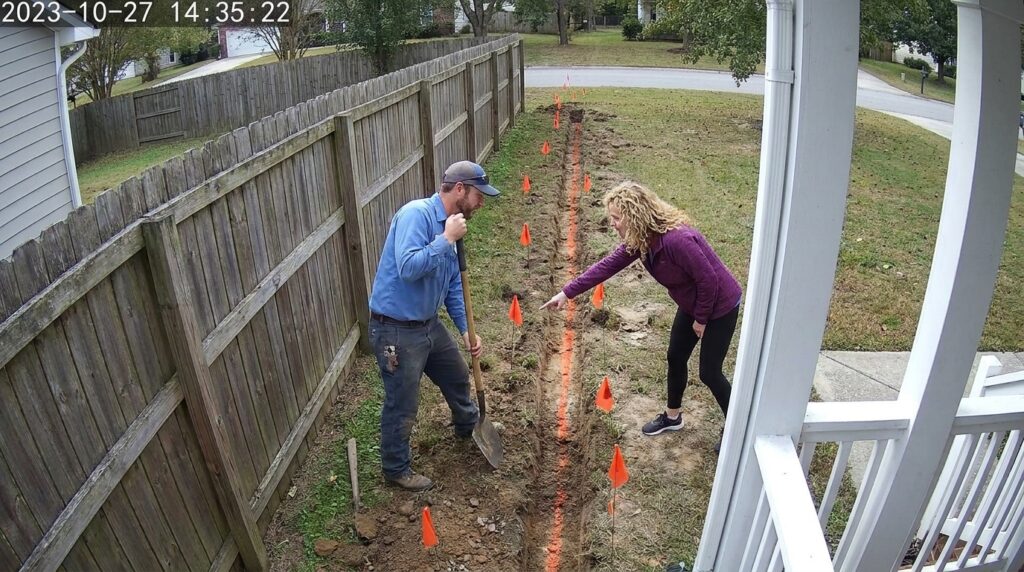
He stayed down in his squat, the heat radiating off the weathered pine planks of the fence line pressing into the side of his neck. With his bare gloved finger, he cleared the packed silt away from the curve of the pipe. The line didn’t run straight along the modern parcel grid. It cut across at an angle of roughly fifteen degrees, pointing straight toward the base of the neighboring brick terrace like an iron finger pointing at a buried secret.
“What is that?”
The neighbor’s voice had lost its formal call-center flatness. She stepped closer, her phone held low against her thigh now, the purple fabric of her sleeve brushing the rough cedar posts. She leaned over the trench, her oversized sunglasses slipping slightly down the bridge of her nose, revealing sharp, hyper-focused eyes that scanned the exposed gray metal. “That looks like old infrastructure. That looks like a city code violation right on my easement boundary.”
“It’s an unmapped service tie,” he said, his voice flat, dry as the clay crusting on his knees. He picked up his fiberglass locator rod, touching the tip to the oxidized lead. The yellow receiver on his hip didn’t scream; it gave a low, confused stutter, a fractured click that indicated the signal from the modern tracer wire was splitting, bleeding half its current into this ancient trunk line. “It isn’t on the grid ticket. When the city laid the modern feeder loop back in ninety-four, they were supposed to cut and cap every lead lateral on the block.”
“Well, they clearly didn’t,” she said, her fingers tightening on the edges of her folder. A strange, sharp urgency crept into her posture, her shoulders squaring against the sun as she took a calculated step forward, physically blocking the light from entering the narrow ditch. “Which means your current work order is based on faulty data. The city has no right to excavate a line that shouldn’t legally exist under the municipal utility act.”
He didn’t argue the point. He reached out, his thumb finding a seam where the lead pipe met the pitted iron collar he had discovered earlier beneath the premium cedar mulch. The two pieces didn’t fit together cleanly. The iron sleeve was modern—galvanized, heavy-gauge steel that showed zero signs of long-term soil corrosion. The lead pipe had been forcibly pried upward to meet it, the old soft metal kinked and scraped by a pipe wrench that had left fresh, bright silver teeth marks in the oxide.
The paperwork in his pocket said the county easement was clean fescue. The ground under his feet said someone had been working down here with heavy tools long before he pulled his utility truck up to the curb.
“I have to check the connection,” he said, adjusting his cap against the glare. He slid his fingers beneath the lead joint, feeling for the cold underbelly of the line where it disappeared under the fence rail. “If this lateral is still live, the pressure check on the main loop won’t hold. I can’t close the ticket until I verify the source.”
“You aren’t digging under that fence,” she said, her voice dropping into a hard, threatening whisper. She stood directly over him, the shadow of her stocky frame falling square across his hands. Her pointed finger came back up, rigid, targeting the scuffed toe of his boot. “The marshal is on his way out here. If you touch that collar again before the official survey unit arrives, I will personally file a civil injunction for property destruction.”
He ignored the warning, his fingers pushing deeper through the loose, bag-bought soil. His hand struck something small, round, and remarkably cold embedded in the clay directly behind the new iron sleeve. It wasn’t lead, and it wasn’t iron. It felt like a smooth, hard cylinder of brass, perfectly clean, with no rust and no tarnish, sitting three feet away from where the true city survey pin was supposed to be anchored.
Before he could pull it clear, the low, twin-tone wail of a city vehicle siren echoed from the bottom of Crestview Drive, the amber lights already casting long, rhythmic strobes against the gray paint of the suburban garage doors.