
CHAPTER 2: THE SOD LAW
“Go ahead and dial it,” he said.
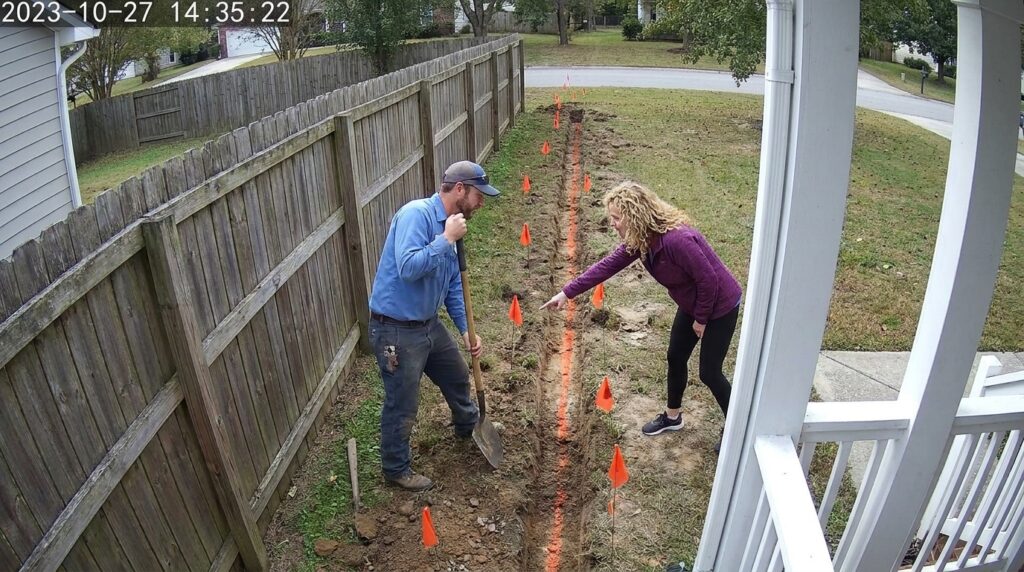
He didn’t raise his voice to cut through the hum of the diesel engine behind him. He didn’t have to. The air between them was tight enough to carry the scrape of his boots as he stepped off the metal lip of the spade and stood full-height on the undisturbed fescue of Lot 4. He was shorter than she was by two inches, but his shoulders had the thick, square set of a man who spent forty hours a week lifting cast-iron valve covers out of the mud.
The neighbor didn’t move her thumb from the screen of her phone, but she didn’t hit the call button either. Her jaw shifted, a tiny lateral twitch under the smooth, tan skin of her cheek. “I’ve already got the neighborhood watch coordinator on text. We have an agreement with the city about the visual integrity of this boundary.”
“The city don’t make agreements with subdivisions about gas loops,” he said. He reached down, took a roll of blue plastic marking tape from his belt, and ripped off a six-inch tail with a sharp snap of his wrist. He didn’t look at her face; he looked at the purple sleeve of her jacket where the synthetic fibers were slicked with a sheen of condensation from her own heat. “This is a two-inch high-pressure feeder. If the regulator at the station drops three pounds of head because a root system pinches the wrap, the whole north sector goes cold by five o’clock. You want to explain that to the watch coordinator?”
He bent down, ignoring the creak in his left knee, and jammed the blue plastic tail into the loose, dark soil at the base of the fence post.
The dirt felt wrong under his leather gloves. It wasn’t the dense, gray-orange clay that defined the rest of this ridge. It was loose, rich compost, the kind they sold in forty-pound bags at the big box store down by the interstate. It had no gravel in it, no ancient shale fragments, and when he pressed his thumb into the mound, the earth gave way too easily, sinking three inches until it hit something solid and flat beneath the rot.
“Don’t touch that,” she snapped, stepping forward so fast her sneakers crunched into the orange flag he’d set ten minutes prior. The fiberglass rod bent, the small plastic square fluttering against her black legging like a trapped moth. “That’s premium cedar mulch. I put that down myself to keep the runoff from draining into my sunroom.”
“You put it down over a city pin,” he murmured, his fingers remaining still against the buried obstruction.
Through the double layer of cowhide on his gloves, he could feel the contour of the object beneath the mulch. It wasn’t the top of a cedar root. It was too regular. A ninety-degree edge, smooth on one side, rough with the pitted texture of cast iron on the other. But it wasn’t the standard round head of a county survey stake either. It felt like an old sleeve—a collar used for industrial conduits before the valley was subdivided into quarter-acre lots.
He looked up at her from his crouch. The oversized sunglasses reflected two identical versions of his own sweat-stained cap and the dusty gray fence behind him. “The plat map says the original line pin is six inches off the post. This collar here is three feet inside the number.”
The neighbor took a half-step back, her hand dropping slightly, though the phone remained pointed at his head like a small, glass-faced shield. “The fence is the line. It’s been the line since the foundations were poured in ninety-four. My husband checked the deeds before we signed the mortgage.”
“Your husband checked the wrong book,” he said, standing up and wiping the dark loam from his palms onto the thighs of his work pants. The fabric was stiff with old hydraulic fluid and salt rings from his own skin. He pointed the blunt end of his fiberglass locator rod toward the center of her yard, where a new brick patio rose three levels out of the grass, its neat red pavers terminating exactly four inches from the wooden pickets. “If this collar is the old utility line, then the easement isn’t running along the fence. It’s running under your brickwork.”
The silence that followed wasn’t the quiet of a lazy suburban afternoon. It was the heavy, breathless pause that happened right before a cable snapped under tension. Across the street, the delivery driver had turned off his engine; the only sound left was the dry, metallic ticking of the yellow receiver on his belt, still picking up the steady, unfeeling pulse of the copper wire six feet down.
She didn’t bluff this time. She brought the phone up to her ear, her eyes drilling into the municipal logo on his shirt with a cold, calculated focus that had nothing to do with lawn care or aesthetics.
“Yes,” she said into the receiver, her voice dropping into a rhythmic, formal register that sounded like she was reading from a prepared script. “This is Lot 5 on Crestview Drive. We have a non-compliant contractor on site destroying established residential structures without a county supervisor present. Send the marshal’s unit out immediately.”
He didn’t try to stop her. He turned back to the trench, picked up his spade, and drove the iron edge four inches deep into the clay, right beside the blue tape. The earth gave a low, dry groan as the spade pried it loose, revealing a glint of old, unrecorded lead pipe running crosswise against the map.








