CHAPTER 5: THE REMOVAL OF THE IVY
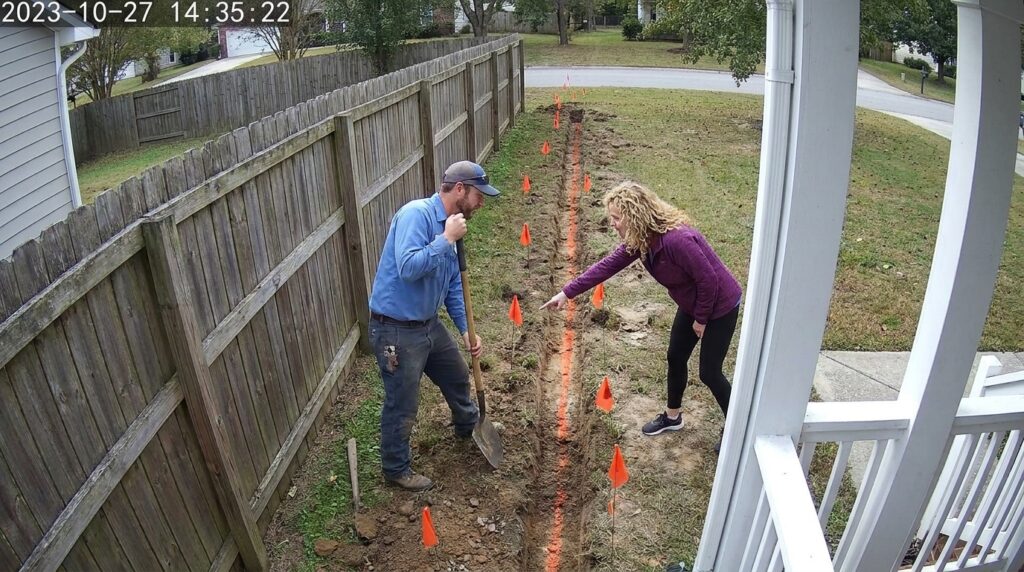
The short, serrated pruning saw cut through the main trunk of the English ivy with a wet, pulpy crunch. He didn’t use the shovel for this part. The thick, hairy vines had spent ten years anchoring the rotten bottom rail of the privacy fence to the dirt, their black rootlets drilled straight into the grain of the gray wood. He ripped a handful of the green growth away, his leather gloves tearing the broad leaves down to the bare, damp soil below.
Vance stood two feet back, the digital survey tablet balanced against his forearm. The screen flickered with a grid of bright green lines, the real-time satellite layout of the subdivision trying to match the location of the fiberglass rod pinned between his boots.
“The beacon isn’t locking,” Vance said, his thumb tapping the glass twice. The glass emitted a dull, flat sound in the midday sun. “It’s throwing an obstruction error. The coordinate marker says the primary benchmark is forty-eight inches south of where she’s got her fence line pinned.”
“The fence is standard,” the neighbor said, her purple jacket rustling as she shifted her weight from one foot to the other. She hadn’t stepped back onto her fescue yard; she stayed right on the edge of the cutting lane, her sunglasses still aimed at the technician’s neck as he worked the saw through the dense root mass. “The developer laid the posts according to the original plat numbers. If your satellite unit is picking up interference from the high-pressure gas main, that’s a failure of city equipment, not a boundary violation.”
The technician didn’t look up to answer. He reached deep into the cavity he’d carved out of the ivy, his fingers brushing past the modern iron sleeve he’d found in the third beat. His thumb caught the edge of the smooth brass cylinder. The metal didn’t move when he gave it a firm, lateral jerk. It was set in concrete—a standard three-inch cylindrical plug used by county surveyors to establish absolute lot corners.
But when he cleared the final layer of damp loam from the top of the metal face, his glove came away coated in that same dry, white masonry slag he’d noticed in Chapter 4. The concrete collar around the brass wasn’t aged, porous, or gray like the foundation footings of the fence. It was bright white, fresh hydraulic cement that hadn’t fully cured in the damp shadow of the hedge, still soft enough to leave a chalky streak on his leather palm.
“Vance,” the technician said, his low voice cutting through the thick hum of the idling SUV at the curb. He didn’t point; he simply leaned back enough to let the inspector see down into the dark opening between the post and the sod. “Look at the stamp on the brass cap.”
The inspector leaned in, his heavy vest creaking as he squatted beside the ditch. He reached down with a small wire brush from his kit, dragging the steel bristles across the face of the plug. The scratching sound was sharp, metallic, echoing against the wood planks.
The neighbor took a half-step forward, her index finger twitching toward her phone. “That’s an official landmark. If you deface county property to support a false labor report—”
“Quiet, ma’am,” Vance said. The flat authority in his voice was absolute, carrying the weight of twenty years of civil enforcement. He held the digital tablet directly over the hole, letting the lens on the back scan the exposed metal. “Technician, this isn’t the marker for Lot 5. The serial number stamped on this cap belongs to the old municipal fire lane marker from the north intersection.”
The neighbor’s lips leaned into a thin, white line, her jaw shifting back and forth as she looked from Vance to the red brick terrace rising behind her pickets. “The lane was abandoned by the county council three years ago. The land reverted to the HOA.”
“The land didn’t revert three feet south,” Vance said, standing up and locking the screen of his tablet with a final, decisive snap. He looked over at the quiet homeowner who was still watching from the driveway of Lot 4. “Sir, you might want to come over here. We’ve got a major infrastructure discrepancy on your boundary.”
The technician drove his spade back into the clay, right beside the shifted plug. The iron blade struck something hollow this time—a vertical void in the earth where the old survey stake had been pulled out, leaving a neat, four-inch core hole that had been hastily stuffed with bag-bought cedar mulch to hide the extraction site. The decoy secret of the unmapped utility line was gone, shattered by the physical reality of the core drill marks running down the side of the buried post.