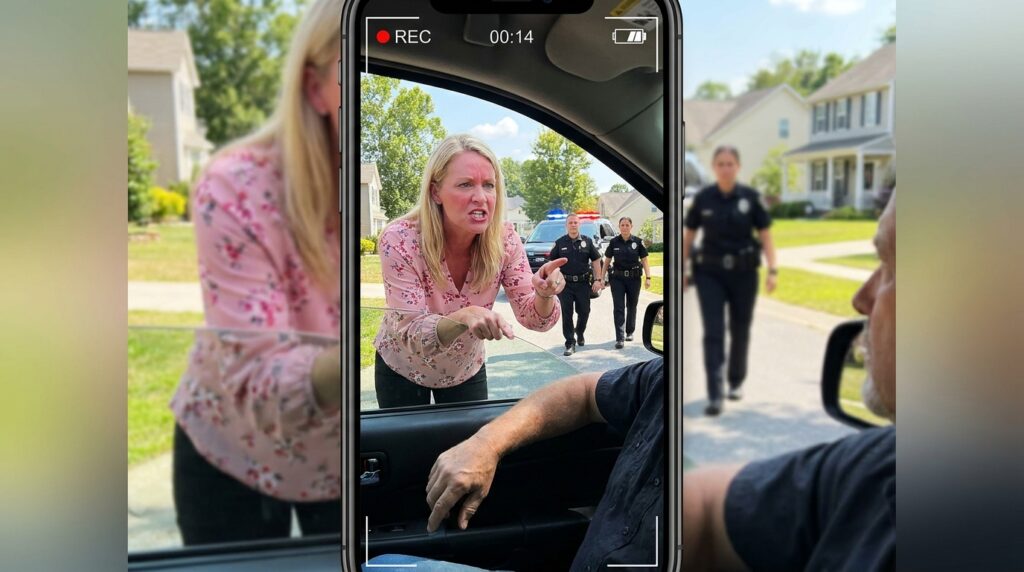
CHAPTER 8: THE BOUNDARY ENFORCEMENT
The yellow municipal citation pad crackled as the female deputy flipped the carbon-copy layer back against the cardboard backing. The dry sound carried across the hot hood of my sedan, sharp as a breaking locust branch. Brenda didn’t move her boots from the gray dirt of the drainage ditch, her fingers frozen around the plastic strap of her accordion folder while the scarlet and blue pulses from the cruiser bar washed across the front of her smudged floral blouse.
“Sign the lower line, ma’am,” the female officer said, extending a cheap, blue-barreled ballpoint pen across the space separating their shoulders. The deputy’s uniform shirt was perfectly still, her weight distributed evenly across her equipment belt. “This is an official citation for a civil easement obstruction under section four-twelve of the township infrastructure code. It isn’t an admission of liability, but it requires you to clear the designated ingress lane within fifteen minutes of notice.”
Brenda’s hand shook slightly as she took the pen, the plastic barrel scraping against the dirt-caked skin of her index finger. She didn’t look at the document as she struck a quick, jagged line across the bottom of the carbon layer. She handed the pen back with a stiff, unyielding jerk of her wrist, her eyes remaining fixed on the second deputy who was already walking toward the front bumper of her crossover.
“The street association isn’t going to accept this baseline, Deputy,” she whispered, her voice dry, catching on the dust rising from the cul-de-sac. Her chin was down now, her short blonde bangs damp against her forehead from the baking valley heat. “We have an infrastructure fund. We have the ninety-two blueprint signed by the clerk.”
“The clerk didn’t have the authority to override the state water-main dedication, ma’am,” the male officer said without looking up from his pocket notebook. He stepped into the narrow path between her front grille and my apron, his heavy leather heels grinding the limestone gravel into a fine, white powder that coated his boot laces. “You can take the layout copy down to the county commissioner’s hearing next Tuesday if you want to contest the mapping, but right now, that vehicle needs to move back across the asphalt line.”
I lowered my phone from the window frame, my right thumb clicking the power button to terminate the video file. The small screen went dark, its surface greasy with the heat of my palm and the gray road dust that had settled into the charging port. My forearm felt cold where the air from the manual crank had hit the skin, but the interior cabin still smelled of old vinyl and stale machinery oil. I reached down, my fingers hooking around the iron handle of the emergency brake, clicking the release button to let the sedan settle into its suspension blocks.
Brenda didn’t look at me as she turned toward her vehicle. Her shoulders were hunched forward under the pink fabric of her blouse, her stride short and heavy as her boots dragged through the gravel transition line. She pulled the driver’s side door open, the old metal hinges groaning with a dry, iron-on-iron squeak that cut through the low idle of the patrol unit.
The starter motor of her crossover let out a high-pitched, slipping whine before the cylinders caught, the engine coughing a gray plume of unburnt diesel smoke out over the juniper bushes. The loose iron washer pinning her lower license plate rattled violently against the bracket, a frantic, tinny chatter that grew louder as she threw the transmission into reverse. The tires spun once against the loose limestone, throwing a small shower of white stones into the dry grass before the vehicle backed slowly across the curb lane, clearing the mouth of my driveway by exactly three feet.
The female deputy stepped up to my open window, her fingers sliding my laminated plotting map back through the gap. The thick plastic sleeve was hot from the sun, the corners sharp against my palm as I took it back and laid it across the passenger seat next to the phone.
“Keep that map in the vehicle, Arthur,” she said, her eyes tracking the movement of Brenda’s sedan as it backed into the driveway across the street. “If she places another administrative notice on this mailbox line before the county hearing, you call the dispatch desk directly. Don’t engage through the glass.”
“Understood, Deputy,” I said. My voice was flat, stripped of the dry grit that had been catching in my throat since the screen door first rattled.
I reached for the manual window crank, my thumb catching the worn plastic knob as I turned it three times, lifting the heavy pane back into the rubber track. The black interior door panel formed a hard, locked perimeter around me once more, cutting off the high whine of the cruiser’s light bar as the officers walked back toward their unit. Through the dust-filmed glass, the street looked wide and desaturated under the falling western light—the pale concrete of the turnaround loop ending exactly where the seventy-four master plot had marked the boundary forty years ago.
The street didn’t belong to her, and neither did the driveway. The original iron pin was still buried deep behind the locust trees, silent and rusted, holding the line in place while the neighborhood watched from behind their screens.