CHAPTER 2: THE ENGAGEMENT APON
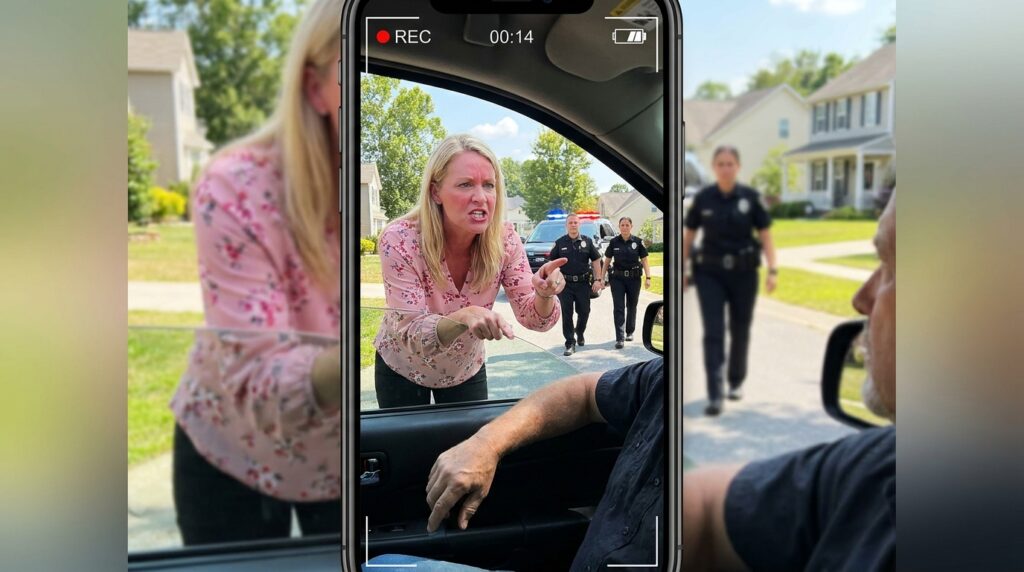
The shadow didn’t just block the light; it came with the smell of old upholstery and dry, unwashed polyester. Through the double-paned glass of the passenger window, her silhouette was a heavy, dark blur against the stark white of the neighboring garage. Her knuckles rapped against the glass—two sharp, dry cracks that vibrated through the window regulator mechanism inside the door panel. It sounded like loose iron hitting a cold anvil.
I didn’t roll the window down. My thumb remained hooked over the top edge of the phone, my index finger resting flat against the volume rocker to keep the camera feed locked. On the small screen, her face appeared in grainy real-time, her features sharpened by the harsh angle of the sun behind her. Her lips were a thin, compressed line, the skin around her mouth graying with white ringlets of tension. Every line on her forehead was etched deep with the dry grit of an afternoon spent watching the asphalt.
“Open the door, Arthur,” she said. Her voice was muffled by the weatherstripping, reduced to a low, gravelly rasp that lacked the resonant authority she usually pulled out for the street association meetings. “We’re not doing this through the glass today. You know exactly what you’re doing by putting this frame here.”
I shifted my gaze from the screen to the real-world gap between my side mirror and her front fender. The distance was exactly twelve inches. If I swung the passenger door open, the sharp corner of the stamped steel would bite directly into the oxidized red paint of her door panel. It was a classic leverage play—force the target into an action that creates visible property damage, then use that damage to establish a legal fault baseline. I kept my knees locked under the steering column, my weight centered, using the mass of the sedan as a stationary shield.
Through the window, her hand rose. She wasn’t holding the blue accordion folder anymore; she had tucked it under her armpit, pinning it against the pink floral pattern of her blouse like a shield. Instead, her index finger was extended, the nail short and chipped down to the quick, coated in a layer of fine, chalky garden soil. She brought the tip of that finger within an inch of the glass, jabbing it downward toward the broken concrete apron of the driveway.
“This lane has been designated for common-turn use since ninety-two,” she shouted, her voice rising enough to clip the small microphone at the base of my phone. The camera feed twitched slightly with the vibration of my hand, but the baseline stayed level. “You don’t get to park the work truck here, and you don’t get to leave this junker idling on the easement strip. The association has the civil mapping filed at the township clerk’s desk. I have the copies right here.”
She slapped the blue folder against the glass. The impact made the window glass shudder inside its felt tracks. Through the transparent plastic pocket on the front of the folder, I could see the edge of a photocopied document—a heavy, black-lined grid with an official-looking state seal at the top corner. The ink was too dark, typical of an old flatbed copier running hot on toner, the margins crowded with handwritten annotations in a thick grease pencil.
My eyes dropped to her front bumper. A loose, rusted iron washer was pinning the lower left corner of her license plate to the bracket. Every time her engine grumbled across the street, that washer rattled against the tin plate, leaving a circular stain of orange iron oxide on the reflective white backing. It was the same orange rust that lined the drainage ditch at the back of our properties—the iron-heavy runoff that always pooled right where our deeds supposedly dissolved into public land.
“I am parked within my property line, Brenda,” I said. My voice sounded flat inside the quiet cabin of the sedan, stripped of the dry grit that was catching in my throat. I didn’t raise my volume to match hers. I spoke to the steering wheel, letting the phone’s microphone capture the proximity of the stone-faced delivery. “And I am recording this interaction.”
Her jaw twitched. The blonde bob of her hair shifted as she leaned her forehead closer to the glass, her sunglasses sliding down the bridge of her nose until the plastic frame clicked against the exterior weatherstripping. Her breath left a small, circular patch of fog on the outside of the window, a tiny cloud of moisture that slowly evaporated under the direct heat of the afternoon sun, revealing the layer of fine gray dust underneath.
“Your line ends at the water meter, Arthur,” she whispered, her lips moving with an exaggerated, clinical precision against the glass. “Everything past that belongs to the block. We built the turnaround here twenty years ago while you were still hauling drywall in the next county. You don’t get to change the asphalt because you bought a bigger rig.”
She reached down, her fingers hooking into the bottom edge of the passenger side door handle. The chrome-plated plastic gave a dry, hollow click as she lifted it against the internal spring tension. She pulled once, hard, her shoulder dipping as she tried to force the latch mechanism from the outside. The deadbolt inside the door frame caught the pressure with a heavy, metallic thud that resonated through the floorboards beneath my boots.
The lock didn’t yield, but the friction of her grip left a long, oily smudge across the chrome handle—a distinct mark of sweat and garden dirt that sat directly above the rusted keyway. She didn’t let go of the handle; she kept her weight back, her boots scraping against the loose gravel at the edge of the asphalt as she prepared to pull a second time.
Behind her, at the far end of the block, a low, rhythmic pulse of light bounced off the white siding of the corner house. It wasn’t the steady glare of the sun. It was a sharp, alternating flash of violet-blue and deep scarlet, slicing through the dusty leaves of the locust trees like a clean blade.