CHAPTER 5: THE POLICE INTERVENTION
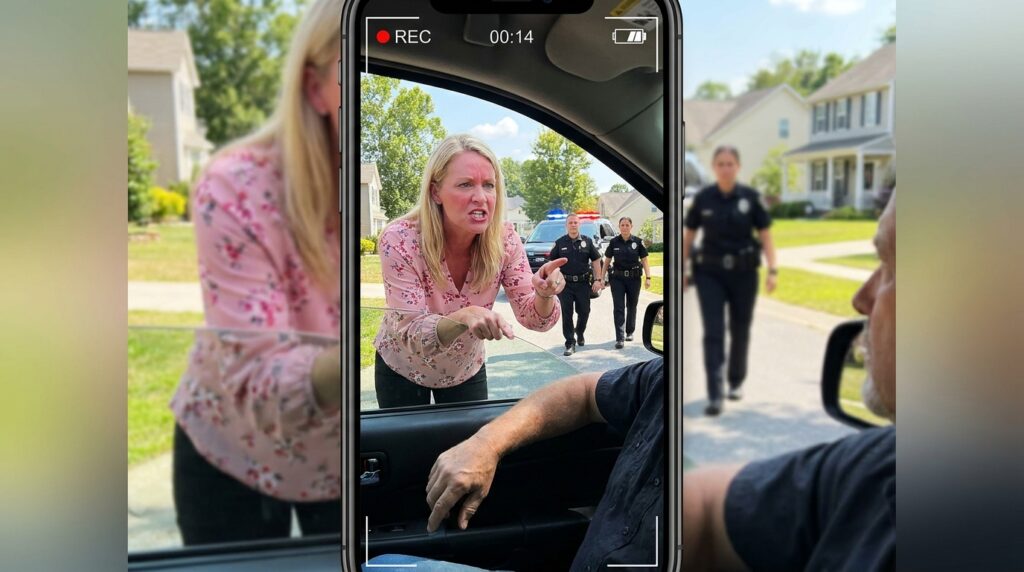
The female officer’s hand didn’t drop. Her palm stayed locked in the space between Brenda’s floral blouse and my side mirror, the thick black fabric of her tactical glove casting a steady shadow across the oil-filmed chrome door handle. Brenda’s boots ground backward into the limestone gravel, a small shower of dry white dust puffing over her black trousers as she broke her forward lean. Her breath still fogged a circular patch on the glass, but the cloud was rapidly evaporating under the direct glare of the afternoon heat, leaving nothing but the smudged imprint of her jawline on the dirt.
“He’s blocking a designated turnaround, Deputy,” Brenda said. Her voice lacked its previous razor-sharp edge, flattening into a rapid, high-register pitch as she held the blue accordion folder up like a barrier against the officer’s utility belt. The plastic strap creaked under the tension of her grip, squeezing another tiny bead of black grease from the lower hinge onto the yellowed edges of her paperwork. “I have the civil layout from ninety-two. The road crew left this apron open for public maintenance vehicles. He knows he can’t leave a commercial rig inside the county right-of-way.”
The female officer didn’t look down at the folder. Her eyes—cold, alert, and entirely unbothered by the alternating blue and scarlet pulses bouncing off the fence—stayed fixed on the tight lines around Brenda’s mouth. To her left, the second responding officer, a sturdy man with short-cropped dark hair, drifted toward the front fender of her crossover, his hand resting with casual weight near his side latch. His uniform shirt was damp along the spine from the valley humidity, the smell of dry wool and laundry detergent mixing with the hot oil rising from my engine bay.
“Ma’am, I told you to step back from the door panel,” the female officer repeated. Her tone wasn’t loud, but it had the flat, unyielding weight of a municipal ordinance. She moved her left foot six inches forward, her boot heel striking the gravel with a solid thud that physically occupied the entry lane. “We have a dispatch call on this address regarding a civil dispute and vehicle obstruction. You need to take three steps back toward the shoulder so I can speak with the operator.”
I lowered the phone by two inches, keeping the lens level with the lower window track. On the digital display, the red recording timer continued to click forward in the lower corner, capturing the crisp texture of the officer’s shoulder patch against the desaturated backdrop of Brenda’s porch. My forearm remained flat on the interior armrest, the plastic warm and slightly sticky against my skin from the enclosed heat of the cabin.
“He called you?” Brenda’s jaw tightened, her eyes darting over the hood of my car toward the second deputy who was now taking a small pocket notebook from his uniform shirt. “I’m the one who’s been filing the code complaints with the township clerk for six months. He’s the one violating the setback rules. If you look at the master plotting map—”
“We’ll look at the paperwork in a minute,” the female officer cut her off, her arm dropping slightly but her torso remaining positioned as a hard barrier between Brenda and my passenger frame. She turned her head toward the glass by three degrees, her gaze dropping to my still forearm. “Driver, step out of the vehicle or roll down the window so I can see your hands.”
I kept my right hand on the phone, letting the camera continue to run as my left hand moved to the manual window crank. The handle was cold iron, its plastic knob worn smooth and pitted from years of grease-stained thumbs. I turned it three times, the internal regulator mechanism groaning with a dry, scraping friction as the thick glass panel slid down into the felt-lined slot of the door. A heavy wave of hot, unmoving air rushed into the cabin, carrying the sharp scent of baked ragweed and the high, electric hum of the cruiser’s light bar.
As the window cleared the frame, the blue folder under Brenda’s arm shifted, the movement exposing the back of the topmost yellowed document. In the harsh glare of the direct sun, a faded, hand-stamped ink seal code was visible through the thin wood-pulp paper. It wasn’t a county archiving mark. It was a three-digit sequence—WM-REJ-88—the exact code used by the internal water-main division when a utility easement was rejected for structural instability due to shale shifting.
The second deputy stepped closer to the front bumper of Brenda’s crossover, his heavy boot kicking against a piece of loose limestone that rolled until it struck the rusted washer on her lower license plate bracket. The tin plate let out a thin, hollow vibration that sounded exactly like the rattle of an empty tool bin.
“Keep your hands where I can see them,” the female officer said, her eyes shifting rapidly between my phone and the property marker stake behind her heel. The blue light bar caught the edge of her badge, turning the silver plating into a brief, violent flash of purple before the scarlet pulse took its place.