CHAPTER 3: THE GRAVEL TRANSITION
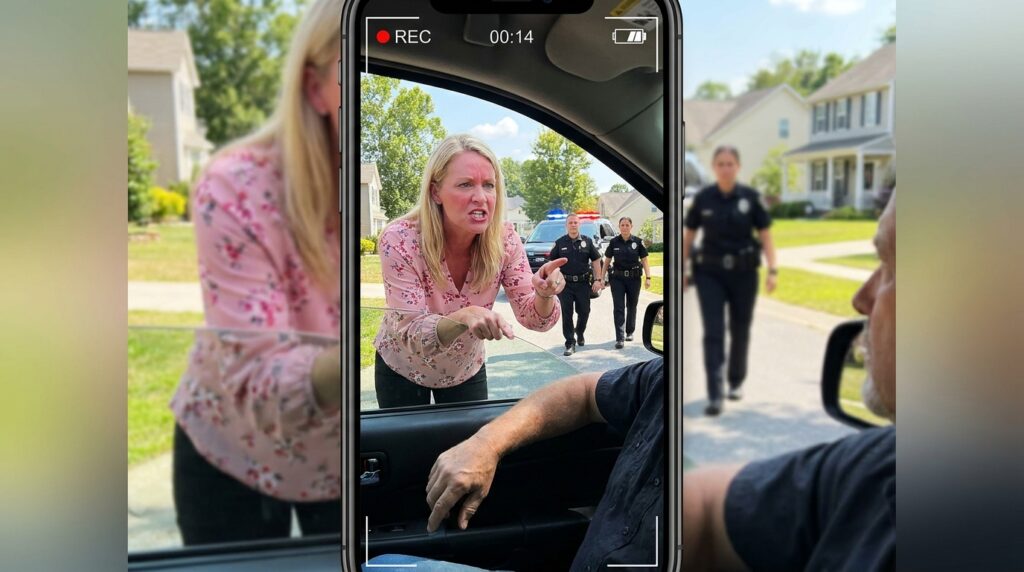
The blue and red flashes cut through the dust-moted air inside the cabin, striking the cracked dashboard in rhythmic, alternating bars. Brenda’s hand dropped from the door handle as if the plastic had suddenly superheated under her palm. Her knuckles scraped against the window molding, leaving a chalky streak of skin cells across the dried black rubber gasket. She didn’t fully step back; instead, her weight shifted onto her rear heel, her body pivoting toward the curb while her shoulders stayed squared against my door panel.
“They won’t do anything about the civil layout, Arthur,” she said, her voice dropping into a flat, practiced cadence that she used whenever the county road crew ignored her phone calls. She tapped the heavy accordion folder against her hip, the thick grease-pencil markings on the top page catching the red pulse of the cruiser’s roof rack. “They don’t enforce code disputes. This is an administrative boundary layer. I’ve got the ninety-two plat right here, stamped by the district clerk before you even pulled a permit for your fence.”
I kept my hand steady against the lower rim of the steering wheel. Through the side view mirror, the reflection of the black-and-white SUV was slightly warped by the convex glass, its light bar scattering sharp blue needles across the dry siding of my garage. The engine of my truck remained cold, but the ambient heat rising from the dry drainage ditch between our properties was thick with the smell of iron-heavy silt and baked ragweed.
“The ninety-two filing didn’t dissolve the drainage easement, Brenda,” I said, my voice low enough to avoid vibrating the glass. I adjusted my phone by two degrees, ensuring the frame caught the exact position of her boots relative to the small brass survey cap embedded in the curb. “The county didn’t sign off on the turnaround loop. The asphalt just ended where the grading crew hit the shale layer.”
She made a sharp, clicking sound with her tongue, her sunglasses dropping another fraction of an inch down her nose. “The township surveyor signed it, Arthur. Old man Miller didn’t make mistakes with the right-of-way. He spent thirty years mapping these sections before the county even laid the sub-base for the subdivision. If he marked this line as a shared apron, then it’s a shared apron.”
She stepped off the concrete edge of the driveway, her left boot coming down onto the dry gravel strip that ran parallel to my stone wall. The small limestone rocks ground together under her heel with a dry, crunching friction that sounded like dry bone breaking. She reached into her folder, her fingers slipping past the grease-pencil annotations to pull out a single, yellowed sheet of grid paper—a legal description template with a faded county ledger header from June of nineteen eighty-eight.
My eyes didn’t follow her fingers. They stayed on the gravel layer three feet to her left, where a small, notched brass disk sat half-buried under a mat of creeping clover. The metal was dark with age, its edge scored with three deep vertical lines that had been struck with a cold chisel before the concrete beneath it had fully cured. It was the original benchmark from the seventy-four master plot—the one that wasn’t listed on any of the neighborhood association flyers she pinned to the mailboxes every spring.
“Miller was gone by ninety-four, Brenda,” I said, my thumb clicking the side button of my phone to lock the current file into the flash storage. The small green light at the top of the bezel blinked twice, a silent indicator that the data was secured against a power loss. “And the county didn’t archive his field books after the office moved down to the courthouse basement. They used the general index maps for the repaving project.”
Her fingers tightened on the edge of the yellowed paper, the old wood-pulp sheet crinkling with a high, paper-thin snap that carried through the closed window. Her shoulders went rigid under the pink floral pattern of her blouse, the fabric drawing tight across her shoulder blades as she watched the first officer’s boots clear the rear quarter panel of my car.
“The index maps are just summaries,” she whispered, her gaze finally breaking from mine to look at the dark uniform shirt moving down the driveway lane. “The real intent is in the filed record. You think you can just sit inside this steel box and ignore forty years of established usage because you found an old survey stake behind your woodpile?”
The crunch of the officer’s boots on the gravel transition was heavier than hers, the thick rubber soles of the utility boots striking the stones with a flat, unyielding rhythm that didn’t slide or scatter. The shadow of the cruiser’s roof rack reached us first, long and blue, stretching across the baked asphalt until it touched the brass cap at the lip of the drive.