
CHAPTER 8: THE RETURN TO THE PAGE
The latch on the southern fence didn’t click behind him. It swung through its short, rusted travel, the worn iron tongue scraping a crescent groove into the dry limestone dust of the lane before settling against the wooden stop. Frank walked slowly, the boots that had carried him through thirty winters of heavy concrete now finding the level, unyielding grade of the park path. His left arm was strapped tight against his ribs with a clean length of oiled canvas from his workbench, the initial heat of the torn muscle fading into a cold, dull ache that throbbed in time with the distant, mechanical pulse of the Route 4 traffic.
The evening had gone desaturated, the copper light thinning out until the long shadows of the cottonwoods looked like gray water marks left on the grass by a receding tide. The park was entirely empty. The joggers had left the perimeter line; the white cruiser had cleared the culvert; the black sedan had disappeared into the warehouse grid down by the county road. There was only the dry, steady chink-chink-chink of the municipal sprinkler heads tossing their fine silver wire against the dark boundary chain.
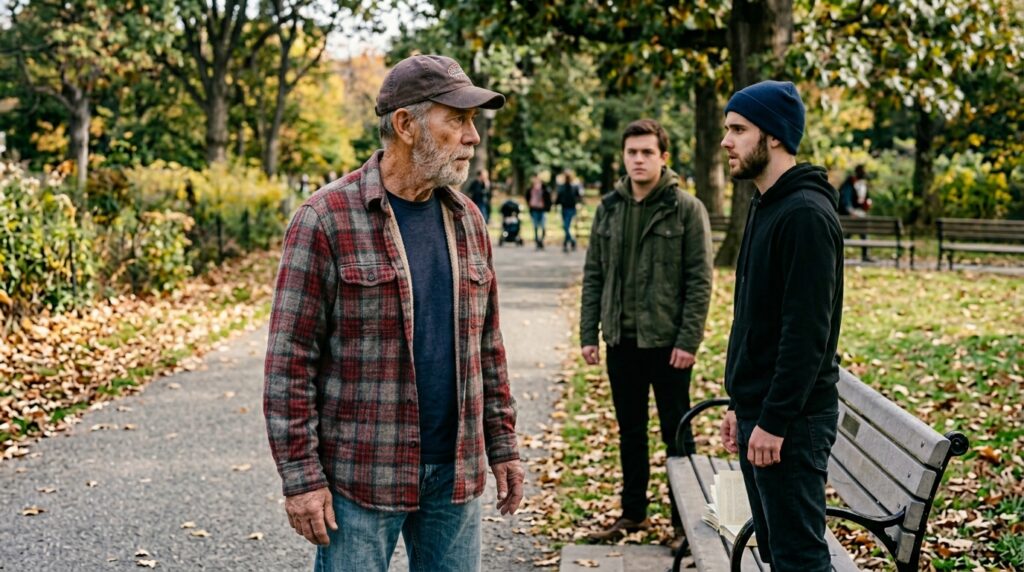
He reached the eastern quad. The fixed park bench sat foreground center, its heavy timber slats holding the final, grey heat of the afternoon.
Frank didn’t sit down immediately. He stood beside the cast-iron frame, his right hand resting on the top edge of the backrest. His thumb traced the rough, open grain where Tyler’s boots had scuffed the pine five hours ago. The wood was cold now, the fiber closing up under the blue descent of the twilight until the texture felt like seasoned slate beneath his leather glove.
On the far edge of the seat lay the hardcover book—the three-dollar repair manual with its uncracked spine. It hadn’t moved an inch. The thin white marker still stuck straight out from the margin of page eighty-four, a narrow tooth of dry paper catching the flat, failing light from the western ridge.
Frank knelt, his right knee joint giving the familiar, dry click that had marked every crossing of his threshold since the year the stamping plants closed their registers. He didn’t reach for the manual. He reached down into the narrow gap between the wooden support and the iron anchor plate, where his fingers found the clean, silver-gray file mark on the spare brass key he had carried from Henderson’s counter.
He didn’t put it back in his watch pocket. He dropped it down through the vertical iron slot of the municipal drain cover beside his boot. The brass dropped twelve feet through the dry air before hitting the pooled limestone water at the baseline of the old substation culvert with a short, heavy plop that didn’t echo.
He stood back up, his shoulders settling into their old, straight alignment under the plaid cloth of his overshirt. He reached down with his right hand, lifted the repair manual by its spine, and took his seat on the cold wood.
The paper under his thumb was dry, smelling of the old lime cellar where his crates had spent forty years waiting for the ink to fade. He didn’t turn back to the beginning; he didn’t look for the survey map folded deep in his denim pocket. He simply cleared the white marker, laid his right hand flat across the open text of page eighty-four, and let his eyes find the first line of the schematic layout.
The water tower rose above the treeline four blocks north, its white paint completely dark now against the deep purple of the Ohio sky. The town had moved past the ledger; the escrow lines were locked; the warehouse grid was already clearing the common red brick of the old foundations down by the spur. But the iron under his boots was stable, the seals were holding three hundred feet below the limestone, and the page didn’t turn until he gave the word.
Frank pulled the dark canvas of his cap down until the shadow covered his brow, his fingers releasing the corner of the leaf as the park returned to its absolute, cold quiet.








