
CHAPTER 2: THE INSIGNIA IN THE DIRT
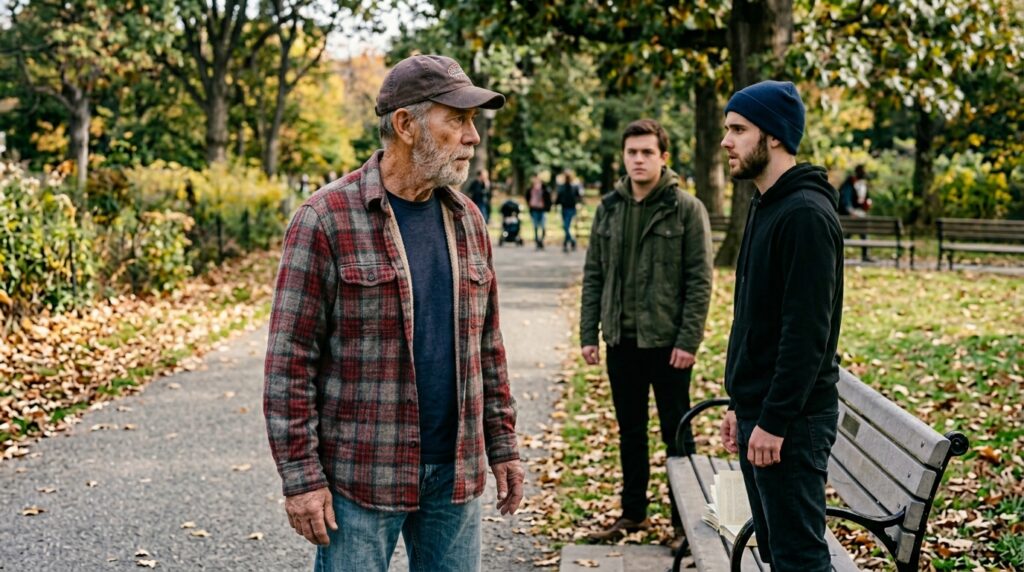
“Don’t touch it,” the shorter one hissed, his voice scraping like a dry shovel against gravel. He was still on his knees, his hands pressed hard into the frost-cracked asphalt to keep his weight off his bruised shin. His casual jacket was smeared with the gray, chalky dust of the park path. “Come on, Tyler. Get up. Get up.”
Tyler didn’t get up. He remained slumped against the iron base of the bench, his fingers clamped around his left wrist. The skin there was already puffing into a purple ridge where Frank’s thumb had anchored. He looked up at Frank through a screen of loose greasy hair, his chest heaving under the dark fleece hoodie. The arrogance had drained from his face, replaced by the white, hollow sharpness of a predator that had just felt the trap snap on its own leg.
Frank didn’t look at Tyler’s face. He looked at the grass three inches from the toe of his right boot.
The brass key lay half-buried in the yellowed dandelion roots. It was thick, heavier than a standard deadbolt blank, its edges pitted with the dull green tarnish of old ordnance storage. Stamped into the flat of the head was the winged propeller of the old Army Air Forces registry—an unglamorous, pre-Cold War die-mark that hadn’t been standard issue since the year Truman signed the defense act.
“I told you,” Frank said, his voice flat as a level iron bar. “Go home.”
He didn’t bend down to pick it up yet. In the park’s eastern quad, the two joggers had stopped completely now. They weren’t moving toward the bench; they were just shapes against the distant chain-link fence, their phones held high and horizontal. The silent witness of the digital frame was already closing around the clearing. Frank could feel the weight of it—the modern, frictionless surveillance that turned every necessary correction into a public ledger.
Tyler spat into the gravel, a dark spot of red mixing with the dry earth. He used his good hand to drag himself backward, his boots scuffing a long, ugly track through the lawn before he found his feet. He didn’t look at his companion. He turned his back, his shoulders hitched high and defensive around his ears, and began a limping, uneven stride toward the southern exit gate near Route 4. The shorter one lingered for a half-second, his eyes darting between Frank’s boots and the open book on the bench, before he broke into a clumsy, protective jog to catch up.
Frank waited until the sound of their footsteps faded into the low, collective drone of the highway traffic.
The wind shifted from the south, carrying the bitter, chemical tang of the old stamping plants three miles out—the smell of zinc wash and oxidized iron that had settled into the valley’s water table forty years ago and never truly left. It was a local smell, the scent of things left to rot under the pretense of industrial progress.
Frank knelt. The joint in his right knee gave a short, dry click—the standard tax of seventy-eight years on concrete floors. He reached into the grass, his fingers closing over the cold brass. The metal was heavy, heavier than it should have been. When he turned it over, he noticed the back of the insignia had been ground down with a coarse file, leaving a clean, silver-gray scar across the old serial numbers.
He didn’t put it in his pocket. He held it in his palm, letting his thumb trace the rough file marks. They were fresh. The bright silver of the raw brass beneath the tarnish hadn’t even begun to oxidize. Whoever had handed this key to Tyler had done it within the last forty-eight hours.
He looked back at the bench. The hardcover book—a three-dollar manual on hydraulic repair from the thrift store near the county line—lay exactly where he had left it. Its spine was uncracked, the white edge of page eighty-four sticking up like a small marker. But the shadow across the timber had lengthened.
Frank reached out and flipped the book over.
Stuck to the underside of the weathered pine slat, held in place by a single, degrading strip of gray electrician’s tape, was a small, square smear of grease. It wasn’t machine oil. It was the thick, graphite-black paste used to seal the inspection ports on military-grade cisterns. He pressed his index finger against the residue, checking the tack. It was dry on the surface, but when he pushed through the skin, the core was wet, smelling faintly of sulfur and stale fuel.
They hadn’t been looking for his wallet. They hadn’t even been looking for the book.
Frank stood up, his boots crunching on the gravel as he turned back toward the neighborhood line. His house sat four blocks north, a flat-roofed brick cottage with a rusted iron awning that caught the afternoon heat like a stove. He could see the upper girders of the water tower rising above the treeline, its white paint peeling away in long, gray strips that looked like dead skin against the sky.
He slipped the brass key into the small watch pocket of his jeans, the cold edge pressing through the denim against his hipbone. The park was entirely empty now; the joggers had moved on, leaving only the mechanical chink-chink-chink of the sprinkler heads and the slow, heavy descent of the midwestern dust.
He reached the gravel margin where the path met the sidewalk. A black sedan—an old-model Ford with dented rocker panels and a missing chrome strip along the driver’s side—was idling near the hydrant. It hadn’t been there when Frank sat down. The exhaust was blue and heavy, pooling in the weed-choked ditch beside the curb. As Frank’s boots hit the concrete sidewalk, the sedan’s brakes released with a sharp, hydraulic hiss, and the vehicle drifted forward ten feet, matching his pace from the opposite side of the asphalt lane.
Frank didn’t quicken his stride. He adjusted the brim of his ball cap, pulling the dark canvas down until the shadow covered his eyes, his left hand settling into the pocket where his ring finger could feel the cold, rigid truth of the iron frame behind his fence.








