
CHAPTER 1: THE TENSION IN THE GRAIN
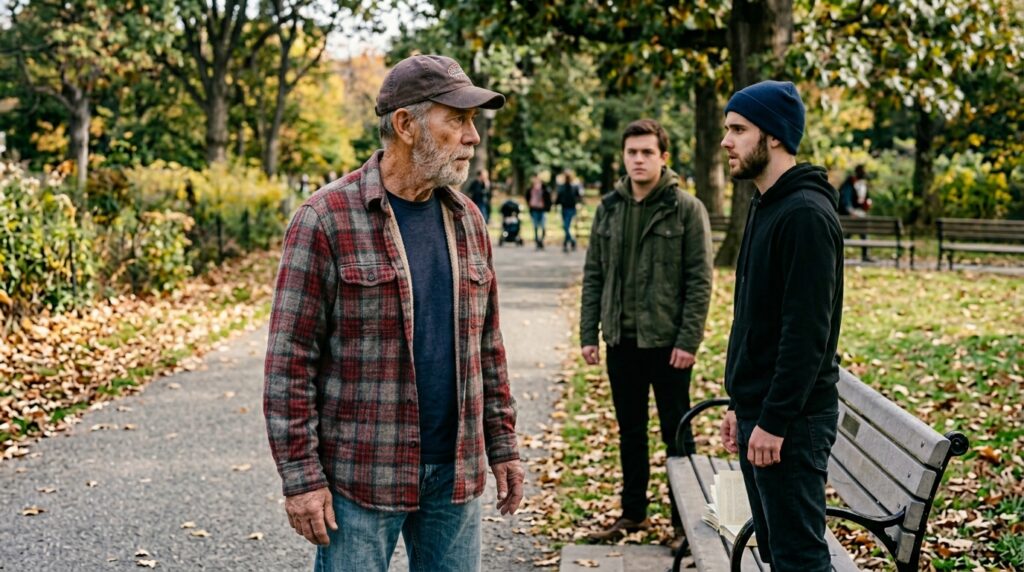
“Hey old man, you shouldn’t be out here alone with something we want.”
The words didn’t carry the heat of an argument; they had the cold, transactional flatness of a bad habit. Frank didn’t look up from page eighty-four. The paper under his thumb was old, thick-grained and smelling of the dry cellar where he kept his crates. Below the path, the municipal sprinklers clicked in their rhythmic, mechanical increments, throwing a fine, metallic mist against the chain-link perimeter fence.
He didn’t move his feet. His worn leather boots were already set three inches apart, wedged firmly into the frost-cracked seam of the asphalt. On his left hand, the warped copper ring felt heavy, a dull band of unpolished metal absorbing the flat heat of the midday Ohio sun.
“I’m just trying to finish my chapter,” Frank said. His voice was a low rumble, like gravel shifting under a tire.
The boy in the dark fleece hoodie stepped closer, his shadow falling directly across the open text. He smelled of cheap tobacco and the sour, damp grease of the local fast-food lanes down on Route 4. His companion, a shorter youth with short-cropped hair and a stiff casual jacket, moved laterally, trying to clear Frank’s right flank, his boots scuffing the dry dandelion heads near the iron frame of the bench. They were young—early twenties at most—with the loose, jerky joints of people who believed their speed was a secret nobody else could read.
“The book ain’t what we’re talking about, pop,” the main challenger said. He leaned forward, his drawstrings swinging against his chest like small pendulums. He reached out, a wide, open-handed gesture meant to collar Frank’s plaid overshirt and drag him off the timber.
Frank didn’t swing. He didn’t drop his head.
The moment the boy’s fingers cleared the edge of the wooden slat, Frank’s left hand moved three inches. It wasn’t the lightning strike of a cinema film; it was the heavy, deliberate leverage of an old lathe driver. His thumb caught the inside of the boy’s wrist bone, his fingers sealing around the tendons like an iron clamp. He didn’t pull—he shifted his weight back into the iron armrest, using the boy’s own forward velocity to pivot the elbow joint past its natural stop.
There was a short, wet thud as the challenger’s center of gravity evaporated. His shoulder checked the edge of the bench, his boots skittering across the dry pavement before his ribs met the hard asphalt. The second boy tried to step into the gap, but Frank’s right boot was already extended, a low, rigid barrier that caught the boy’s shin with the iron-toed weight of five-pound leather.
Both of them were down in the dirt within three seconds. The park went completely silent, save for the rhythmic chink-chink-chink of the distant water lines.
Frank stood up. His spine settled into its old, straight carriage, the plaid cloth falling neat over his gray t-shirt. The book remained face-up on the wood, the pages stationary in the dead air. Two hundred yards away, near the green municipal trash bins, a pair of joggers froze, their neon shirts stark against the desaturated gray of the park fence.
Frank looked down at the path. The boy in the beanie was clutching his wrist, his eyes wide and leaking small, involuntary tears of shock against the gravel.
“You boys picked the wrong man to bother today,” Frank said. He didn’t shout. He didn’t need to. He extended his right hand toward the southern gate, his copper ring catching the dull light. “Now go home and rethink this.”
As the boy scrambled backward, his fingers caught on a small, heavy brass key that slipped from his own torn hoodie pocket, rolling silently into the grass near Frank’s boot—a key stamped with Frank’s old military service branch insignia.








