Chapter 9: The Street Belonged to Everyone
By October, the trees along Brookhaven’s sidewalks had begun turning gold and red.
The air was cooler.
Front porches displayed pumpkins.
Neighbors prepared for the annual fall gathering.
Life had settled into a more comfortable rhythm.
Emily was now working full-time at the senior center.
Her responsibilities included organizing volunteer programs, coordinating community events, and helping older residents connect with local services.
She loved the work.
It was demanding.
Some days were exhausting.
But every evening, she came home knowing she had helped someone.
She continued operating her lemonade stand on occasional weekends, donating a portion of the proceeds to the center.
The association had formally clarified that temporary neighborhood stands were permitted when they complied with applicable local requirements and did not obstruct sidewalks or create nuisances.
The clarification applied to everyone.
Not just Emily.
That mattered.
The goal had never been special treatment for the Carters.
It was fairness.
Thomas Reed, now the elected association president, oversaw the adoption of new enforcement procedures.
Homeowners received clearer notices.
Board decisions were documented.
Residents were encouraged to attend meetings and ask questions.
The association also established a small volunteer committee to review proposed community activities.
Margaret Bell joined.
So did Robert Ellis.
Helen Ramirez volunteered to help coordinate seasonal events.
The changes did not eliminate disagreements.
Neighbors still argued about parking.
Some complained about landscaping.
Others disagreed about holiday decorations.
But the tone had changed.
People were more willing to ask questions before making accusations.
And board members were more careful about distinguishing enforceable rules from personal preferences.
One afternoon, Emily noticed Margaret sitting on her front porch.
The white wooden bench had returned.
Margaret had repainted it.
She had also placed a small pot of yellow chrysanthemums beside it.
Emily stopped to say hello.
Margaret patted the empty space beside her.
They sat together for a few minutes, watching leaves drift across the street.
“My husband built this bench,” Margaret said.
Emily looked at the worn wooden armrest.
“He did a beautiful job.”
“He wasn’t much of a carpenter when we married.”
Margaret smiled.
“But he learned.”
She ran her hand along the bench.
“We sat here every evening after dinner. Sometimes we talked for hours. Sometimes we didn’t say anything at all.”
Emily listened.
“After he died, I kept coming out here. It made the evenings easier.”
Margaret looked toward the sidewalk.
“When Patricia told me to remove it, I felt like she was taking away one of the last places where I still had him.”
Emily felt a lump forming in her throat.
“I wish you’d told us sooner.”
Margaret shook her head gently.
“At my age, you get tired of fighting over things that should be simple.”
They sat quietly.
Then Margaret smiled.
“But sometimes the young people remind us that being tired doesn’t mean we have to give up.”
Emily reached over and squeezed her hand.
Across the street, Michael was mowing the lawn.
He paused to wave.
Margaret waved back.
A few minutes later, Patricia appeared outside her house.
She carried a small watering can and began tending the flowers near her porch.
Emily watched her for a moment.
Patricia had become quieter since resigning from the board.
She still attended occasional neighborhood gatherings.
She still had strong opinions.
But she no longer approached every disagreement as a battle she needed to win.
Some neighbors remained wary of her.
Others had gradually resumed ordinary conversation.
Margaret was among them.
“She brought me a pot of flowers last week,” Margaret said.
Emily looked surprised.
“Patricia?”
Margaret nodded.
“She said she liked the bench.”
Emily smiled faintly.
“That must have been difficult for her.”
“Perhaps.”
Margaret watched Patricia water the flowers.
“People can change. But it takes more than saying they’re sorry.”
Emily agreed.
She had learned that forgiveness and accountability were not opposites.
A person could acknowledge an apology while still expecting better behavior.
A community could allow someone to rebuild trust without pretending the past had never happened.
And justice did not always require a dramatic punishment.
Sometimes it meant restoring what had been damaged, correcting unfair decisions, and ensuring the same harm would be harder to repeat.
The following weekend, Emily organized a small neighborhood gathering outside the Carter house.
There was no formal program.
No speeches.
Just lemonade, homemade cookies, folding chairs, and neighbors enjoying a pleasant autumn afternoon.
Michael placed the repaired table beneath the oak tree.
Emily set out the pitchers.
Margaret brought oatmeal cookies.
Helen arrived with her grandchildren.
Robert and Carol carried extra chairs.
As the afternoon progressed, people wandered over from nearby houses.
Some stayed for five minutes.
Others stayed for hours.
The gathering felt like the kind of neighborhood afternoon Emily remembered from childhood.
Before social media arguments.
Before endless complaints.
Before people became so concerned with controlling their surroundings that they forgot to enjoy the people living beside them.
At one point, Patricia approached.
She carried a plate of homemade lemon bars.
Emily greeted her politely.
Patricia placed the plate beside the lemonade.
“I thought these might go well together.”
“They look good,” Emily said.
Patricia glanced at the repaired table.
“Your father did a nice job fixing it.”
“He did.”
There was a brief silence.
Then Patricia asked whether she could purchase a cup.
Emily poured the lemonade.
Patricia handed her a dollar.
The exchange was ordinary.
Almost comically ordinary, considering everything that had happened.
But that was what made it meaningful.
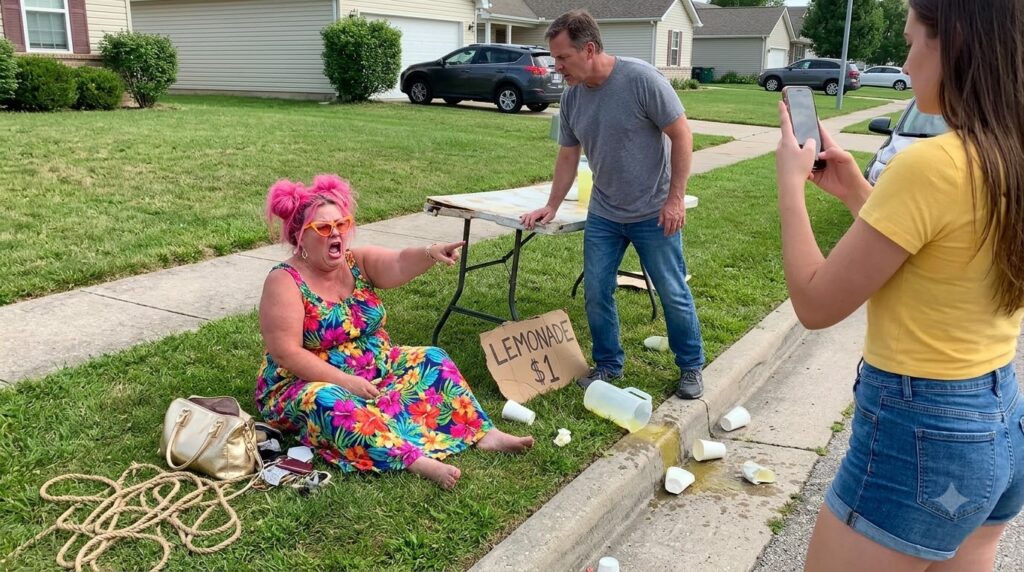
Months earlier, Patricia had tried to drag the table away with a rope.
Now she stood beside it, waiting patiently for a cup of lemonade.
Emily handed it to her.
Patricia thanked her.
Then she walked toward an empty chair near Margaret.
No confrontation followed.
No one shouted.
No one reached for a phone.
The afternoon continued.
Michael watched from the porch.
When Emily joined him, he smiled.
“Quite a difference from the last time we had a crowd out here.”
Emily laughed.
“That’s one way to put it.”
He looked toward the table.
“You know, I was ready to throw that thing away after she damaged it.”
“I’m glad you didn’t.”
“Me too.”
He placed his hand on her shoulder.
“Your mother would have liked today.”
Emily looked at the neighbors laughing beneath the oak tree.
She could almost imagine Anne standing behind the table, telling everyone that the secret to good lemonade was using fresh lemons and never rushing the sugar.
“I think she would have,” Emily said.
As the sun lowered behind the houses, the neighborhood slowly grew quiet.
Families returned home.
Chairs were folded.
Empty pitchers were carried inside.
Emily counted the day’s earnings and set aside the portion designated for the senior center.
Then she noticed the old handwritten sign leaning against the garage wall.
LEMONADE $1.
It was the original sign.
The corners were bent.
One edge still carried a faint yellow stain from the day Patricia pulled the table across the lawn.
Michael had wanted to replace it.
But Emily had insisted on keeping it.
She picked it up and examined the familiar letters.
It reminded her of a terrible afternoon.
But it also reminded her of everything that followed.
Her father’s courage.
Margaret’s quiet determination.
The neighbors who finally spoke up.
The association that learned to govern more fairly.
The career opportunity she had almost been too discouraged to pursue.
And the simple truth that dignity was worth defending, even when the thing being defended looked small to everyone else.
Emily carried the sign inside.
She placed it on a shelf in her room, beside a photograph of her mother.
Then she returned to the porch.
Michael was sitting in his favorite chair, watching the last light fade over the lawns.
Emily sat beside him.
For a while, neither spoke.
Finally, Michael looked at her.
“Do you ever wish you’d never set up that lemonade stand?”
Emily considered the question.
She remembered the spilled lemonade, the accusations, the police visit, and the weeks of uncertainty.
Then she remembered the fundraiser, her new job, Margaret’s bench, and the neighbors gathered beneath the oak tree.
“No,” she said.
“Not even after everything?”
She shook her head.
“Especially after everything.”
Michael smiled.
The street was peaceful.
A few porch lights glowed in the distance.
Somewhere nearby, a dog barked.
And three houses down, Patricia Whitmore quietly closed her front door.
There were no more threats.
No more ropes.
No more demands about who belonged on the street.
Just neighbors living their lives.
Emily had never wanted to become the center of a neighborhood controversy.
She had wanted to earn a little money, honor her mother’s recipe, and find her way forward after a difficult year.
But the experience taught her something she would carry into every part of her life.
A home was more than a property.
A neighborhood was more than a collection of rules.
And respect was not something one person could demand while denying it to everyone else.
It had to move in both directions.
The repaired lemonade table remained in the Carter garage, ready for the next warm weekend.
And whenever Emily brought it outside, she remembered the day someone tried to drag it away.
Not because that day had defeated her.
But because it hadn’t.
The street had never belonged to Patricia Whitmore. It had never belonged to the Carters alone, either.
It belonged to everyone who called it home.