Chapter 2: A Neighborhood Divided
By six o’clock that evening, Patricia’s post had attracted more than eighty comments.
Emily sat at the kitchen table, scrolling through them while her father washed the remaining lemonade pitchers.
Some neighbors immediately questioned Patricia’s account.
Others believed her.
A few demanded that Michael apologize.
One person suggested calling the homeowners association.
Another wrote that the Carters had been causing problems since Emily started operating her stand.
Emily stared at that comment.
She recognized the name.
Denise Harper.
Denise lived two streets away and had never purchased lemonade, spoken to Emily, or even walked past the stand.
Yet she was confidently describing the Carter family as a neighborhood nuisance.
Emily felt a familiar frustration rising.
It wasn’t merely the accusation.
It was how quickly strangers seemed willing to accept it.
Her father dried his hands and sat beside her.
“Don’t argue with people online,” he said.
“She posted your picture.”
“I know.”
“She said you assaulted her.”
“I know that too.”
Emily turned the screen toward him.
Patricia had written that Michael became violent after she politely requested the removal of an unauthorized commercial operation.
According to the post, he had shoved her to the ground, threatened her, and intimidated her into leaving.
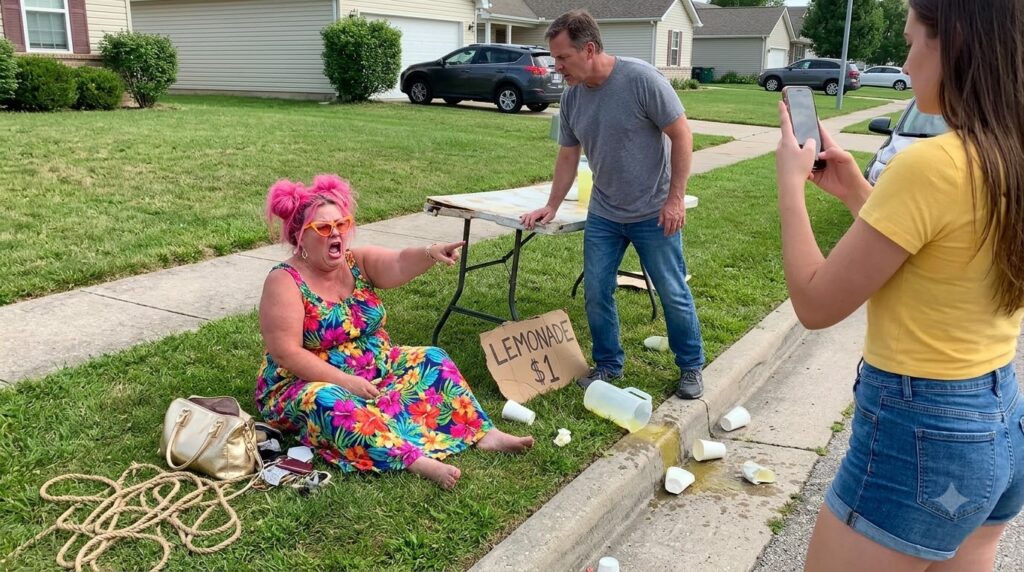
There was no mention of the rope.
No mention of the overturned lemonade.
No mention of Patricia pulling the table across the lawn.
Michael read the accusations without speaking.
Emily could see the muscles tightening along his jaw.
For thirty years, her father had worked as a maintenance supervisor at a local manufacturing plant. He was known for being dependable, patient, and almost stubbornly unwilling to escalate an argument.
He had never been arrested.
He had never been involved in a physical altercation.
Now a woman who lived three houses away was publicly calling him dangerous.
Emily wanted to upload the video immediately.
Michael stopped her.
“Save the original first.”
She looked at him.
“Why?”
“Because once people start making accusations, you need to keep the evidence exactly as it happened.”
Emily transferred the recording to her laptop and created a backup.
Then she watched it again.
The footage was clear.
Patricia’s rope.
The sliding table.
The spilled lemonade.
Michael holding the table.
The rope slipping free.
Patricia falling backward without anyone touching her.
And finally, the accusation.
The entire sequence lasted ten seconds.
Ten seconds that contradicted almost everything Patricia had written.
Emily was about to publish the clip when another notification arrived.
This one came from the neighborhood association.
The email was titled:
NOTICE OF POTENTIAL COMMUNITY VIOLATION.
It stated that the association had received complaints about unauthorized commercial activity at the Carter residence.
The stand would need to remain closed pending review.
Michael read the message twice.
“That’s interesting.”
“What is?”
“The complaint was submitted this afternoon.”
Emily checked the timestamp.
It had been filed less than twenty minutes after Patricia fell.
Michael leaned back in his chair.
“She didn’t waste any time.”
The Carters lived in Brookhaven Estates, a quiet neighborhood of detached houses, mature oak trees, and neatly maintained lawns.
The community had a homeowners association, but its rules were relatively modest.
Residents paid annual dues for common-area maintenance, landscaping, and neighborhood improvements.
The association occasionally addressed parking disputes or neglected properties.
It had never previously challenged a weekend lemonade stand.
Emily knew because she had checked the community handbook before setting up her table.
There was a restriction against operating a permanent retail business from a residence.
But there was no explicit prohibition against temporary neighborhood fundraising or occasional home-based sales.
Her stand operated for only a few hours on Saturdays and Sundays.
It did not block the sidewalk.
It did not create traffic problems.
And she cleaned everything afterward.
Nevertheless, the association’s message instructed her to stop selling lemonade.
For the first time since losing her job, Emily felt the crushing weight of being powerless.
She had returned home six months earlier after the marketing company where she worked eliminated her position.
At first, she believed she would find another job quickly.
Then the interviews slowed.
Her savings disappeared.
She began helping her father with groceries while searching for steady work.
The lemonade stand had started as a small experiment.
Her grandmother’s recipe, a folding table, and a handwritten sign.
Nothing more.
But people liked the lemonade.
Retired neighbors stopped to talk.
Parents bought cups for their teenagers.
A few customers returned every weekend.
Emily had even begun setting aside part of her earnings for the local senior center’s meal program, where her late mother had volunteered.
It wasn’t enough to support her.
But it gave her something she desperately needed.
A reason to get up on Saturday morning.
Now Patricia was trying to take that away.
Michael closed the laptop.
“We’ll answer the association tomorrow.”
Emily shook her head.
“No. We answer tonight.”
She opened a new message and attached the original video.
Then she wrote a brief explanation of what had happened.
She did not insult Patricia.
She did not speculate about her motives.
She simply described the incident and asked the association to preserve the original complaint.
Before sending the email, Emily added one final sentence.
We request that no action be taken against our property based on accusations contradicted by the attached recording.
She clicked Send.
Outside, the neighborhood grew quiet.
Across the street, porch lights flickered on.
Then Michael’s phone rang.
The caller was an old friend named Robert Ellis, a retired police sergeant who lived two blocks away.
Michael answered.
Robert’s voice was unusually serious.
“Mike, I thought you should know something.”
Michael listened.
His expression changed.
Then he asked a question that made Emily look up.
“She actually filed a police report?”