Chapter 8: A Different Kind of Victory
The Brookhaven Senior Resource Center’s summer fundraiser took place on a clear Saturday morning in late August.
White tents lined the community park.
Volunteers arranged folding chairs beneath the shade trees.
Local businesses donated baked goods, gift baskets, and raffle prizes.
A small jazz trio played near the pavilion.
Families arrived carrying picnic blankets.
Retirees greeted old friends.
Children ran across the grass while their grandparents watched from nearby benches.
At the center of the refreshment area stood Emily’s lemonade table.
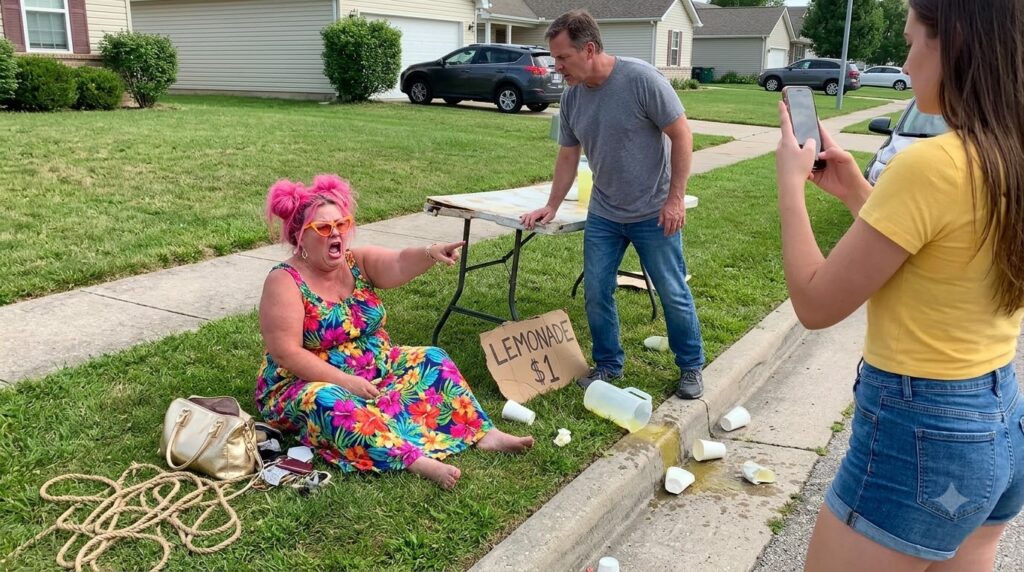
It was the same folding table her father had repaired after Patricia dragged it across the lawn.
Michael had insisted on bringing it.
“It’s sturdy,” he told her.
Emily knew that wasn’t the only reason.
The table had become a reminder of everything they had endured.
But it also represented something more hopeful.
A damaged object could be repaired.
A reputation could be defended.
And a bad experience did not have to determine what came afterward.
Emily had worked for weeks preparing the event.
She created the promotional campaign, recruited volunteers, and coordinated deliveries.
Rachel Morgan supervised the overall fundraiser, but she trusted Emily with many of the daily details.
By midmorning, the park was crowded.
Margaret Bell volunteered at the welcome table.
Robert Ellis helped direct parking.
Helen Ramirez organized children’s activities.
Susan Keller handled the donation records.
Michael carried boxes of bottled water between the supply tent and the refreshment stand.
For the first time in months, Brookhaven felt like a neighborhood again.
People weren’t gathering to argue about rules.
They were gathering to help one another.
The fundraiser supported meal deliveries, transportation assistance, and social programs for older residents.
Many of the people benefiting from those services had spent decades raising families, working, and contributing to the community.
Now they needed a little help.
Emily thought about her mother.
Anne had volunteered at the center every Wednesday until her illness made it impossible.
She believed that aging should never mean becoming invisible.
Emily remembered her saying that dignity often depended on small things.
A ride to a doctor’s appointment.
A hot meal.
Someone remembering your birthday.
Someone asking how you were doing and waiting long enough to hear the answer.
At noon, Rachel announced that the fundraiser had already exceeded its original donation goal.
The crowd applauded.
Emily stood near the lemonade stand, smiling.
Michael placed an arm around her shoulders.
“You did this,” he said.
“We all did.”
He shook his head.
“You brought people together.”
Emily looked around the park.
Margaret was laughing with Helen.
Robert was helping an older gentleman find a chair.
Volunteers carried trays of food toward the pavilion.
The scene was ordinary.
And beautiful.
Then Emily noticed someone standing near the edge of the park.
Patricia Whitmore.
She wore a simple navy-blue dress.
Her pink hair was pulled into a low ponytail.
There were no oversized sunglasses.
No bright handbag.
No dramatic accessories.
She stood alone, watching the gathering from a distance.
Emily felt her stomach tighten.
They had not spoken since the incident.
Patricia had paid for the damage and resigned from the board.
But she had never apologized.
Emily wasn’t sure what she wanted to do.
Michael noticed her expression.
He followed her gaze.
For several seconds, father and daughter stood quietly.
Then Patricia approached.
She stopped a few feet from the table.
“Emily,” she said.
Her voice was subdued.
Emily nodded.
Patricia looked at the repaired table.
Then at the photograph of Anne beside the lemonade pitchers.
“I didn’t know your mother volunteered here.”
“She did for years.”
Patricia studied the photograph.
“My sister used their transportation program after her surgery.”
Emily hadn’t known Patricia had a sister.
For a moment, neither woman spoke.
Then Patricia reached into her purse.
She removed a folded envelope.
“I wanted to contribute to the fundraiser.”
She placed it on the table.
Emily did not touch it immediately.
Patricia seemed to understand her hesitation.
“You don’t have to thank me.”
She turned toward Michael.
Her hands trembled slightly.
“What I said about you wasn’t true.”
Michael remained silent.
Patricia swallowed.
“You didn’t push me. I fell because the rope came loose.”
The words were simple.
But they were the first direct acknowledgment she had made.
“I was angry,” Patricia continued. “And embarrassed. I didn’t want people to see me lose control.”
Emily looked at her carefully.
“That doesn’t explain why you accused my father.”
“No,” Patricia said. “It doesn’t.”
She paused.
“I was wrong.”
Michael took a slow breath.
For months, he had wanted those words.
Now that he heard them, he found he had little to say.
Finally, he nodded.
“Thank you for acknowledging it.”
Patricia looked toward the gathering.
“I’ve spent a long time thinking that keeping everything perfect was the same as keeping things good.”
Her eyes moved toward Margaret, who was helping an elderly visitor into a chair.
“I suppose I confused the two.”
Emily did not offer instant forgiveness.
The harm had been real.
Her father had been publicly accused of violence.
Their property had been damaged.
Neighbors had been pressured.
And several people had paid fines they should never have received.
An apology could not erase those consequences.
But it could mark the beginning of something different.
“If you want to make things right,” Emily said, “you can start by treating people with respect, even when you disagree with them.”
Patricia nodded.
Then she walked toward the donation tent.
Emily opened the envelope later.
Inside was a check made payable to the senior center.
It was for five hundred dollars.
There was also a short handwritten note.
For the people who make this neighborhood worth living in.
Emily placed the check with the other donations.
She did not announce it.
She did not photograph it.
She did not post about Patricia’s visit.
Some moments deserved to remain private.
That afternoon, Rachel asked Emily to step into the pavilion office.
She closed the door and smiled.
The hiring committee had completed its interviews.
They wanted to offer Emily the community outreach coordinator position.
Full-time.
With benefits.
And a salary that would allow her to begin rebuilding her independence.
Emily stared at Rachel.
For a moment, she couldn’t speak.
Then she began to cry.
Not because she was sad.
But because the long months of uncertainty had finally led somewhere.
When she returned to the park, Michael immediately knew something had happened.
She told him.
He wrapped her in a hug.
For several seconds, neither said anything.
Then Michael laughed.
“Your mother always said that lemonade recipe would take you places.”
Emily laughed through her tears.
“She probably didn’t mean quite like this.”
“Knowing your mother,” he said, “she probably did.”