Chapter 3: The Report That Changed Everything
The following morning, two police officers arrived at the Carter residence.
They were polite.
Professional.
And clearly aware that the situation had already become a neighborhood spectacle.
Officer Daniel Brooks, a man in his early forties, introduced himself and explained that Patricia Whitmore had reported an assault.
She claimed Michael had pushed her backward during a dispute over the lemonade stand.
According to Patricia, the fall had caused shoulder pain and emotional distress.
She had also reported that Michael threatened her afterward.
Michael invited the officers onto the front porch.
Emily stood beside him with her laptop.
Before anyone asked a question, she offered the recording.
Officer Brooks watched it.
Then he watched it again.
His partner leaned closer.
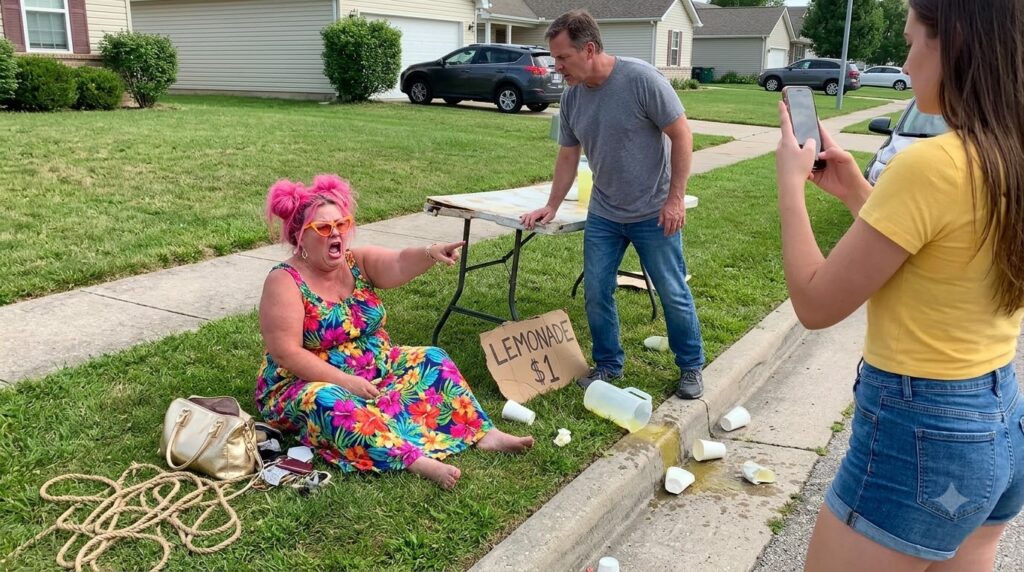
The footage showed Patricia pulling the rope, the table sliding across the grass, Michael grabbing the table, and Patricia falling when the rope came loose.
Neither officer spoke for several seconds.
Finally, Brooks looked at Michael.
“Did you ever make physical contact with Mrs. Whitmore?”
“No, sir.”
“Did you threaten her?”
“No.”
Brooks turned to Emily.
“Is this the original recording?”
“Yes. I have the original file and a backup.”
He asked whether she would be willing to provide a copy through the department’s evidence-submission process.
She agreed immediately.
The officers then photographed the damaged table, the cracked pitcher, and the remaining marks on the grass.
Emily showed them the rope, which her father had placed inside a cardboard box after the incident.
Brooks examined it without touching it.
“Please keep that somewhere secure until we determine whether it needs to be collected,” he said.
The officers also reviewed Patricia’s public accusation and the association’s email.
Brooks made no promises about what would happen next.
He explained that the department would evaluate the available evidence and document the conflicting accounts.
He also warned both Carters against confronting Patricia.
After the officers left, Emily felt relieved.
But Michael remained cautious.
“An accusation doesn’t disappear just because we know it’s false,” he said.
By lunchtime, the situation had become more complicated.
The association sent a second email.
It confirmed that a special board meeting would take place the following Thursday.
The purpose was to review the Carter family’s alleged violations.
Emily immediately requested a copy of the complaint.
The association’s secretary, Linda Foster, replied that the document was confidential pending review.
That answer bothered Michael.
He had served on the association’s landscaping committee years earlier and understood that homeowners were ordinarily entitled to know the allegations against them before a hearing.
He asked Linda to identify the rule Emily had supposedly violated.
She responded with a general reference to residential-use restrictions.
No specific section.
No explanation of how a temporary stand qualified as a prohibited business.
Emily began researching the association’s governing documents.
She found the relevant section.
It prohibited businesses that generated substantial traffic, noise, or interference with neighboring properties.
The language did not automatically ban occasional sales.
More importantly, enforcement required a written notice identifying the alleged violation and an opportunity for the homeowner to respond.
Emily printed the page.
Then she discovered something else.
The association’s current president was Patricia Whitmore.
Patricia had been elected eight months earlier after running on a platform of neighborhood beautification and stricter enforcement of community standards.
Emily knew Patricia held the position.
But she hadn’t realized how much influence the woman exercised over routine complaints.
Michael read the association’s bylaws that evening.
The president could not independently impose penalties.
Enforcement decisions required board approval.
And any director with a personal conflict of interest was expected to disclose it and abstain from the relevant decision.
Michael pointed to the provision.
“She’s the complainant.”
Emily nodded.
“And the person trying to punish us.”
They prepared a formal written objection requesting that Patricia recuse herself from all proceedings involving the Carter property.
The next morning, Linda replied.
Patricia had declined to recuse herself.
She believed her role as president required her participation.
Michael stared at the email.
“That isn’t how impartial decisions work.”
Emily felt her frustration hardening into determination.
She wasn’t interested in revenge.
She wanted to sell lemonade on her own lawn without being harassed.
She wanted her father’s reputation restored.
And she wanted the association to follow its own rules.
That afternoon, an unexpected visitor arrived.
It was Margaret Bell, a seventy-three-year-old widow who lived at the end of the block.
Margaret carried a small paper bag containing homemade oatmeal cookies.
She had purchased lemonade from Emily nearly every weekend.
After exchanging greetings, Margaret sat at the kitchen table.
“I heard about what happened,” she said.
Emily sighed.
“Everybody has.”
Margaret looked toward the front window.
“Not everybody knows the whole story.”
She hesitated.
Then she reached into her handbag and removed a folded letter.
It was an association violation notice dated three months earlier.
Margaret had been ordered to remove a wooden bench from her front porch.
The reason given was that the bench created an undesirable appearance.
Emily frowned.
The bench was a simple white-painted piece of furniture.
Margaret explained that it had belonged to her husband.
They had sat there together every evening for twenty-six years.
After his death, she continued sitting on it because the routine made the house feel less empty.
Patricia had personally demanded its removal.
When Margaret refused, she received a warning about potential fines.
“I took it inside because I couldn’t afford a fight,” Margaret said quietly.
Emily looked at the letter.
Then at Margaret.
“Why are you showing us this?”
The older woman folded her hands.
“Because I don’t think your lemonade stand is the real problem.”
She paused.
“And I don’t think I’m the only person Patricia has treated this way.”