Chapter 5: The Hearing at Brookhaven
Thursday evening arrived under a sky heavy with summer rain.
The Brookhaven Estates community room filled faster than anyone expected.
Usually, association meetings attracted six or seven residents.
That night, nearly forty people attended.
Some came because they had seen Emily’s video.
Others wanted to discuss their own experiences with Patricia.
A few supported the president and believed the entire controversy had been exaggerated.
Michael entered with Emily shortly before seven.
He wore a clean blue button-down shirt and carried a folder containing the relevant documents.
Emily had organized everything into sections.
The video.
The police incident information.
Photographs of the damaged stand.
The association’s governing rules.
Copies of the enforcement notices.
And the email Patricia had sent before the confrontation.
Patricia sat at the front table.
Her bright pink hair was now arranged in a carefully styled bob rather than the two buns she had worn during the incident.
She wore a vivid purple blazer, black trousers, and large silver earrings.
Her expression remained stern.
But Emily noticed that Patricia avoided looking directly at her father.
The meeting began with routine business.
Then the board reached the Carter complaint.
Patricia immediately announced that the family had operated an unauthorized commercial enterprise.
She described the lemonade stand as a threat to neighborhood appearance and property values.
Michael waited until she finished.
Then he calmly asked which provision prohibited the activity.
Patricia referred to the residential-use section.
Emily opened the handbook and read the relevant language.
The restriction concerned activities that created substantial traffic, noise, or interference.
She explained that the stand operated only on weekend afternoons and occupied a small portion of the family’s own lawn.
She also presented photographs showing that the sidewalk remained unobstructed.
One board member, Thomas Reed, asked whether the association had received documented complaints about traffic or noise.
Linda checked the records.
There were none.
Patricia insisted that the stand was inappropriate regardless.
Thomas shook his head.
“Personal preference isn’t the same as an enforceable rule.”
The room grew quiet.
Patricia’s face tightened.
Emily then addressed the incident itself.
She played the ten-second recording on a portable screen.
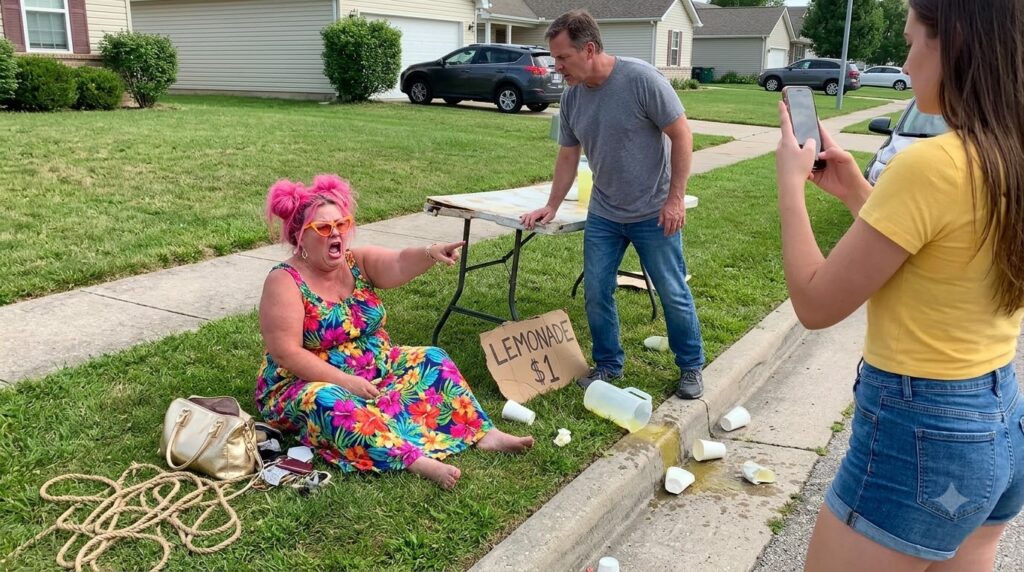
The room watched Patricia pull the table.
The pitcher overturned.
Michael intervened.
The rope slipped.
Patricia fell.
Then came the accusation.
“HE PUSHED ME! CALL THE POLICE!”
A few people shifted uncomfortably in their chairs.
Others looked toward Patricia.
Emily stopped the video before anyone could turn the moment into a joke.
She explained that her father had been accused of assault and that the allegation had caused genuine distress.
He had spent several days wondering whether the accusation might affect his employment or reputation.
He had done nothing more than protect his daughter’s property.
Michael then spoke.
He didn’t raise his voice.
He described the fear of seeing a neighbor publicly accuse him of violence.
He explained how difficult it had been to watch strangers question his character.
And he asked the board to consider what would happen if ordinary residents could be punished based on unsupported personal accusations.
The room remained silent when he finished.
Thomas turned to Patricia.
“Did you authorize the enforcement notice before the board reviewed the complaint?”
Patricia hesitated.
“As president, I have responsibilities.”
“That wasn’t the question.”
Linda opened the meeting records.
She confirmed that no board vote had authorized the initial notice.
Thomas asked whether Patricia had disclosed her personal involvement in the dispute before participating in the enforcement process.
She had not.
The board’s treasurer, Susan Keller, spoke next.
Susan was a retired accountant who rarely involved herself in neighborhood disagreements.
She had reviewed several of the documents Linda provided.
Some notices, she explained, had been issued without the procedures required by the association’s rules.
The issue was no longer simply Emily’s lemonade stand.
It was the association’s decision-making process.
Patricia attempted to interrupt.
Thomas asked her to wait.
Susan continued.
She recommended suspending enforcement of the Carter notice, reviewing recent complaints, and obtaining independent guidance on proper board procedures.
Patricia objected.
She argued that the board was surrendering to public pressure.
But the other directors appeared increasingly uncomfortable.
After a brief discussion, Thomas moved that the complaint against the Carter property be dismissed because the evidence did not establish a violation.
The motion passed.
Four votes to one.
Patricia cast the dissenting vote, despite objections to her participation.
Emily exhaled slowly.
For the first time in days, she felt the tension in her shoulders ease.
Then Thomas introduced a second motion.
He proposed an independent review of the association’s recent enforcement actions.
The board approved it.
Patricia stood abruptly.
She announced that she would not tolerate what she called a coordinated attack on her leadership.
Then she walked out.
The meeting continued without her.
Residents began asking questions about prior notices.
Margaret Bell stood and described the bench she had removed from her porch.
Helen Ramirez explained the warning about her grandchildren’s chalk drawings.
Robert Ellis discussed the flag beside his garage.
The board agreed to review the disputed notices and suspend collection of associated penalties while the review was underway.
When the meeting finally ended, several neighbors approached Michael.
Some apologized for believing Patricia’s accusations.
Others thanked Emily for presenting the evidence calmly.
Margaret squeezed Emily’s hand.
“Your mother would have been proud of you.”
Emily swallowed hard.
Her mother, Anne, had died four years earlier after a long illness.
For a moment, the crowded room seemed to fade.
She remembered Anne sitting at the kitchen counter, squeezing lemons into a glass pitcher while telling Emily that small acts of kindness mattered more than grand gestures.
Emily smiled through sudden tears.
“Thank you, Margaret.”
Outside, rain had begun falling softly.
Michael opened an umbrella as they walked toward the car.
They had won the hearing.
But when Emily checked her phone, she found another message.
This one was from a local reporter.
The reporter wanted to interview the family about the viral video.
And Patricia had apparently already agreed to tell her side of the story.