
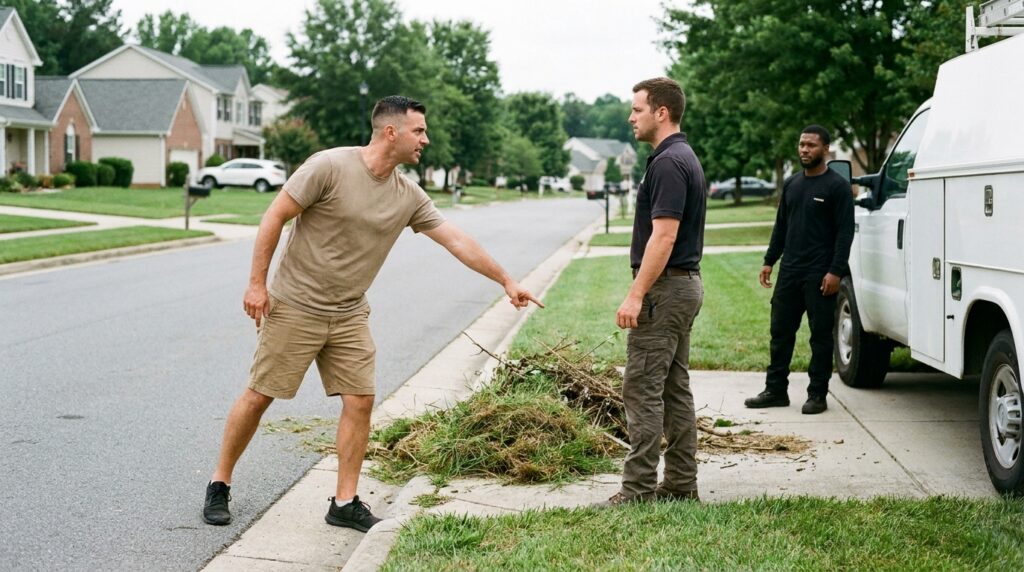
CHAPTER 8: THE COLD CLEARANCE
“The truck stays until the dirt is showing,” Jesse said.
His voice was barely louder than the low, double-stroke rattle of the state supervisor’s idling wagon, but it carried across the entire width of the concrete gutter strip. He didn’t look at the Confronter, whose fingers had finally uncoiled from the zinc clip of the clipboard. The paper had begun to flutter, its crisp corporate edges catching the dusty wind that was blowing in off the state highway, completely detached from the false authority it had held twenty minutes ago.
Jesse took three slow paces toward the rear tire of the flatbed. He reached into the steel side box, his palms grazing the cold, notched gears of the primary winch until his fingers closed around the handle of the long steel sounding rod. The metal was caked in dried grease and fine river silt, the scent of parched earth and iron slag sharp in his nostrils. When he swung the rod down against the exposed rim of the siphon cap, it produced a heavy, solid clack that sounded like an old rail spike hitting a tie.
“The state maps don’t terminate at your driveway line, mister,” the inspector said, his voice level and flat as he unrolled the historical hydrological charts directly over the truck’s blistered hood. His thumb pressed into a large, red-hatched perimeter that covered the lower three properties of the cul-de-sac. “This isn’t a county road lateral. This is an active floodway easement under state jurisdiction. Any unauthorized alteration or placement of grout-base fill inside this weir ring is a structural felony.”
The man in the tan t-shirt didn’t step back onto the parched grass. He stood by his mailbox, his shoulders tightened until his collarbone showed through the fabric of his shirt. He looked down the length of the road where the white utility van was already disappearing over the crest of the hill, its transmission screeching as the driver pushed it through the outer gate without waiting for his partner.
“The board didn’t execute the filling to block the flow,” the Confronter muttered, his thumb tapping the cold glass of his phone screen with a short, regular rhythm that had no code left to run. “It was an emergency stabilization project. The water table was rising into the foundation piers.”
“The water table was rising because your brother-in-law dumped five hundred tons of highway scrap into the siphon basin to avoid the commercial landfill fees,” Jesse said. He didn’t lift his eyes from the open trap. He shoved the steel sounding rod four feet down into the dark, bubbling water until it struck a jagged piece of reinforced concrete that had been wedged across the intake valve. “You didn’t call the tow truck to clear an obstruction. You called it because you knew that if a county crew dropped an inspection camera down this shaft, the state would be digging up your entire front yard by Monday morning.”
Across the street, the woman in the canvas apron walked right out into the middle of the road, her smartphone held steady, the glass lens reflecting the slow, rhythmic rotation of the inspector’s orange safety lights. She stopped three feet from the Confronter’s mailbox, her face expressionless as she tracked the line of the gray water seeping down the concrete gutter.
“The whole street’s on the ledger, Gary,” she said, her voice small but sharp enough to cut through the hum of the truck’s diesel injectors. “The board’s been collecting the drainage assessment from every house on this ridge for four years. Where’s the county receipt folder?”
The Confronter didn’t answer her. He let the clipboard slide out from beneath his arm, the plastic board hitting the parched earth with a dull, hollow thud that sent up a small circle of gray limestone dust. He turned on his heel, his expensive running shoes dragging through the loose gravel as he began the slow, heavy walk back up his pristine concrete driveway toward the shadow of his double garage.
Jesse didn’t track his retreat. He reached down to the winch assembly, his hands moving with the deliberate, rhythmic discipline of a man who measured his life by the weight of the material in his bed. He gripped the iron clutch lever, pulling it backward until the heavy transport chain hummed with mechanical tension, lifting the final root ball of the oak debris clear of the cast-iron storm grate.
The pile came up with a dry, splintering crackle, revealing the raw, unpainted concrete of the municipal rim underneath. The water in the channel was already starting to drop, draining out through the opened siphon cap with a deep, gurgling rattle that shook the iron plate beneath Jesse’s boots.
“Miller,” Jesse said, his voice dropping into the quiet center of the fading afternoon heat. “Get the shovel from the cab. We’ve got twenty minutes of clearing before the county surveyor closes the office ledger.”
He leaned his weight against the side rail, his fingers tracing the rusted edge of the steel box where his tools were locked. The cul-de-sac was silent now, the houses on the low side of the ridge sitting quiet beneath the wide, desaturated blue of the suburban sky, their foundations resting on lines that had been drawn forty years before the first brick was laid. Jesse pulled his wire brush from his pocket and began to clean the limestone grit from his shears, his face settled into the gray lines of a man who knew exactly how much labor it took to keep a boundary straight.








