CHAPTER 7: THE UNCOVERED FLUID
The heavy hexagonal socket of the long iron crowbar didn’t slide smoothly onto the silt trap nut; it bit with a jagged, metallic screech that sheared away twenty years of layered rust and dried alkaline mud.
Jesse threw his weight into the shaft. The steel bar groaned, flexed under his palms, and then let go with a loud, hollow bang that echoed off the corrugated metal undercarriage of the idling utility van. A sour pool of stale, iron-choked drainage water seeped immediately out of the cast-iron seam, running down the gray asphalt until it hit the dry dirt of the lawn edge. It smelled of sulfur, spent transmission fluid, and old silt—the distinct chemical footprint of a shortcut hidden under the sub-base of a street.
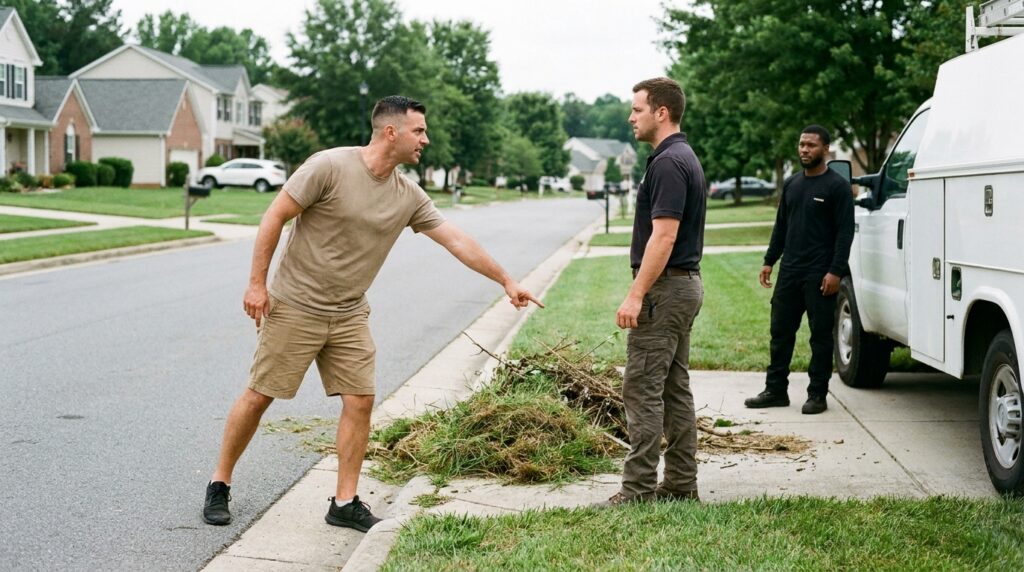
“You don’t have authorization to breach that utility lid,” the Confronter shouted, though his voice was thin now, fighting the deep, rhythmic rattle of the state inspector’s diesel wagon. He didn’t come down his concrete driveway. He stood by his mailbox, his fingers white where they clamped around his clipboard, his phone still held flat against his collarbone like a radio transmitter. “The drainage grid is under an exclusive engineering easement. If you alter the chamber pressure, you’re violating municipal safety codes.”
Jesse didn’t give him a glance. He reset the point of the crowbar, leveraging the wedge until the twelve-inch round inspection cap began to heave.
“The safety code left the lane when the unpermitted construction fill came in,” Jesse said. He wiped his palms on his dark canvas pants, leaving two greasy black streaks near the pockets. He looked at the state inspector, whose thick leather map cylinder was now resting flat against the hood of Jesse’s own truck. “Take a look at the neck of this bypass channel, sir. That’s not river gravel coming up. That’s crushed masonry from the commercial site off the highway.”
The state inspector stepped into the wet zone, his heavy boots crunching through the loose limestone gravel that Miller had shoveled into a heap beside the tire. He didn’t use a clipboard. He pulled an old, steel-edged rule from his khaki shirt pocket and dropped it straight down into the black water of the open silt trap. The metal rule went down eighteen inches before hitting a solid, grinding stop that sounded like stone hitting concrete.
“The record sheet says this sump runs five feet deep to the primary siphon pipe,” the inspector muttered, his eyes narrowing through his sun-bleached eyebrows. He pulled the rule back up, its zinc plating covered in a slick, blue-grey mud that left an oily iridescent rainbow on the surface of the puddle. “This isn’t silt accumulation. Someone has dumped a low-grade grout base straight into the state clearway. Who gave the authorization to alter the flow profile of this weir line?”
The man in the tan t-shirt looked toward the white van, but the passenger had already pulled his high-visibility vest off, throwing it across the dashboard to hide the corporate logo of Vance Contracting LLC. The van’s transmission clicked into reverse, its tires spinning once against the oil-streaked gravel strip before it backed down the throat of the cul-de-sac, leaving a dark trail of unburned fuel in the hot midday air.
“The board approved a soil stabilization remedy,” the Confronter said, his voice crackling with a rehearsed legal defensiveness that had no weight left on the asphalt. “The contractor provided a full indemnity bond to the clerk’s office. It’s an internal neighborhood matter.”
“An internal matter doesn’t alter a state reservoir bypass,” the inspector said. He didn’t look at the paper on the clipboard. He unbuckled his leather cylinder, pulling out a set of thick canvas-backed charts that had been printed before the subdivision was even cleared of timber. He laid them flat over Jesse’s laminated sheets, the two sets of paper overlapping until the true geometry of the cul-de-sac appeared under the noon sun.
The lines on the inspector’s chart didn’t match the HOA plat. They showed that the entire road strip—every square foot of asphalt the truck was sitting on—was part of a non-negotiable public floodway. It wasn’t an easement for the neighborhood’s benefit; the neighborhood had been built by developers who had systematically lied about the width of the state clearway to squeeze three extra houses into the low side of the cul-de-sac.
Jesse looked down into the black water of the trap. A small, floating piece of plastic caught the glare of the rotating orange safety lights—it was an old county water district tag, cut clean through the center by a heavy-duty bolt cutter. It had been dumped down the shaft to hide the original serial number of the municipal valve.
“Miller,” Jesse said, his tone dry and level, matching the unyielding weight of the iron bar in his hand. “Go back to the toolbox. Grab the long steel sounding rod and the digital field kit. We aren’t just clearing a debris pile today. We’re going to map the whole fraud down to the bedrock before the surveyor’s office unseals the grand jury files.”
The woman across the street had stepped off her porch now, her canvas apron flapping around her knees as she walked toward the curb, her smartphone still recording every micro-second of the confrontation. The Confronter didn’t try to stop her. He looked down at his own expensive running shoes, which were now stained with the blue-grey muck that had bubbled up from the state’s hidden bypass.
“The line goes all the way under your garage, mister,” Jesse murmured, his voice flat as he pointed the crowbar toward the man’s driveway. “Let’s see if your board’s insurance covers a federal obstruction citation when the back-water hits your kitchen floor.”