CHAPTER 6: THE MAP ON THE HOOD
The white county engineering maps didn’t move when the heavy door of the supervisor’s wagon slammed shut down the block, but the sudden compression of air caused the yellowed corners to flap against the hot steel of Jesse’s truck.
Jesse didn’t smooth the paper down. He placed his open palm over the thickest cluster of blue topographical lines, feeling the radiator’s iron heat radiating through the linen sheets and into his calluses. The sun had baked the vehicle’s hood until the salt crust from the spring roads was blistering into small, grey bubbles. Across the street, the tow driver was already back inside his cab, his low-pressure air lines hissing as he retracted the heavy J-hooks from the front stabilizer bar. He wasn’t waiting for an explanation from the board; he was moving his asset before the county plates cleared the intersection.
“The file on your hood doesn’t alter the township plat,” the Confronter said, though his boots didn’t hold their ground on the grass line. He took two steps back toward his own concrete driveway, his zinc clip held low against his thigh as if he were trying to hide the grey lint square where the water district sticker had been scraped off. “The easement records at the county clerk’s office show a clear private assignment. If your crew damages that retaining structure while you’re pulling those trunks, the recovery costs hit your bond before five o’clock.”
“The county clerk didn’t map this clearway,” Jesse said, his voice flat, retaining the dry, unhurried weight of the dust coat on his clothes. He didn’t look at the white utility van that was now idling by the curb, its rear tires kicking up small plumes of parched soil as the driver tried to find a gear that didn’t grind. “The state hydraulic office drew these grids after the valley flood of eighty-four. If you look at the lower margin on this sheet, under the blue boundary seal, there’s a handwritten cross-reference code: M-B-Four-Zero-Nine.”
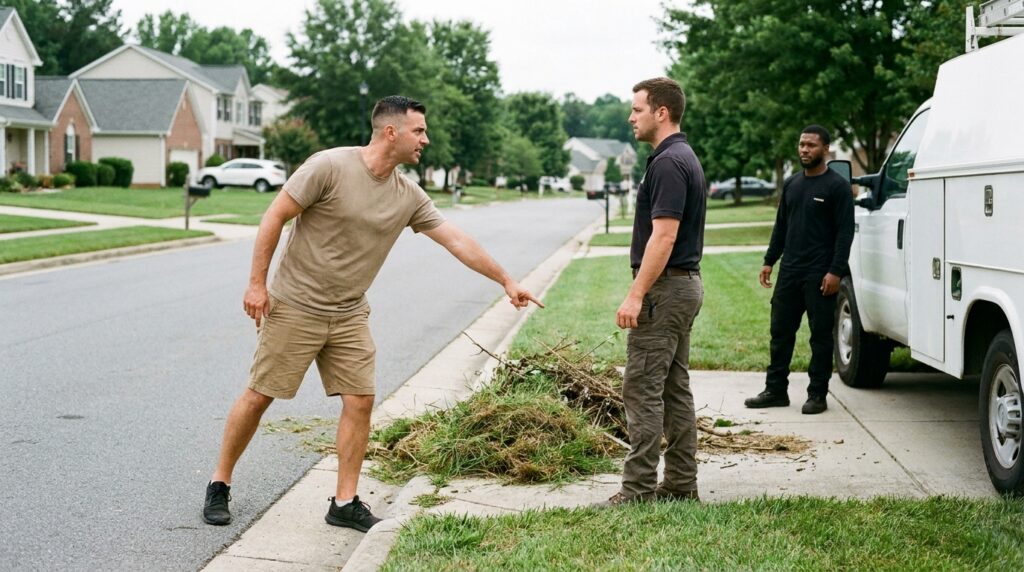
The man in the tan t-shirt didn’t offer a reply. His eyes shifted past Jesse’s shoulder toward the white wagon that had stopped right at the throat of the cul-de-sac, its amber lights rotating with a silent, heavy sweep that turned the white ranch houses across the street a regular, pale orange. A man in a clean khaki uniform with a state environmental division badge on his belt stepped onto the asphalt, his fingers already unbuckling a leather map cylinder from his shoulder strap.
“Jesse,” Miller said, leaning his bulk over the passenger side rail of the flatbed. He had a pair of rusted iron calipers in his gloved hand, the tips caked in the wet, grey silt he’d scraped from the storm grate’s lower frame. “The van crew’s dumping their tracking gear. The guy in the passenger seat just kicked a plastic casing under the box elder tree behind the sign.”
Jesse didn’t turn around to check the grass line. He reached down to the black vinyl folder, flipping the heavy plastic leaves until he found the third-tier drainage layout—the one that wasn’t stamped by the local township developers. The grid lines here didn’t stop at the property lines of Oak Ridge Estates. They cut straight through the center of the cul-de-sac, through the brick planters, and directly under the basement foundations of the three houses sitting on the low side of the ridge.
“This layout isn’t an HOA drainage lateral,” Jesse said softly, his voice dropping into the small space between the truck’s rattling grill and the Confronter’s sunglasses. “This whole strip of dirt is a registered flood mitigation bypass channel. It’s tied to the state reservoir system. Your brother-in-law’s company didn’t just fail to clean the silt trap, mister. They filled the back-end of the weir with five hundred yards of unpermitted construction fill from the shopping center excavation last winter. You’ve been using this easement as a private dump site to save his hauling permits.”
The Confronter’s face didn’t pale; it hardened into the rigid, grey lines of a man whose legal leverage had just dissolved into raw, civil infrastructure violations. He thrust the clipboard into his armpit, his hand dipping into his pocket for his phone, his thumb tapping the screen with a dry, frantic cadence.
“The filling was part of a foundation stabilization project,” the man muttered, his boots finally leaving the gravel strip entirely as he backed into the mouth of his driveway. “The board approved the grade modification. It’s all documented in the annual infrastructure report.”
“The board can’t modify a federal spillway line,” Jesse said, his hand closing over the black folder. He lifted the maps off the hood, the paper dry and stiff against his shirt as he turned to face the state inspector who had just reached the rear tire of the tow rig.
The tow truck’s transmission engaged with a heavy, mechanical clunk that shook the entire flatbed deck, its tires biting into the loose gravel as it began to back out of the lane without its prize. The driver didn’t look through his side mirror at the man in the tan t-shirt; he kept his eyes locked on the state vehicle blocking the middle of the road.
The inspector didn’t call out to anyone. He stopped five feet from Jesse’s truck, his boots white with limestone dust, his eyes tracking the long line of transport chains that still connected the contractor’s chassis straight to the cast-iron storm grate. He looked at the iron links, then looked down at the fresh, unpainted score mark in the concrete curb where the tapes had been run before dawn.
“Who ran the boundary string on this easement?” the inspector asked. His voice was old, worn thin by thirty years of county enforcement work, carrying the sharp, chemical tang of state-issue insect repellent.
Jesse looked at the Confronter, who had stopped ten yards up his own concrete driveway, his cell phone held tight against his ear while he watched the white van try to back out through the narrow gap between the state wagon and the curb.
“He did,” Jesse said, pointing his brush toward the tan t-shirt. “He wanted to make sure we didn’t touch the dirt under the roots.”
The inspector didn’t open his leather cylinder yet. He just looked across the parched grass strip at the brick planter, where the little black GPS transponder was still throwing its tiny, regular red blinks into the weeds.
“Miller,” Jesse said, his voice level and cold as the iron links under his feet. “Get the long crowbar out of the cab. We’re going to need to look at the silt trap ourselves before the county clerk pulls the original plat.”